Search Header Logo
Biology 1_Unit 5_Milestone & Final Exam_Evolution

Biology 1_Unit 5_Milestone & Final Exam_Evolution

Assessment

Presentation

•

Biology

•

9th - 12th Grade

•

Medium

•
NGSS
MS-LS4-2, MS-LS4-4, MS-LS3-1

+5

Standards-aligned

Created by

Mariz Rondina

Used 2+ times

FREE Resource

8 Slides • 30 Questions

1

Biology 1_Unit 5_Milestone & Final Exam_Evolution

Biology 1_Unit 5_Milestone & Final Exam_Evolution
Slide image

2

3

Multiple Choice

A ____________ descriptor is the ___________ part of a scientific name.

1

species, first

2

species, second

3

species, third

4

species, fourth

4

Multiple Choice

Classification is...

1

The process of grouping things based on their similarities

2

The process of dissecting a frog

3

The process in which someone puts an animal in a box

4

I don’t know

5

Multiple Choice

What is the order of the taxon from LARGEST to SMALLEST?

1

Genus, kingdom, phylum, class, order, species, family, domain

2

Domain, kingdom, phylum, class, order, family, genus, species

3

species, genus, family, order, class, phylum, kingdom, domain

4

domain, family, species, order, class, phylum, kingdom, genus

6

7

Multiple Choice

2. Match each term to its definition: Autotrophic

1

a. Can move on their own

2

b. Can produce their own energy, usually by photosynthesis

3

c. Cannot move on their own

4

h. Must get their energy from outside their bodies, usually by eating it

8

Multiple Choice

2. Match each term to its definition: Eukaryotic

1

d. Cells have membrane-bound organelles, especially a nucleus

2

f. Made of more than one cell

3

e. Cells have no membrane-bound organelles

4

g. Made of only one cell

9

Multiple Choice

Archeabacteria...
1
are eukaryotic
2
live in extreme environments
3
are non-living
4
live in the soil

10

Multiple Choice

The members of the _________ Kingdom use photosynthesis to create energy.

1

Fungi

2

Bacteria

3

Archaea

4

Plants

11

Multiple Choice

Which kingdoms are in domain Eukarya?

1

Archaeabactera and Eubacteria

2

Plant and Animal

3

Protist and Fungi

4

Plant, Animal, Protist and Fungi

12

13

Multiple Choice

Question image

Who is most closely related to Taxidea taxus?

1

Lutra lutra

2

Panthera pardus

3

Canis latrans

4

Canis lupus

14

Multiple Choice

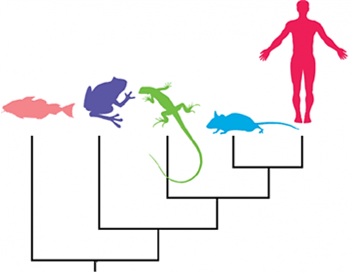
Question image

According to this phylogenetic tree, which creature is the least related out of all pictured?

1

Fish

2

Frog

3

Salamander

4

Human

15

Multiple Choice

_________________ is an evolutionary tree is a branching diagram or "tree" showing the inferred evolutionary relationships among various biological species or other entities.

1

Line graph

2

Cladistics

3

Phylogenetic tree

16

Multiple Choice

Question image

According to this cladogram, birds are LEAST related to:

1

Amphibians

2

Birds

3

Sharks

17

Multiple Choice

Question image

According to the diagram, what is the common ancestor of ALL organisms on the phylogenetic tree?

1

B

2

C

3

D

4

E

18

19

Multiple Choice

Prokaryotes do not have a nucleus. Which of the following is an example of a prokaryote?

1

Virus

2

Plant

3

Bacteria

4

Fungi

20

Multiple Choice

What does bacteria, viruses and Eukaryotes all have in common?

1

Ribosomes

2

Cytoplasm

3

DNA and/or RNA

4

Cell Membrane

21

Multiple Choice

Why is a virus not considered living?

1

It is a host cell

2

Has a nucleus

3

Has DNA

4

Can not reproduce on its own

22

23

Multiple Choice

Question image

the selection pressure favors the extreme phenotypes, dividing the population into 2 distinct groups

1

directional selection

2

stabilizing selection

3

geographic selection

4

disruptive selection

24

Multiple Choice

Question image

individuals with alleles for an extreme type are more likely to survive and reproduce

1

stabilizing selection

2

directional selection

3

disruptive selection

4

genetic drift

25

Multiple Choice

A fire has wiped out the vegetation that produces medium sized seeds. As a result, the finches left can feed on seed that are available in two sizes: small and large. What type of selection is likely to take place in this population?

1

directional selection

2

disruptive selection

3

stabilizing selection

4

artificial selection

26

Multiple Choice

Question image

The small seeded plants in an area were killed by a fungus. Finches with a small beak cannot crack open the large seeds from the plants that were left. What type of selection is likely to occur?

1

directional selection

2

stabilizing selection

3

disruptive selection

4

artificial selection

27

Multiple Choice

Question image

The small seeded plants in an area were killed by a fungus. Finches with a small beak cannot crack open the large seeds from the plants that were left. What type of selection is likely to occur?

1

directional selection

2

stabilizing selection

3

disruptive selection

4

artificial selection

28

29

Multiple Choice

Which of the following best describes how natural selection results in bacteria that are antibiotic resistant?

1

When you take an antibiotic when you're sick, a few bacteria survive. These bacteria happen to have a random mutation that makes them resistant to the antibiotic. These bacteria survive and reproduce, eventually resulting in an antibiotic-resistant population.

2

When you take an antibiotic when you're sick, the bacteria respond by mutating their DNA, making them resistant to the antibiotic. Therefore, an antibiotic-resistant population evolves.

3

When you take an antibiotic when you're sick, it causes mutations in the bacteria DNA. Some of these mutations make the bacteria antibiotic-resistant. These bacteria now form a bacteria-resistant population.

30

Multiple Choice

Which of the following best describes how natural selection results in insects that are pesticide resistant?

1

When a pesticide is sprayed on a crop, a few insects survive. These insects happen to have a random mutation that makes them resistant to the pesticide. These insects survive and reproduce, eventually resulting in pesticide-resistant population.

2

When a pesticide is sprayed on a crop, the insects respond by mutating their DNA, making them resistant to the pesticide. Therefore, a pesticide resistant population evolves.

3

When a pesticide is sprayed on a crop, it causes mutations in the insect DNA. Some of these mutations make the insects pesticide-resistant. These insects now form a pesticide-resistant population.

31

Multiple Choice

A population of cockroaches was sprayed with an insecticide. Some cockroaches survived and produced a population of cockroaches that was resistant to this spray. What can BEST be inferred from this example?

1

species will adapt no matter what the environment

2

environment has no effect on the survival of an organism

3

Individuals with favorable variations survive and reproduce

4

Insecticides cause mutations that are passed on to the next generation

32

Multiple Choice

A population of cockroaches was sprayed with an insecticide. Some cockroaches survived and produced a population of cockroaches that was resistant to this spray. What can BEST be inferred from this example?

1

species will adapt no matter what the environment

2

environment has no effect on the survival of an organism

3

Individuals with favorable variations survive and reproduce

4

Insecticides cause mutations that are passed on to the next generation

33

34

Multiple Choice

Question image

Which structure is shown in the picture?

1

analogous structure

2

homologous structure

3

vestigial structure

4

DNA

35

Multiple Choice

The appendix, which is not needed to survive, is conisdered to be a

1

Homologous Structure

2

Analagous Structure

3

Vestigial Structure

4

Homology

36

Multiple Choice

Question image

Which layer is the oldest

1

B

2

A

3

E

4

C

37

Multiple Choice

Tests show that there are similarities in the genes of chimpanzees and gorillas.

1

Embryology

2

Homologous structures

3

Vestigial organs

4

Molecular evidence

38

Multiple Choice

The arm of a human, the flipper of a whale, and the wing of a bat all have similar bone structures. Therefore, these parts of the body would all be considered...

1

homologous structures

2

vestigial structures

3

transitional fossils

4

common ancestors

Biology 1_Unit 5_Milestone & Final Exam_Evolution

Biology 1_Unit 5_Milestone & Final Exam_Evolution

Slide image

Show answer

Auto Play

Slide 1 / 38

SLIDE