

The Warren Court

Presentation
•
History, Social Studies
•
9th - 12th Grade
•
Hard

The Coach Williams
Used 4+ times
FREE Resource
24 Slides • 42 Questions
1
The Warren Court
2
3
Civil Rights Cases
4
5
6
Multiple Choice
What was the couple's sentence for being married?
5 years in prison
3 years in prison
1 year in prison
4 years in prison
7
Multiple Choice
Which Amendment made interracial marriage unconstitutional?
13th Amendment
14th Amendment
15th Amendment
16th Amendment
8
Multiple Choice
What practice did Loving v. Virginia decide was unconstitutional?
segregation of schools
segregation of public transportation
interracial marriage
9
Multiple Choice
10
Multiple Choice
The Warren Court is named for...
Billionaire Warren Buffet
Senator Elizabeth Warren
Chief Supreme Court Justice Earl Warren
"War in Court" made more formal
11
Voting and Redistricting
12
13
Multiple Choice
What did Baker v. Carr establish?
State courts have the decision in redistricting cases
Federal courts have the decision in redistricting cases
14
Multiple Choice
15
Multiple Choice

16
Multiple Choice
Baker case showed how...
Tennessee kept up with population shifts and economic growth within the states.
Tennessee ignored the population shifts and economic growth within the states.
17
Multiple Choice
What caused Baker to create this case?
He felt his voice was not being heard!
He was mad a law that he favored did not get passed!
Someone peer pressured him into it !
18
Multiple Choice
Which amendment did this case violate?
17th amendment
19th amendment
26th amendment
14th amendment
19
Criminal Procedures
20
21
22
23
24
Multiple Choice
This ruling held that evidence obtained in violation of the Fourth Amendment protection against "unreasonable searches and seizures" must be excluded from criminal prosecutions in state courts, as well as federal courts.
Mapp v. Ohio, 1961
Miranda v. Arizona, 1966
McCulloch v. Maryland, 1819
Marbury v. Madison, 1803
25
Multiple Choice
The Mapp v Ohio case was a win for....
speech
amendment 6 rights
amendment 2 rights
privacy
26
Multiple Choice
In the Mapp case, the police officers didn't have....
probable cause
a search warrant
a letter from the Chief of Police
a key to the house
27
Multiple Choice
28
Multiple Choice
29
Multiple Choice
ruled that a defendant must be allowed access to a lawyer before questioning by police
Skinner v. Railway
Abington School District v. Schempp
Escobedo v. Illionis
New York times v. US
30
Multiple Choice
What did the Miranda case require all law enforcement due prior to arresting someone?
Read parts of "Miranda Warning"
Read the ENTIRE "Miranda Warning"
Offer bail
Question the suspect
31
Multiple Select
Why did Miranda believe that his confession should not be used in court? (check all that apply)
There was not a lawyer present
He did not commit the crime
It was not voluntary
He was forced to confess
32
Multiple Choice
Which of the following is NOT included in the Miranda Warning?
You have the right to remain silent
Anything you say or do can be used against you in a court of law
If you cannot afford a lawyer, one will be appointed to you
You have the right to bail no matter the crime
33
Freedom of Speech Cases
34
35
Multiple Choice
Defendant mailed fliers to draftees during WWI urging them to protest the craft peacefully. Was convicted of violating a federal law against encouraging the disobedience of military orders. Oliver Wendel Holmes wrote in the opinion that such speech was not protected during wartime because it would create a clear and present danger, establishing a standard for measuring what would and would not be protected speech. The question before the Court was the line between the effect of freedom of speech and national draft orders.
US v Lopez
Engel v Vitale
Schenck v US
New York Times v US
36
Multiple Choice
Why did Brandenburg win this case?
His right to Due Process was violated.
His First Amendment right to Freedom of Speech was violated.
He never held a KKK rally.
37
Multiple Choice
Why did Brandenburg win this case?
His right to Due Process was violated.
His First Amendment right to Freedom of Speech was violated.
He never held a KKK rally.
38
Multiple Choice
What was the Criminal Syndicalism law?
A law that made it illegal advocating crime, sabotage, violence and assembling within any society or group to advocate the doctrines of Criminal Syndicalism.
A law that made it illegal to threaten people.
A law that made it illegal to discriminate against other races.
A law that made it illegal to burn religious symbols.
39
40
Multiple Choice
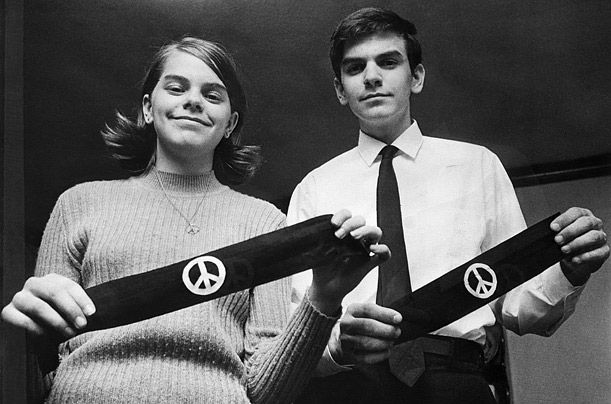
41
Multiple Choice
The District Court and the Court of Appeals upheld the principle that
school officials could limit students’ rights to prevent possible interference with school activities.
students’ individual rights were subject to the higher school authority while on school grounds.
free speech was a privilege to be exercised discreetly and within the guidelines set by the school.
allowing political expression on school grounds could impinge upon the rights and beliefs of other students.
42
Multiple Choice
When can a school limit student speech?
When the act fails the "disruption test".
When the expression offends the teacher.
When parents get annoyed.
43
Multiple Choice
What was the Supreme Court's response to siding with the students and parents?
The first amendment is irrelevant to this case.
Parents and students have a stronger say in decisions than schools.
Students have unlimited rights in expression.
Students and teachers don't shed their constitutional rights to freedom of speech or expression.
44
Multiple Choice
What was the school's response to the students wearing the black arm bands?
The school supported the students.
They suspended the students.
School officials made extras so other students could participate.
The students were arrested without trial.
45
Multiple Choice
What was the issue in Tinker v. Des Moines (1969)?
The students and parents sued the school district claiming a violation of their first Amendment right of freedom of speech.
The school district wanted to search the bags of the students.
The parents did not want their children wearing black arm bands in school.
The students felt that their freedom of religion was violated.
46
Multiple Choice
What was the issue in Tinker v. Des Moines (1969)?
The students and parents sued the school district claiming a violation of their first Amendment right of freedom of speech.
The school district wanted to search the bags of the students.
The parents did not want their children wearing black arm bands in school.
The students felt that their freedom of religion was violated.
47
48
Multiple Choice
School sponsorship of religious activities (teacher led / directed prayer) violates the establishment clause
Tinker v. Des Moines
Engel v. Vitale
Wisconsin v. Yoder
Schenck v. United States
49
Multiple Choice
A state authorized students in its public schools to recite a short, voluntary prayer. The Court found that prayer could not be mandated by public schools as it violated the establishment clause of the 1st Amendment
Engel v Vitale
Schenck v US
Wisconsin v Yoder
Shaw v Reno
50
NON WARREN COURT
SUPREME COURT CASES
51
52
Multiple Choice
This case started with a prank phone call.
Tinker v. Des Moines
In Re Gault
DC v. Heller
Gideon v. Wainwright
53
54
Multiple Choice
Students have limited freedom of speech in a school setting. Which of the following cases helped prove that point?
Plessy v. Ferguson
Gideon v. Wainwright
In re Gault
Hazelwood v. Kuhlmeier
55
56
Multiple Choice
Which supreme court case did the U.S. supreme court rule that recounting ballots in only 4 counties instead of ALL counties in a state violated the 14th amendment?
Hazelwood v. Kuhlmeier
Gideon v. Wainwright
US v. Nixon
Bush v. Gore
57
58
Multiple Choice
US v. Nixon is considered a landmark case because it provided what lesson for future leaders?
You must obey a court order
The president is accountable for enforcing the law
The president is not above the law
The president is not allowed to have private meetings
59
60
Multiple Choice
A constitutional right to an abortion is established, though the court laid down a trimester criteria in determining whether states can impose restrictions
Regents of California v. Bakke,
Roe v. Wade, 1973
Tinker v. Des Moines School District, 1969
Texas v. Johnson, 1991
61
62
Multiple Choice
This ruling affirmed the government’s decision regarding the Japanese American Internment during World War II and found that it was not unconstitutional.
McCulloch v. Maryland, 1819
Mapp v. Ohio, 1961
Marbury v. Madison, 1803
Korematsu v. United States, 1944
63
64
Multiple Choice
This ruling gave a school district had the constitutional authority to limit a student’s (Frasier) speech because of the educational authority that is given to schools by the tenth amendment.
Brown vs Board of Education
Hazelwood School District v. Kuhlmeier
Bethel School District vs Frasier
Mapp v. Ohio
65
Multiple Choice
Bethel School District v. Fraser (1986)
A Supreme Court case which determined that school newspapers could be censored by school administrators.
A Supreme Court case which ruled that student free speech rights do not extend to expressions of a vulgar nature.
A Supreme Court case in which it was famously decided that free speech rights don't end at the schoolhouse gates.
A 13-year-old girl who wore a black armband to school in protest of the Vietnam Conflict.
66
Multiple Choice
The Warren Court
Show answer
Auto Play
Slide 1 / 66
SLIDE
Similar Resources on Wayground

59 questions
NAMING BINARY IONIC COMPOUNDS
Presentation
•
10th - 12th Grade
57 questions
Genes and Punnett squares
Presentation
•
9th - 12th Grade
62 questions
4-5-23 MLA Citation
Presentation
•
9th - 12th Grade
61 questions
Illinois State Constitution
Presentation
•
10th - 12th Grade
61 questions
French Rev
Presentation
•
9th - 12th Grade
59 questions
Intro to Agriculutre - the Revolutions
Presentation
•
9th - 12th Grade
59 questions
African American History
Presentation
•
KG - 12th Grade
63 questions
End of WW1 Lesson
Presentation
•
9th - 12th Grade
Popular Resources on Wayground
10 questions
How much do you know about our Portrait of an Eagle?

Quiz
•
10th Grade
10 questions
Fast Food Slogans
Quiz
•
6th - 8th Grade
21 questions
Continents and Oceans
Quiz
•
6th Grade
20 questions
Parts of Speech
Quiz
•
5th Grade
16 questions
Subject & Predicate
Quiz
•
5th Grade
25 questions
Multiplication Facts
Quiz
•
5th Grade
12 questions
Map Skills
Quiz
•
3rd Grade
22 questions
Continents and Oceans
Quiz
•
5th Grade
Discover more resources for History
10 questions
Exploring the Journey of Early Humans

Interactive video
•
6th - 10th Grade
10 questions
Exploring Jamestown: John Smith and Pocahontas
Interactive video
•
6th - 10th Grade
20 questions
The Early Colonies
Quiz
•
7th - 11th Grade
10 questions
Recap on Mesopotamia: Key Concepts and Facts
Interactive video
•
6th - 10th Grade
16 questions
Government Unit 2
Quiz
•
7th - 11th Grade
10 questions
Exploring Types of Government
Interactive video
•
6th - 10th Grade
16 questions
Students of Civics Unit 2: The Constitution
Quiz
•
7th - 11th Grade
15 questions
Unit 4
Quiz
•
10th Grade