Search Header Logo
HAP5 Respiratory System

HAP5 Respiratory System

Assessment

Presentation

•

Science

•

10th - 12th Grade

•

Practice Problem

•

Medium

Created by

Lloyd Cascabel

Used 6+ times

FREE Resource

18 Slides • 42 Questions

1

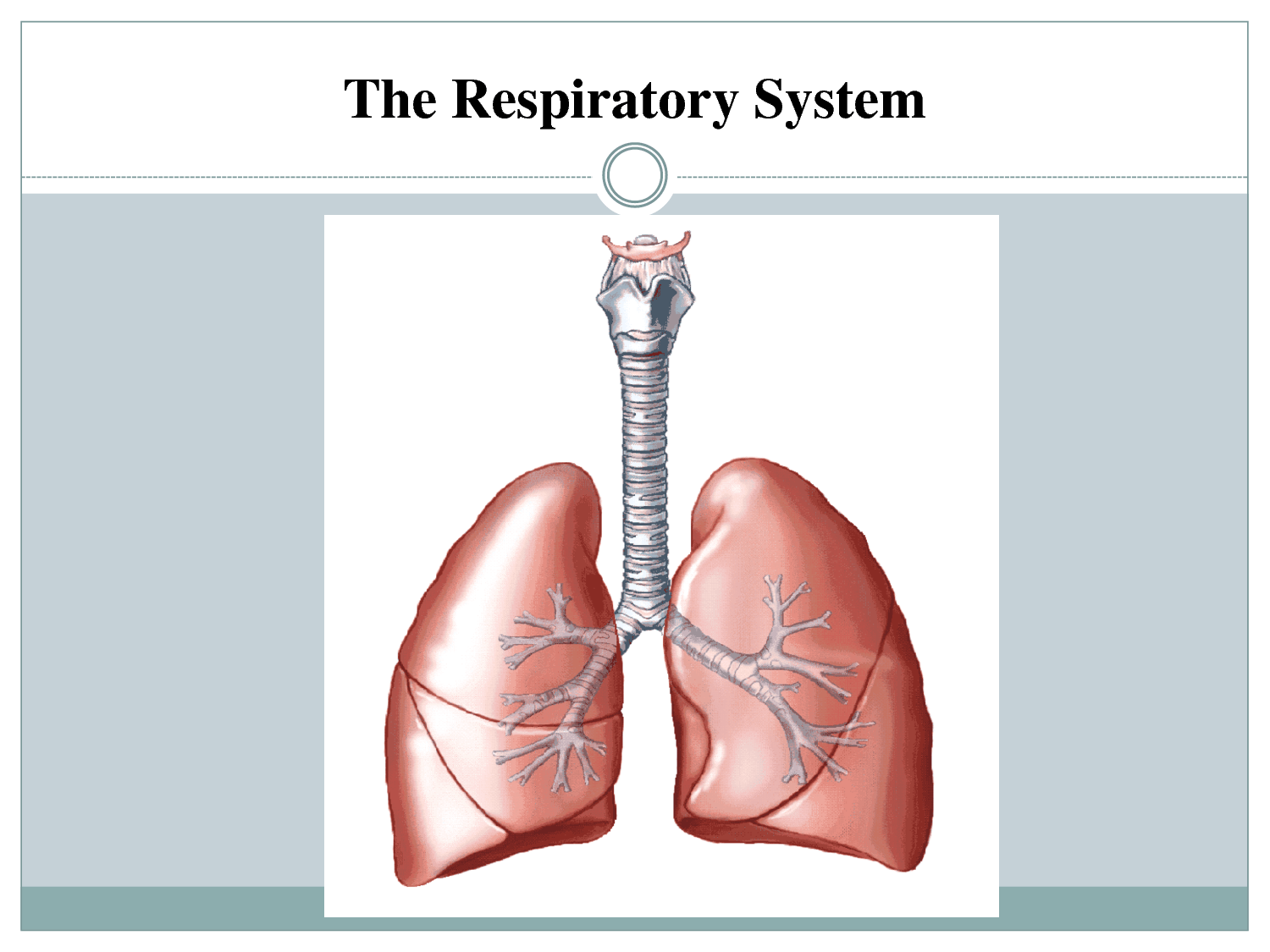
Respiratory System

Structures related to gas exchange

media

2

Objectives

  • distinguis between ventilation, gas exchange, and cell respiration

  • explain the need for ventilation system

  • describe the features of the alveoli that adapt them to gas exchange

  • draw and label a diagram of the upper and lower respiratory tract

  • explain the mechanisms of ventilation of the lungs in terms of volume and pressure changes caused by the internal and external intercostal muscles

3

Overview

Our lungs act in concert with our heart and blood vessels to ensure that body cells are well supplied with oxygen and are able to give up carbon dioxide. In our lesson on cell respiration, you understood why oxygen is necessary and why carbon dioxide comes out as a by-product of ATP production.

4

There are three processes involved with the respiratory system.

media

5

Ventilation

Ventilation is the process of bringing fresh air into the lungs and removing the stale air. It maintains the concentration gradient of carbon dioxide and oxygen between the alveoli (air sacs) and the blood in the capillaries.

media

6

Gas Exchange

Gas exchange happens by diffusion in two locations:


1. oxygen moves from the alveolus into the bloodstream (and CO2 in the opposite direction)


2. oxygen moves from the capillary bed into a tissue elsewhere (and CO2 in the opposite direction.)

media

7

In this diagram, the two gases begin to diffuse to the other container and eventually reach equilibrium.

media

8

Concentration Gradient

concentration gradient is present when a membrane separates two different concentrations of molecules. In this case, the gases. 


If you hold your breath, both your blood and your alveoli will become concentrated with carbon dioxide.

media

9

Cell Respiration

Cell respiration is the catabolic process of metabolizing glucose and oxygen to produce ATP and carbon dioxide. Every single cell in need of ATP needs oxygen and glucose to perform their function.

media

10

Multiple Choice

Oxygen is generally absorbed by our tissues and carbon dioxide is released out.

1

True

2

False

11

Multiple Choice

No carbon dioxide is inhaled and no oxygen is exhaled

1

True

2

False

12

Multiple Choice

The process of inhalation and exhalation is called

1

cell respiration

2

gas exchange

3

ventilation

4

all of these

13

Multiple Choice

The metabolic process that needs oxygen and releases CO2 also produces

1

glucose

2

ATP

3

PGAL

4

NADPH

14

Multiple Choice

How do the gas molecules diffuse through the alveolus and capillaries?

1

from higher concentration to lower concentration without using ATP

2

from lower concentration to higher concentration without using ATP

3

from higher concentration to lower concentration using ATP

4

from lower concentration to higher concentration using ATP

15

Multiple Choice

Question image

Which of the following is not true about this chart?

1

Process 1 is gas exchange

2

Process 2 depends on concentration gradient

3

Process 3 is aerobic cell respiration

16

Amoeba doesn't need a ventilation system

Some organisms such as protozoans do not need a ventilation system. They only require an environment with a higher concentration of dissolved oxygen than their cells.

media

17

Ventilation System

Different organs work together to bring fresh air into our alveolus. We can categorize the anatomy of this organ system into two: the upper and the lower respiratory tract.

media

18

media

19

Multiple Choice

Question image

Identify the structures labeled _1_

1

skull

2

sinuses

3

glottis

4

larynx

20

Multiple Choice

Question image

Identify the structure labeled _2_

1

external nose

2

nasal cavity

3

nostril

4

eustachian tube

21

Multiple Choice

Question image

Identify the structure labeled _10_

1

esophagus

2

trachea

3

pharynx

4

larynx

22

Multiple Choice

Question image

Identify the structure labeled _12_

1

glottis

2

trachea

3

eustachian tube

4

epiglotis

23

Multiple Choice

Question image

Identify the structure labeled _7_

1

nostril

2

esophagus

3

larynx

4

glottis

24

Fill in the Blank

Question image

Identify the structure labeled _8_

25

Fill in the Blank

Question image

Identify the structure labeled _6_

26

Fill in the Blank

Question image

Identify the structures labeled _1_

27

Fill in the Blank

Question image

Which structure serves to filter the air from dust and suspended particles?

28

media

29

Multiple Choice

Question image

Identify the structure labeled _1_

1

larynx

2

trachea

3

bronchi

4

bronchioles

30

Multiple Choice

Question image

Identify the structure labeled _4_

1

larynx

2

trachea

3

bronchi

4

bronchioles

31

Multiple Choice

Question image

Identify the structure labeled _5_

1

larynx

2

trachea

3

bronchi

4

bronchioles

32

Fill in the Blank

Question image

Identify the structure labeled _7_

33

Fill in the Blank

Question image

Identify the structure labeled _8_

34

Fill in the Blank

Question image

Identify the structure labeled _9_

35

Fill in the Blank

Question image

Identify the structure labeled _6_

36

Adaptations of the alveoli

  • spherical shape of alveoli - for large surface area for gases to diffuse through

  • flattened, single cell thickness of each alveolus - prevents respiratory gases from having to diffuse through more layers

  • moist inner lining of alveolus - allows for efficient diffusion

  • associated capillary bed - respiratory gases do not have to diffuse far to reach the capillaries

37

Mechanism of Ventilation

Each time we breathe in, a fairly complex series of events occurs that we do not even realize is happening. The tissue that makes up our lungs is passive and not muscular, therefore the lungs themselves are incapable of purposeful movement. It is the muscles surrounding the lungs that cause air movement. This movement is based on the inverse relationship between pressure and volume.

38

Mechanisms of Inspiration (breathing in)

  • The diaphragm contracts (moves down), and the ribcage is raised by the contraction of the external intercostal muscles to increase the lung volume.

  • With greater volume, the pressure decreases in this thoracic cavity which leads to a partial vacuum effect.

  • Air comes in through your oral and nasal cavities and through your windpipe to fill the lungs.

  • (Internal and external Intercostal muscles move in opposite directions.)

39

Mechanisms of Expiration (breathing out)

  • The diaphragm (moves up) relaxes as well as the external intercostal muscles which cause the ribcage to get smaller resulting in decreased lung volume.

  • With lower volume, the pressure increases in this thoracic cavity which causes the air to be pushed out.

  • Air comes out through the windpipe and the nose and mouth.

  • (Internal and external Intercostal muscles move in opposite directions.)

40

Multiple Choice

As we inhale, our diaphragm contracts and moves up

1

True

2

False

41

Multiple Choice

As we inhale, our external intercostal muscles contract to move the ribcage up

1

True

2

False

42

Multiple Choice

As we exhale, our internal intercostal muscles contract to move the ribcage down

1

True

2

False

43

Multiple Choice

As we exhale, our external intercostal muscles relax, and our internal intercostal muscles contract.

1

True

2

False

44

Multiple Choice

As we exhale, our diaphragm relaxes and moves up.

1

True

2

False

45

Multiple Choice

As the thoracic cavity (lungs) volume increases, the air is pushed out.

1

True

2

False

46

Multiple Choice

As the thoracic cavity (lungs) volume increases, the pressure inside drops.

1

True

2

False

47

Multiple Choice

As the thoracic cavity (lungs) volume increases, a partial vacuum is created.

1

True

2

False

48

Multiple Select

Check all that applies:


During exhalation or expiration...

1

the external intercostal muscles relax

2

the diaphragm relaxes

3

the rig cage rises up

4

lung pressure is decreased

49

Multiple Select

Check all that applies:


During inhalation or inspiration...

1

the external intercostal muscles contract

2

the diaphragm moves up

3

the rig cage rises up

4

lung volume is increased

50

Multiple Choice

A small flap of tissue that covers the trachea is called the

1

bronchi

2

larynx

3

pharynx

4

epiglottis

51

Multiple Choice

A chamber behind the nose and mouth that leads to the trachea

1

pharynx

2

trachea

3

epiglottis

4

larynx

52

Multiple Choice

What does the Larynx hold?

1

The larynx holds the whole respitory system.

2

The larynx holds the trachea.

3

The larynx holds the vocal chords.

4

The larynx hold the wind pipe.

53

Multiple Choice

Question image
What is the main function of the respiratory system?
1
to provide oxygen and remove carbon dioxide from the body
2
to bring oxygen to the body
3
to break down food and absorb nutrients
4
to remove oxygen from the body and deliver carbon dioxide

54

Multiple Choice

cleans, moistens, and warms the air
1
trachea
2
larynx
3
nasal passage
4
windpipe

55

Multiple Choice

When you exhale, the diaphragm

1

moves upwards

2

moves downwards

3

flattens

4

none of the above

56

Multiple Choice

Question image
Label C is...
1
Trachea
2
Diagphragm
3
Bronchus
4
Alveolus

57

Multiple Choice

Question image
Label A is...
1
Trachea
2
Diagphragm
3
Bronchus
4
Alveolus

58

Multiple Choice

What are the names of the air sacs in the lungs where gas exchange takes place?
1
Alveoli
2
Bronchi
3
Bronchioles
4
Intercostal muscles

59

Multiple Choice

What is the correct name for the windpipe?
1
Trachea
2
Bronchus
3
Bronchiole
4
Larynx

60

Good Job!

Feel free to retake this Q lesson if you like.

Respiratory System

Structures related to gas exchange

media

Show answer

Auto Play

Slide 1 / 60

SLIDE