

Proteins

Presentation
•
Biology
•
11th - 12th Grade
•
Practice Problem
•
Easy

PUTERI BM
Used 45+ times
FREE Resource
12 Slides • 3 Questions
1
Proteins
a)Describe the basic structure of amino acids
b)State how many amino acids are grouped
c)Describe primary (1°), secondary (2°), tertiary (3°) and quaternary (4°) levels of protein and the types of bonds involved

2
3

4
5

6
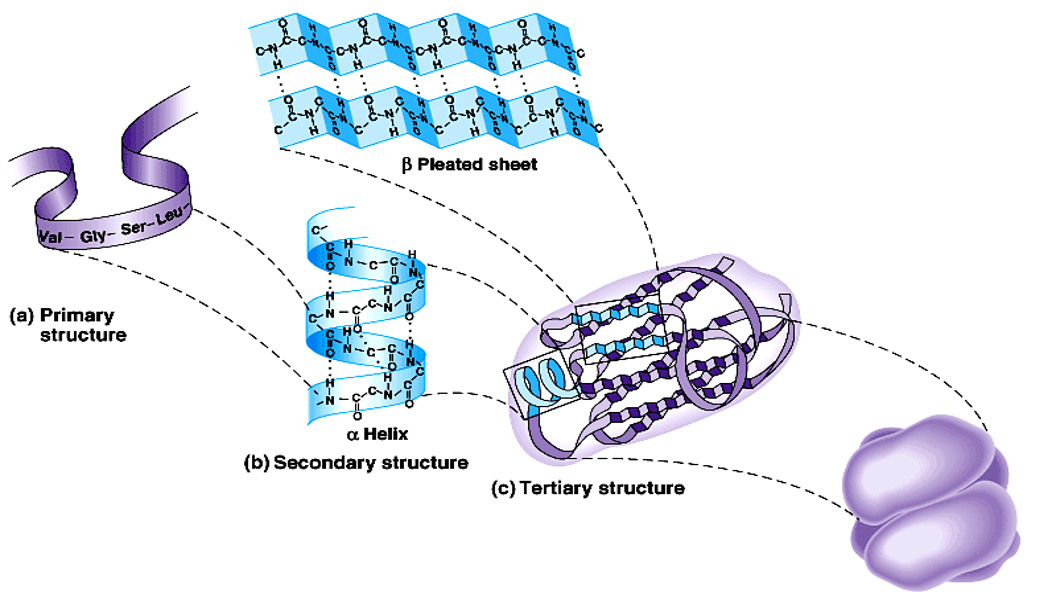
Levels of protein structure
Each protein has a specific 3-D conformation.
4 levels of protein structure are:
Primary (1o)
Secondary (2o)
Tertiary (3o)
Quaternary (4o)
7
Primary structure
Unique sequence of amino acids joined by peptide bonds in a linear polypeptide chain
The 20 common amino acids can be arranged in different ways (determined by genetic information)
Eg: Glucagon consist of a sequence of 29 amino acids

8
Secondary structure
Once a linear chain of amino acids is formed, it spontaneously coils to form the alpha helix or folds to form the beta pleated sheet.
Because of hydrogen bonds between the repeating constituents of the polypeptide backbone (not the amino acid side chains).

9
Secondary structure
Two forms:
- alpha helix (coiled)
- beta pleated sheet (folded)
alpha helix - Keratin found in hair, nails, horn
beta pleated sheet - Silk protein produced by many insects & spiders
10
Tertiary structure
A polypeptide may be further coiled into a globular shape which is maintained by bonds & interactions among side chains.
The bonds and interactions that maintained the structure are:
i. Disulfide bridges
ii. Ionic bonds
iii. Hydrogen bonds
iv. Hydrophobic interactions
v. Van der Waals interactions

11
Quaternary structure
Consists of 2 or more polypeptide chains joined to form a single functional molecule.
The bonds that formed between the polypeptide chains are :
i) Disulfide bonds
ii) Ionic bonds
iii) Hydrogen bonds
iv) Hydrophobic
v) Van der Waals interactions

12
Quaternary structure
Eg : haemoglobin and collagen
a) Haemoglobin
• Consists of 4 polypeptide chains
• 2 α-chains
• 2 β-chains
b) Collagen
• Consists of 3 polypeptide chains that forms triple- stranded helical coils.
• Fibrous protein
13
Multiple Choice
14
Multiple Choice
15
Multiple Choice
Proteins
a)Describe the basic structure of amino acids
b)State how many amino acids are grouped
c)Describe primary (1°), secondary (2°), tertiary (3°) and quaternary (4°) levels of protein and the types of bonds involved
Show answer
Auto Play
Slide 1 / 15
SLIDE


