

Evolution & Taxonomy Unit Review

Presentation
•
Biology
•
10th Grade
•
Medium
+4
Standards-aligned

Amber Smith
Used 26+ times
FREE Resource
30 Slides • 28 Questions
1

Evolution/Taxonomy EOC Review

2

Evolution is the change in genetic characteristics of a population over time. These changes have led to the diversity of organisms we see today.
3
Charles Darwin
Voyage of HMS Beagle
Made observations, collected specimens and fossils
Published "On the Origin of Species" in 1859

4
Charles Darwin
Other scientists helped him shape his ideas
Lamarck
Hutton & Lyell
Malthus
Alfred Russel Wallace

5
Natural Selection
Natural Selection: Organisms with favorable traits are more likely to survive, reproduce, and pass traits on than organisms that don't have favorable traits "Survival of the Fittest"

6
Conditions for
Natural Selection
Overproduction
Variation
Adaptation
Reproduction
Survival of the fittest

7
Multiple Choice
Lamarck’s ideas about evolution include the concept that differences among the traits of organisms arise as a result of
continual increases in population size.
the actions of organisms as they use or fail to use body structures.
an unchanging local environment.
the natural variations already present within the population of organisms.
8
Multiple Choice
Darwin’s concept of natural selection was NOT influenced by
the work of Charles Lyell.
knowledge about the structure of DNA.
his collection of specimens.
his trip on the H.M.S. Beagle.
9
Multiple Choice
How well an organism can survive and reproduce in their environment.
Adaptation
Fitness
Genetic Equilibrium
Variation
10
Evidence of Evolution


11
Biogeography
Patterns in distribution of living and fossil species tell us how modern organisms evolved from their ancestors.

12
Fossil Evidence
Darwin struggled with what he called “imperfection of the geological record.”
Not enough intermediate forms of life had been found at the time to document the evolution of modern species from their ancestors.
Over time, more intermediate forms have been discovered

13
Anatomical Evidence: Homologous Structures
Structures that are shared by related species and have been inherited from a common ancestor.
Different functions, but same anatomical structure

14
Analogous Structures
Body parts that share common function, but not structure are said to be analogous structures.

15
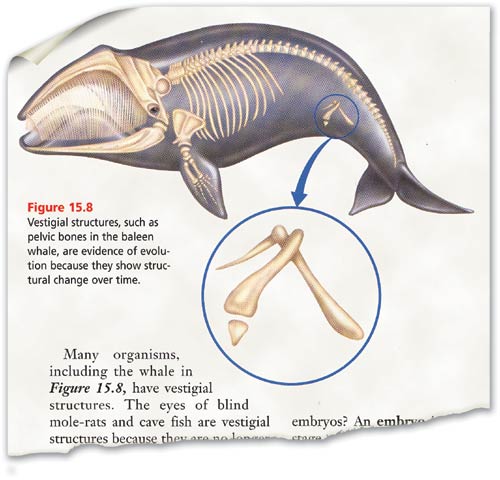
Vestigial Structures
Structures that are inherited from ancestors but have lost much or all of their original function due to different selection pressures acting on the descendent.


16
Embryology
Similar patterns of embryonic development provide further evidence that organisms have descended from a common ancestor. Suggests gene expression is similar in early development among related species.

17
Genetic/Molecular Evidence
At the molecular level, the universal genetic code and homologous molecules provide evidence of common descent.

18
Multiple Choice
Which statement about the members of a population that live long enough to reproduce is consistent with the theory of evolution by natural selection?
They transmit characteristics acquired by use and disuse to their offspring.
They tend to produce fewer offspring than others in the population.
They are the ones that are best adapted to survive in their environment.
They will perpetuate unfavorable changes in the species.
19
Multiple Choice
Molecular evidence in support of natural selection includes
the nearly universal genetic code.
the presence of vestigial structures.
a tendency toward perfect, unchanging DNA in various species.
the transmission of acquired characteristics by DNA.
20
Multiple Choice

Structures such as the ones shown here are evidence of
artificial selection
common ancestry
descent with modification
analogous structures
21
Multiple Choice
the wings of a red-tailed hawk
the hind limbs of a house cat
the fins of sharks
the tailbone of a human
22
Multiple Choice

23
Multiple Choice

24
Multiple Choice

25
Multiple Choice
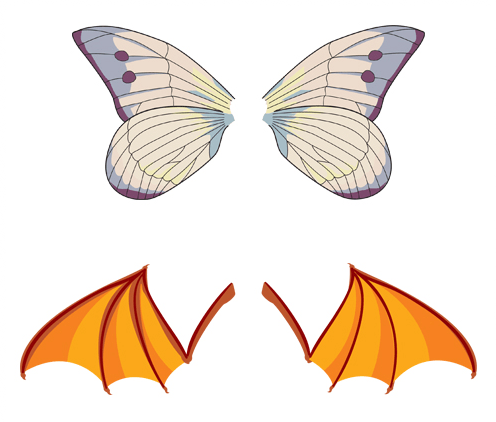
Homologous structure
Analogous structure
Structural adaption
Functional adaption
26
Genetics and Evolutionary Theory
Natural selection never directly acts on genes, only phenotype.
It is the entire organism, not a single gene, that either survives and reproduces or dies without reproducing.

27
Selection on Polygenic Traits
Directional Selection
Stabilizing Selection
Disruptive Selection

28
Genetics and Evolutionary Theory
Allele frequency: Number of times an allele occurs in a gene pool, as a percentage of the total occurrence of all alleles

29

Genentic Bottleneck
30

31
Multiple Choice
The frequency of phenotypes for a typical polygenic trait is most often illustrated as
a scatter plot.
a bell-shaped curve.
a pie chart.
a histogram.
32
Multiple Choice
In genetic drift, the allele frequencies in a gene pool change because of
mutations.
natural selection.
genetic equilibrium.
chance.
33
Multiple Choice
Genetic drift tends to occur in populations that
are very large.
are small.
are formed from new species.
have unchanging allele frequencies.
34
Multiple Choice
In a certain population of 100 individuals, one fourth of the individuals have the genotype AA, half have the genotype Aa, and one fourth have the genotype aa. One day, 10 individuals with the genotype aa leave the area and cross a river into a new habitat. Which of these processes has changed the population’s gene pool?
nonrandom mating
immigration
natural selection
emigration
35
Multiple Choice
The concept of gene flow is demonstrated when a cow is driven off from its herd, joins another herd, and reproduces. When the cow contributes to the new herd, which of these most likely increases?
Natural Selection
Genetic Variation
Environmental Fitness
Reproductive Mutations
36
Multiple Choice
More and more bacteria are becoming resistant to antibiotics. This is an example of which of the following?
evolution by natural selection
chance
predation
competition
37
Multiple Choice

The type of selection shown here where the intermediate phenotype is favorable, but not the extremes is called ___________________ selection.
Disruptive
Stabilizing
Directional
Geographic
38
Reproductive Isolation leads to Speciation


39
Multiple Choice
Form of reproductive isolation in which two populations develop differences in courtship rituals or other behaviors that prevent them from breeding.
Temporal
Behavioral
Geographic
Bottleneck
40
Multiple Choice
Which of the following statements is FALSE?
Humans have had no effect on the evolution of organisms on earth.
The evolution of organisms on earth has been affected by humans.
Humans are a result of evolution.
Species continue to evolve
41
Multiple Choice
The Galápagos finch species are an excellent example of
speciation.
genetic equilibrium.
stabilizing selection.
selection on single-gene traits.
42
Multiple Choice
A factor that is necessary for the formation of a new species is
reproduction at different times.
geographic barriers.
different mating behaviors.
any form of reproductive isolation.
43
Classification System
Developed by Linnaeus who used Greek and Latin names
all organisms placed into a few large groups - KINGDOMS -

44

45
Taxonomy
Taxonomy is the science of classification.
More specifically, taxonomy is the science of classifying life according to shared characteristics.

Taxon: individual levels used to classify organisms
46
Binomial Nomenclature
The system of naming is called BINOMIAL NOMENCLATURE - which means it is a 2-name system.
Rules:
1. names must either be underlined or italicized
2. Genus capitalized, species is lowercase
3. Can be abbreviated. Ex. F. leo and F. tigris

47
Dichotomous Key


Tool to identify organisms
48
Phylogeny: The study of evolutionary relationships between organisms.

CLADOGRAM = a diagram that shows clades and how they are related
49
DERIVED CHARACTER = a trait that arose in a common ancestor that all its descendants share

50
Multiple Choice
Which of the following is the correct way to write the scientific name of the Northern cardinal?
cardinalis cadinalis
Cardinalis cardinalis
cardinalis Cardinalis
Cardinalis Cardinalis
51
Multiple Choice
52
Multiple Choice

Which derived character is common to clade amniota and all descendants?
amniotic egg
hair
retractable claws
specialized shearing teeth
53
Multiple Choice

All organisms to the right of the hagfish would have the common characteristic of
fur
claws or nails
lungs
jaws
54
Domain: Archaea
Archaea includes only one Kingdom of life within it: archaebacteria.
Archaea are single-celled, very ancient, and often extremophiles.

55
Domain: Bacteria
Bacteria includes only one Kingdom of life within it: eubacteria.
Eubacteria are single-celled. They are what we think of when think of bacteria, and they exist all around us and inside us.

56
Domain: Eukarya
Eukarya includes four Kingdoms of life:
Protista
Fungi
Plantae
Animalia

57
Multiple Choice
Which is not one of the three domains?
Bacteria
Archaea
Protista
Eukarya
58
Multiple Choice
Unicellular, prokaryotic organisms that live in extreme environments are members of the domain
Fungi
Eukarya
Bacteria
Archaea
Evolution/Taxonomy EOC Review
Show answer
Auto Play
Slide 1 / 58
SLIDE
Similar Resources on Wayground

50 questions
Biology Lesson Cell Membrane
Presentation
•
9th - 10th Grade
53 questions
Ecology Overview
Presentation
•
9th - 10th Grade
53 questions
Understanding and Writing ECR
Presentation
•
9th Grade
53 questions
Community Ecology Ch. 3 L. 1
Presentation
•
9th Grade
53 questions
Biology Spring Review Part 1 2025
Presentation
•
9th Grade
54 questions
CONSTITUTIONAL DESIGN
Presentation
•
10th Grade
50 questions
Lesson Plan on Tissues and Membrane
Presentation
•
9th - 10th Grade
50 questions
Cell Membrane
Presentation
•
9th - 10th Grade
Popular Resources on Wayground
19 questions
Naming Polygons

Quiz
•
3rd Grade
10 questions
Prime Factorization
Quiz
•
6th Grade
20 questions
Math Review
Quiz
•
3rd Grade
15 questions
Fast food
Quiz
•
7th Grade
20 questions
Main Idea and Details
Quiz
•
5th Grade
20 questions
Context Clues
Quiz
•
6th Grade
20 questions
Inferences
Quiz
•
4th Grade
19 questions
Classifying Quadrilaterals
Quiz
•
3rd Grade
Discover more resources for Biology
50 questions
Biology Final Review
Quiz
•
10th Grade
15 questions
Biology EOC Review P2
Quiz
•
10th Grade
20 questions
Food Chains and Food Webs
Quiz
•
7th - 12th Grade
20 questions
Biology EOC Review 1
Quiz
•
10th Grade
50 questions
NC EOC Biology Review part 1
Quiz
•
9th - 12th Grade
15 questions
Evolution and Natural Selection Review
Quiz
•
10th Grade
10 questions
Exploring Food Webs and Energy Pyramids

Interactive video
•
6th - 10th Grade
15 questions
Evidence of Evolution
Quiz
•
8th - 12th Grade