

10.2 Wetland Ecology

Presentation
•
Science
•
11th - 12th Grade
•
Hard

James Cram
Used 14+ times
FREE Resource
12 Slides • 0 Questions
1
10.2 Wetland Ecology
2
Key Vocabulary
Obligate Species
Hydrophytes
Halophytes
Central Flyway
Mississippi Flyway
Waterfowl
3
Wetlands Plant and Animal Life
Many plant and animal species live in the wetlands, including a number of rare and endangered species
The plants that grow in wetlands provide shelter from predators for prey species and nesting areas for birds
The water gives fish and shellfish a place to spawn
Some animal species spend their entire lives in the wetlands
others -- called obligate species -- need to visit the wetlands to breed or raise offspring
4
Wetland Plants
Hydrophytes: plants that live in water. Can be completely or partially submerged in water
Adaptations include strategies for getting oxygen such as: stem porosity, root and trunk adaptations
5
6

Wetland Plants
Adapted to take advantage of every ray of sunlight
Roots that pull in water and still get air
Roots that hold tight to the soil
Buoyant leaves
Long stems so they can grow in deeper water
Plants that float on surface like duckweed
Halophytes
Plants that can live in high salinity
Wetland Plants
7

Animals in Wetlands
home to many invertebrates, amphibians, reptiles, fish, birds, and mammals
small young fish hide from larger predators in the plant filled shallow water wetlands
most of the important fish and invertebrates in the Gulf of Mexico are dependent on wetlands as a place for their young to feed and grow up safely
Wetland Animals
8
Examples:
Whirligig beetle: eye to focus above and below water line
Black-necked stilt: legs and feet to walk in mud, beak to hunt frog & fish below surface
Mosquito fish: upturned eyes and mouth to eat larvae from surface
Ducks: spoonlike, flat beaks to strain water for seeds & invertebrates from the water
Wetland Animals

9
10
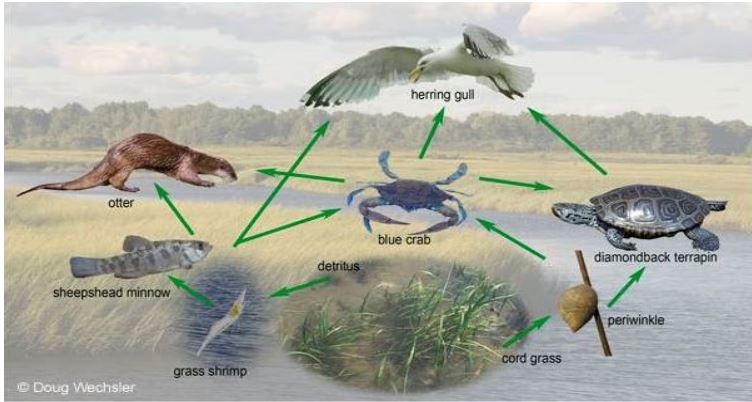
Wetland Food Web
11

Texas’ coastal wetlands are especially important places for migratory waterfowl(ducks, geese, swan) to spend the winter
Texas is at the southern end of the Central and Mississippi Flyways.
These flyways are like highways in the sky that extend from one end of North America to the other
Texas’s prairie and coastal wetlands provide winter food and lodging for 90 percent of all ducks and 75 percent of all geese in the Central Flyway
These wetlands supply plants, seeds, and invertebrates that migrating birds must eat to get enough energy to continue their flight north or south.
Food and Lodging for Travelers
12
If the chain of healthy wetlands from north to south is ever broken, waterfowl like the blue-winged teal we see in Texas, will be unable to survive and reproduce from one year to the next
Citizen conservation groups, work together with Texas Parks and Wildlife Department and other state and federal wildlife agencies to protect and restore wetlands in Texas and everywhere else migratory birds go
Migratory bird hunters buy special stamps to help pay for this wetland conservation.
Food and Lodging for Travelers
10.2 Wetland Ecology
Show answer
Auto Play
Slide 1 / 12
SLIDE
Similar Resources on Wayground

10 questions
CREDIT
Presentation
•
12th Grade
11 questions
Renewable and Nonrenewable Resources
Presentation
•
11th Grade
8 questions
APB Unit 1 - Review
Presentation
•
11th - 12th Grade
10 questions
Chemical Equilibrium
Presentation
•
11th - 12th Grade
9 questions
Coastal Ecosystems
Presentation
•
11th - 12th Grade
10 questions
Quiz
Presentation
•
KG
9 questions
Reading Strategies
Presentation
•
6th - 8th Grade
7 questions
Interactions of Earth's Atmosphere and Hydrosphere
Presentation
•
11th - 12th Grade
Popular Resources on Wayground
10 questions
HCS SCI 03 Summer School Assessment 1

Quiz
•
3rd Grade
15 questions
HCS SCI 05 Summer School Assessment 1 Review
Quiz
•
5th Grade
22 questions
Day 9 Equations and Inequalities Review
Quiz
•
9th Grade
10 questions
Writing and Identifying Ratios Practice
Quiz
•
5th - 6th Grade
7 questions
PYRAMID PERSPECTIVES part 1
Presentation
•
9th - 12th Grade
12 questions
Understanding the Fourth of July
Quiz
•
9th Grade
15 questions
Soccer World Cup Quiz Questions
Quiz
•
7th Grade