Waves - Lenses Review (S8P4g)
Presentation
•
Science
•
8th Grade
•
Medium
Standards-aligned
Sierra Lawhorne
Used 12+ times
FREE Resource
7 Slides • 58 Questions
1
Waves - Lenses/Characteristics of Waves Review (S8P4g)
By Sierra Lawhorne
2
3
4
5
6
Pause
Review the Lenses Mirrors and Notes in your study guide, then continue through the slides.
Some text here about the topic of discussion
7
Multiple Choice
8
Multiple Choice
Which of the following statements is false?
A convex lens refracts light.
A concave lens refracts light.
We see objects because they absorb visible light waves.
We see objects because they reflect visible light waves.
9
Multiple Choice
3. Which of the following correctly shows what happens to light when it passes through a convex lens?
1
2
3
4
10
Multiple Choice
This lens is an example of what type of lens?
concave
convex
refracting
oval
11
Multiple Choice
This lens is an example of what type of lens?
concave
convex
hourglass
refracting
12
Multiple Choice
The lens pictured is exhibiting _______ behavior and is ______ in shape.
converging, convex
converging, concave
diverging, convex
diverging, concave
13
Multiple Choice
The lens pictured is exhibiting _______ behavior and is ______ in shape.
converging, convex
converging, concave
diverging, convex
diverging, concave
14
Multiple Select
Classify the image produced by the projector lens. Check two.
real
virtual
larger than original
smaller than original
15
The next slides will review the relationship between amplitude, frequency, wavelength, and energy.
Some text here about the topic of discussion
16
Poll
You can tell a lot about a wave by looking at its parts.
The amplitude of a wave is the amount of energy carried by a wave. In a transverse wave, the amplitude is the height of the wave.
Wavelength is the distance between one point on a wave and the nearest point just like it. In a transverse wave, the wavelength is the distance from crest to crest or trough to trough.
Frequency is the number of waves that pass a given point in one second.
I don't get it.
GOT IT!
17
Multiple Choice
If a sound wave has a high pitch, it has a ___.
high frequency
low frequency
18
Multiple Choice
Which wave has a higher frequency per second?
blue wave
red wave
19
Multiple Choice
The number of wavelengths that pass by a point each second is called ...
wavelength
pitch
frequency
20
Multiple Choice
A low frequency has a ........... pitch.
low
high
21
Multiple Choice
The high pitch sound is
22
Multiple Choice
23
Multiple Choice
Diagram shows 3 types of sound waves generated from speaker. Which of the following statements is true?
P has a higher pitch than Q
Q has a higher pitch than R
R has the highest pitch
P, Q and R have the same pitch
24
Multiple Choice
What is changed in the second picture?
Someone is talking louder in picture 2
Someone is talking softer in picture 2
Someone is talking lower pitch in picture 2
Someone is talking higher pitch in picture 2
25
Multiple Choice
Which of the following determines the pitch of a sound wave?
Frequency
Amplitude
Reflection
Absorption
26
Multiple Choice
Volume (Loudness) tells you if a sound is:
wavy or straight
deep or wide
low or high
loud or soft
27
Multiple Choice
A sound with a _________ frequency will have a _________ pitch.
lower, higher
higher, loud
higher. lower
lower, lower
28
Multiple Choice
The loudest sound is
29
Multiple Choice
A sound with a tall amplitude will be...
quiet
loud
30
Multiple Choice
How does this waveform change?
low pitch - high pitch - low pitch
high pitch - low pitch - high pitch
low pitch - high volume - high pitch
31
Multiple Choice
32
Multiple Choice
The distance between the resting point and a crest or trough
acoustics
pitch
amplitude
volume
33
Multiple Select
Classify the image formed in the magnifying glass.
real
virtual
larger than original
smaller than original
34
Multiple Choice
Which wave has a longer wavelength?
A
B
35
Multiple Choice
Classify the image formed in this scenario.
real, inverted, larger than original
real, inverted, smaller than original
virtual, upright, larger than original
virtual, upright, smaller than original
36
Multiple Choice
Which wave has a shorter wavelength?
A
B
37
Multiple Choice
A person standing in front of a lens creates an image that is both smaller than the original and closer to the lens. Classify the image formed in this scenario.
real, inverted
real, upright
virtual, inverted
virtual, upright
38
Multiple Choice
The __________ of a wave is the distance between one point on a wave and the nearest point just like it. In a transverse wave, this is the is the distance from crest to crest or trough to trough.
amplitude
wavelength
frequency
baseline
39
Multiple Choice
40
Multiple Choice
Which wave has a higher frequency?
A
B
41
Multiple Choice
42
Multiple Choice
Which wave has a lower frequency?
A
B
43
Multiple Choice
44
Multiple Choice
The __________ of a wave is the number of waves that pass a given point in one second.
amplitude
wavelength
frequency
period
45
Multiple Choice
46
Multiple Choice
True or False: Waves A and B have the same amplitude.
True
False
47
Multiple Choice
48
Multiple Choice
Which wave has a more amplitude?
A
B
49
Multiple Choice
This image is.....
inverted and smaller
inverted and larger
not inverted and smaller
not inverted and larger
50
Multiple Choice
Which wave has a less amplitude?
A
B
51
Multiple Choice
52
Multiple Choice
The _______________ of a wave is the amount of energy carried by a wave. In a transverse wave, the this is the height of the wave (or the distance between the baseline and the crest or trough).
amplitude
wavelength
frequency
baseline
53
Multiple Choice
54
Multiple Choice
True or False: Both waves A and B have the same wavelength.
True
False
55
Multiple Choice
56
Multiple Choice
True or False: Both waves A and B have the same frequency.
True
False
57
Multiple Choice
58
Multiple Choice
59
Multiple Choice
60
Multiple Choice
Why does light refract when it encounters the glass in a lens?
because it speeds up, which causes it to bend
because it slows down, which causes it to bend
because it hits a dense medium, which causes it to bounce off
because it gets absorbed, which causes it to lessen in intensity
61
Multiple Choice
_____ lenses refract light rays in toward a central point. When this lens is held close to your eye, the image is magnified and right side up.
Concave
Convex
Prismatic
Refractive
62
Multiple Choice
Which image CORRECTLY shows how light behaves when it travels from air through glass?
63
Multiple Choice
A ____ lens is sometimes called a converging lens because it_____.
convex; makes parallel light rays curve outward or diverge
concave; makes parallel light rays travel at a faster speed than before they encountered the lens
convex, makes parallel light rays passing through it bend inward and meet (converge) at a spot just beyond the lens known as the focal point.
concave; makes parallel light rays passing through it bend inward and meet (converge) at a spot just beyond the lend known as the focal point.
64
Multiple Choice
A concave lens has an inward curved shape. It refracts light outward from the lens. They light rays spread apart as they exit the lens. Which represents a concave lens?
A
B
A and B
neither A or B
65
Multiple Choice
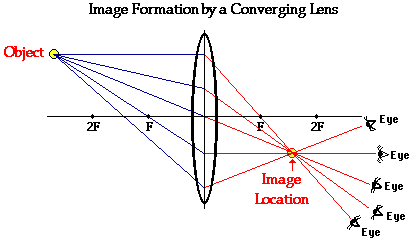
What type of image is formed?
virtual and inverted
virtual and upright
real and upright
real and inverted
Waves - Lenses/Characteristics of Waves Review (S8P4g)
By Sierra Lawhorne
Show answer
Auto Play
Slide 1 / 65
SLIDE

Similar Resources on Wayground
61 questions
Bio Tech - Virus
Presentation
•
8th Grade
61 questions
Galaxies Lesson
Presentation
•
8th Grade
61 questions
Rock Cycle (lesson)
Presentation
•
6th - 8th Grade
58 questions
Moon Phase Notes
Presentation
•
8th Grade
60 questions
Planetary Properties
Presentation
•
8th Grade
60 questions
D Assessement part #1 Review
Presentation
•
8th Grade
60 questions
HHE Unit Review
Presentation
•
8th Grade
61 questions
Respiratory System 6.1
Presentation
•
8th Grade
Popular Resources on Wayground
5 questions
A Home on the Shore
Quiz
•
3rd Grade
28 questions
US History Regents Review
Quiz
•
11th Grade
6 questions
A Horse Tale
Quiz
•
3rd Grade
20 questions
Math Review
Quiz
•
3rd Grade
10 questions
Juneteenth History and Significance
Interactive video
•
5th - 8th Grade
20 questions
Dividing Fractions
Quiz
•
5th Grade
55 questions
A Long Walk to Water Final Review
Quiz
•
6th - 8th Grade
10 questions
Equation Word Problems
Quiz
•
7th Grade
Discover more resources for Science
10 questions
Juneteenth History and Significance
Interactive video
•
5th - 8th Grade
55 questions
A Long Walk to Water Final Review
Quiz
•
6th - 8th Grade
10 questions
Juneteenth: History and Significance
Interactive video
•
7th - 12th Grade
30 questions
Circles, Area, & Volume II 2026
Quiz
•
8th Grade
20 questions
summer trivia
Quiz
•
8th Grade
28 questions
A Rover's Story, part 1
Quiz
•
6th - 8th Grade
40 questions
Flags of the World
Quiz
•
KG - Professional Dev...
5 questions
8th Grade- Multi Step Equations
Presentation
•
8th Grade