

Unit 4 Section 1: Introduction to Microscopes

Presentation
•
Science
•
8th Grade
•
Medium
+11
Standards-aligned

Abby Fancsali
Used 18+ times
FREE Resource
16 Slides • 15 Questions
1
Science Root of the Day:
DO NOW: Write what you think the example words mean in your lab manual.

2
3
Introduction to Microscopes

4

Lesson Objectives
Describe the History of Microscopes and how they work
Identify the parts of a microscope
Understand Proper Microscope Usage
5
What is a Microscope?
Microscope: a laboratory instrument used to view objects too small to be seen with the naked eye
Micro=small Scope= to look at
Are many different types depending on what you want to look at
Microscopy: the science of observing small objects

6
Lens History
Early Humans used small crystals to help focus light
Could aid in vision and help start fires
Ancient Egyptians and Mesopotamians would polish quartz rock to make lenses
Nimrud Lens: a piece found in Assyria from between 750 and 710 BC

7
Microscopy History
13th Century: Italian Glass blowers created early eyeglasses
Each lens built to bend light to a specific spot
Set the stage for lenses to be used in vision aids
Telescopes, Microscopes, hand lenses, etc

8
Early Microscopes
1590's: The first microscopes developed in the Netherlands
Two rival inventors came up with the idea, and no one is sure who the true inventor is due to claims of one stealing the others design
Early design only had 3x Magnificaation
Galileo refined the design in 1609 to create a microscope with a magnification of 30x

9
The Father of Microscopes
Anton Van Leeuwenhoek
Born in 1634
A thread maker who began working with lenses to get a better view of threads
would melt glass rods to form smaller lenses, which gave the best magnification
His compound microscope design could magnify up to 200x, far better than Galileo's design
tested his design by looking at water samples, and discovered microbial lifeforms
Is known as the father of the microscopy

10
Multiple Choice
True or false: Galileo invented the first microscope
True
False
11
Multiple Choice
makes faraway objects look closer.
makes small objects appear larger.
decreases the size of small objects.
increases the size of small objects.
12
Multiple Choice
True or false: the earliest lenses were made of glass
True
False
13
How does a Microscope Work?
In class, we will be using a compound light microscope
It uses a light source and mirrors to direct light through lenses to the eye
The compound has two lenses, one at the bottom and one at the top by the eyes
Both affect the magnification

14
Microscope Parts-Arm
Arm: The support structure of the microscope
Has a different size and shape depending on the type of microscope
Always carry a microscope with one hand around the arm and the other supporting the bottom

15
Microscope Parts-Stage & Diaphragm
Stage: Where you place whatever specimen you are looking at
Mainly slides, but could also be Petri plates
Diaphragm: Controls the amount of light let in
In General, you will not worry about it in this class

16
Microscope Parts-Adjustment Knobs
Coarse Adjustment Knob: Allows for major changes in the stage location
ONLY USE WITH THE LOWEST OBJECTIVE LENS
Is larger
Fine Adjustment Knob: Allows for smaller changes in the stage location
Is smaller
Sometimes both knobs are connected but are sometimes two separate pieces

17
Microscope Parts- Ocular Lens
Ocular Lens: Part of the microscope you see through, Can not be changed
Generally has a magnification of 10x, but some are stronger
Always check the magnification before you start

18
Microscope Parts-Objective Lenses
Objective Lenses: The set of second lenses that can be switched to change magnification
When using, always start with the smallest lens size to avoid breaking the slide or microscope
Are on a rotating nosepiece
Total Magnification= occular * Objective
If ocular is 10, and objective is 20,
total= 10 * 20=200

19
Multiple Choice
In Class we will use
An electron Microscope
A compound Microscope
A single lens Microscope
A hand lens
20
Multiple Choice
This part of the microscope can be adjusted to change the amount of light on the sample
Ocular Lens
Stage
Diaphragm
Objetive Lens
21
Multiple Choice
A microscope has a 4x ocular lens and a 10x objective, what is this microscope's total magnification?
4x
14x
40x
400x
22
Multiple Choice
You must carry a microscope with...
your nose in the air like you just don't care
your hand and your chin
two hands, one under the base and one on the top
two hands around the arm
two hands under the base
23
Multiple Choice
To focus a specimen, it is best to start with which objective lense
The high power
the lowest power
The medium power
The ocular
24
25
Multiple Choice
What term refers to the ability to distinguish between two objects in a microscope?
Resolution
Contrast
Magnification
Illumination
26
Multiple Select
Which type of microscope uses electron beams to visualize images?
Transmission Electron Microscope (TEM)
Phase-contrast microscope
Brightfield light microscope
Scanning Electron Microscope (SEM)
27
Multiple Choice
What is the function of the coarse focus knob on a microscope?
Move the stage up or down dramatically
Adjust the light level
Center the image
Fine-tune focus
28
Multiple Choice
What should be used to clean the lens of a microscope?
Regular tissue
Microfiber cloth
Lens paper
Wet wipes
29
Multiple Choice

Base
Stage
Tube
Arm
30
Multiple Choice
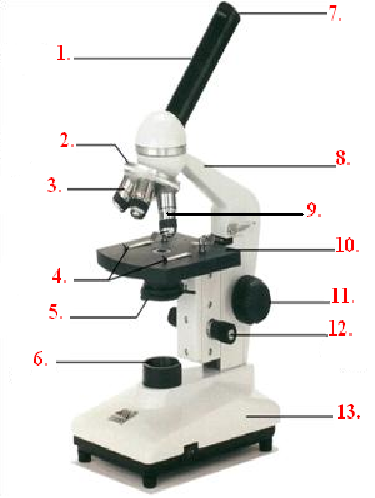
Coarse Adjustment
Fine Adjustment
Small Adjuster
Large Adjuster
31
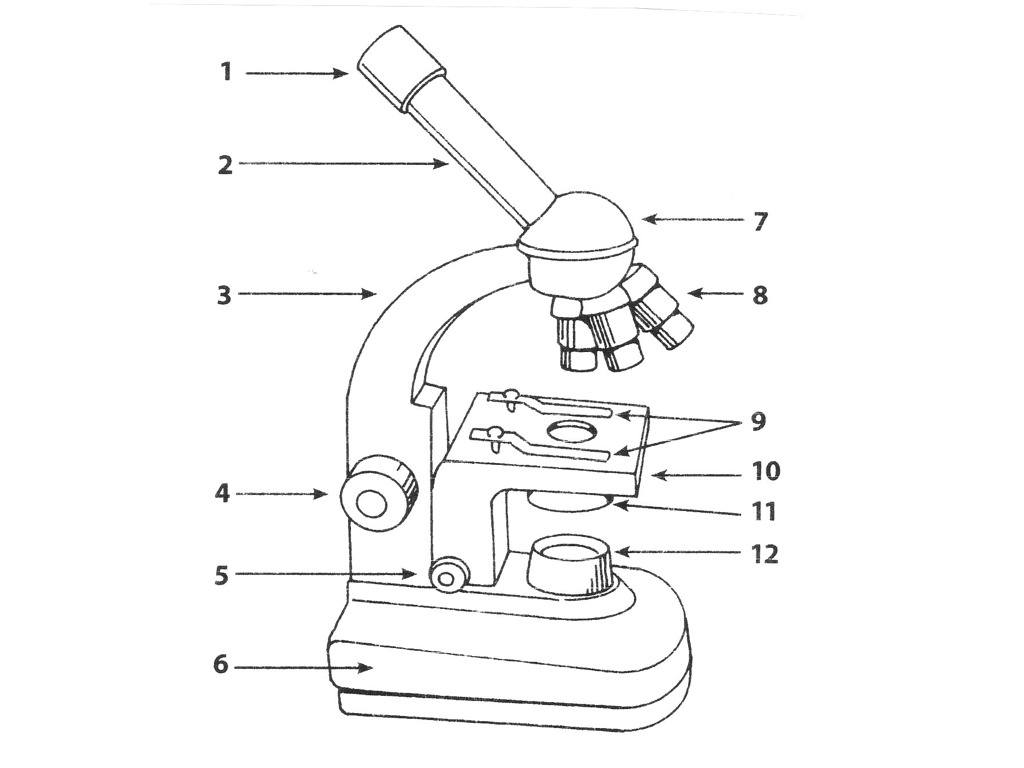
Labeling
Label the parts of the Microscope
Coarse Adjustment Knob
Occular Lens
Arm
Stage
Science Root of the Day:
DO NOW: Write what you think the example words mean in your lab manual.
Show answer
Auto Play
Slide 1 / 31
SLIDE
Similar Resources on Wayground

24 questions
Rock Cycle
Presentation
•
8th Grade
25 questions
Inherited Traits
Presentation
•
8th Grade
25 questions
Cluster 4 Day 2-Food Webs and Ecology
Presentation
•
8th Grade
25 questions
LESSON - Cell Organelles
Presentation
•
8th Grade
23 questions
Chemical and Physical Properties
Presentation
•
8th Grade
23 questions
Intro to Environmental Changes 8.11B
Presentation
•
8th Grade
22 questions
Module H-Conduction, Convection, & Radiation
Presentation
•
8th Grade
22 questions
Day/Night and Seasons
Presentation
•
8th Grade
Popular Resources on Wayground
10 questions
Impact of 9/11 and the War on Terror

Interactive video
•
10th - 12th Grade
21 questions
Continents and Oceans

Quiz
•
6th Grade
5 questions
9/11
Interactive video
•
9th Grade
20 questions
Parts of Speech
Quiz
•
5th Grade
16 questions
Subject & Predicate
Quiz
•
5th Grade
10 questions
Riddles Riddles fun Riddles
Quiz
•
6th - 12th Grade
21 questions
Lab Safety
Quiz
•
10th Grade
6 questions
PRIDE in the Hallways and Bathrooms
Presentation
•
12th Grade
Discover more resources for Science
20 questions
Lab Safety
Quiz
•
5th - 8th Grade
20 questions
Scientific Method and Variables
Quiz
•
8th Grade
20 questions
Scientific method and variables
Quiz
•
8th Grade
27 questions
Counting Atoms - Subscripts
Quiz
•
8th Grade
22 questions
Scientific Method and Variables
Quiz
•
8th Grade
20 questions
Claim, Evidence and Reasoning (CER)
Quiz
•
6th - 8th Grade
18 questions
Counting Atoms
Quiz
•
7th - 8th Grade
20 questions
Elements, Compounds and Mixtures
Quiz
•
8th Grade