Search Header Logo
Ecology

Ecology

Assessment

Presentation

Biology

9th Grade

Medium

Created by

Jasmine Rodriguez

Used 2+ times

FREE Resource

18 Slides • 93 Questions

1

Unit 9: Ecosystems

  • Must complete this quizziz with a 70 or higher. If you finish it early, and scored below a 70 please retake.

  • Add your name when you start Quizziz so I can give you credit for completion

  • Must work on this individually, on your own laptop

2

media

Ecology—the scientific study of interactions between
different organisms and between organisms
and their environment or surroundings

3

Multiple Choice

What is ecology?

1

the study of rocks

2

the study of relationships between organisms and their environments

3

the study of the ocean

4

the study of animals and plants

4

media

Level of Organization of an Ecosystem

5

media
media

What are the levels of organization for

the environment?

1. Individual
2. Population
3. Community
4. Ecosystem
5. Biome
6. Biosphere

6

Fill in the Blanks

Type answer...

7

media

What is an individual?

An individual is a single organism.

8

media

What is a population?
A population is a group of individuals that belong
to the same species.

9

Multiple Choice

What is the definition of a population?

1

all individuals of one kind living in one area

2

one single organism

3

any living thing

4

many different organisms living in one area

10

media

What is a community?

A community is all the living things (plants,
animals, bacteria, etc.) living in the same place; all
the populations put together.

11

Multiple Choice

What is the definition of a community?

1

any living thing

2

one single individual

3

all the individuals of one kind in one area

4

all of the populations living in one area

12

media

What is an ecosystem?

An ecosystem is all the living and non-living things
in an environment. (The community plus all the
rocks, dirt, water, temperature, weather, etc.)

13

Multiple Choice

All of the living and nonliving components that interact in an environment.

1

population

2

ecosystem

3

community

4

organism

14

media

Biome

Biome – a group of
ecosystems that have
the same climate and
similar dominant
communities.

15

media

What shapes an Ecosystem?

16

media

What are biotic and abiotic factors?

Biotic factors = living things

Examples: plants, animals, bacteria, fungi, predators,
producers, decomposers, etc.

Abiotic factors = nonliving things

Examples: rocks, dirt, weather, temperature, water, ice,
etc.

17

Multiple Choice

Biotic means:

1

living organisms and the remains of living organisms

2

non-living

18

Multiple Choice

Abiotic means:

1

living organisms and the remains of living organisms

2

non-living

19

media

What is a niche?

A niche is an organism’s job in the ecosystem
Example: consumer of deer, nitrogen fixer,
decomposer, producer etc.
Usually each species has its own niche.
If 2 species try to share the same niche, they will
compete for resources and one will probably do
better than the other (competitive exclusion).

20

media

Processing Piece:

Describe the niche of the bald eagle.

21

media

What happens when a species disappears?

If new niches suddenly open up (like after an
extinction or natural disaster) then new species
will usually migrate in or evolve to fill those niches.

22

media

What happens when a species disappears?

If new niches suddenly open up (like after an
extinction or natural disaster) then new species
will usually migrate in or evolve to fill those niches.

23

media

What is a biome?

Biomes are regions of the world that have similar
ecosystems: similar climates, environments, and
species living in them.
Examples: tropical rainforest, desert, grasslands

24

media

What is the biosphere?
The biosphere is all the places on Earth where
living things are; all the biomes put together.

25

Multiple Choice

Question image
the entire Earth 
1

biosphere 

2

community 

3

ecosystem 

26

Questions

The remainder of this Quizziz will be questions from today's lesson AND questions from this unit (plants structures, reproduction, responses, and the carbon+nitrogen cycles)

27

Multiple Choice

When the animal dies, what do you call those organisms that break them down?
1

Producers

2

Decomposers

3

Consumers

4

None of the choices

28

Multiple Choice

Any living thing is called a.................

1

ecosystem

2

community

3

population

4

organism

29

Multiple Choice

These are different groups of organisms that belong to the same species (Example: rats, rabbits, snakes)
1

Population

2

Community

3

Producers

4

Consumers

30

Multiple Choice

Question image
A snake 
1

ecosystem 

2

organism 

3

population 

31

Multiple Choice

snakes, mice, small birds, crickets, hawks, cactus, tumbleweed
1

organism

2

community

3

population 

32

Multiple Choice

Question image
all the snakes in the area 
1

organism 

2

ecosystem 

3

population 

33

Multiple Choice

Question image
a bird 
1

abiotic 

2

biotic 

34

Multiple Choice

Question image
the sun 
1

abiotic 

2

biotic 

35

Multiple Choice

Question image
soil 
1

abiotic 

2

biotic 

36

Multiple Choice

Question image
a dead plant 
1

abiotic 

2

biotic 

37

Multiple Choice

Why is carbon such an important element?

1

carbon is a key element in producing electricity

2

without carbon the Sun would run out of energy

3

carbon is the central element to all living organisms

4

  All of the above

38

Multiple Choice

All of the nitrogen cycle processes are performed by


1

decomposers

2

plants

3

animals

4

bacteria

39

Multiple Choice

The process of nitrogen turning into Ammonia is


1

nitrification

2

ammonification

3

lightning

4

denitrification

40

Multiple Choice

The percentage of Nitrogen in the atmosphere

a.       21%                                                          c. 78%

b.       80%                                                          d. 79%

1

A

2

B

3

C

4

D

41

Multiple Choice

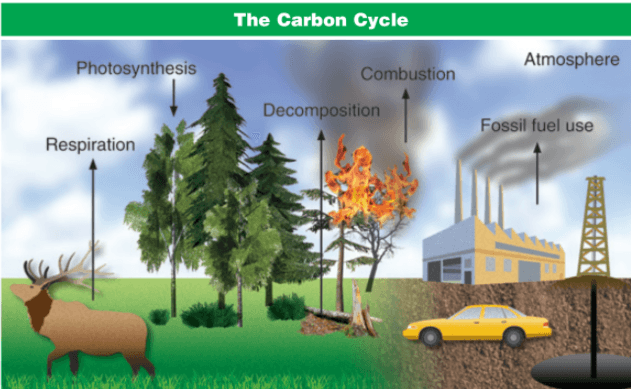
  Which part of the carbon cycle occurs when plants convert sunlight and C02 into oxygen and sugar?

1

combustion

2

decay

3

respiration

4

photosynthesis

42

Multiple Choice

How has man influenced the carbon cycle and increased the amount of carbon in the atmosphere?

1

burning oil

2

burning coal

3

cutting down trees

4

all of the above

43

Multiple Choice

In the nonliving environment, carbon exists as a gas in _____.
1

cells

2

geosphere

3

atmosphere

44

Multiple Choice

Carbon enters the living world through the process of _____.
1

photosynthesis

2

respiration

3

combustion

4

decomposition

45

Multiple Choice

Question image
Burning fossil fuel has which effect in the carbon cycle?
1

It removes carbon dioxide from the atmosphere.

2

It puts carbon dioxide under the ground.

3

It adds carbon dioxide to the atmosphere.

4

It has no effect in the carbon cycle.

46

Multiple Choice

Question image
Which process takes carbon dioxide out of the atmosphere?
1

respiration

2

combustion

3

decomposition

4

photosynthesis

47

Multiple Choice

What does NOT produce carbon dioxide?
1

Photosynthesis

2

Burning Fossil Fuels

3

Animal respiration

4

Plants decaying

48

Multiple Choice

TRUE or FALSE?
All of the carbon in existence is continually recycled in the carbon cycle.
1

True

2

False

49

Multiple Choice

Carbon can be found in...
1

The atmosphere

2

Soil

3

Fossil fuels

4

All of the above

50

Multiple Choice

Respiration is the process by which animals take in _____ and release _____. 
1

photosynthesis, air

2

carbon, oxygen

3

oxygen

4

oxygen, carbon dioxide

51

Multiple Choice

Plants use ____________________ to make their own food.

1

Carbon Dioxide

2

Oxygen

3

Materials

4

Gravity

52

Multiple Choice

How do animals get carbon?

1

By eating plants and or other animals.

2

They absorb it from the atmosphere.

3

From the ground

4

They do not get carbon from anywhere.

53

Multiple Choice

What are fossil fuels made from?

1

Plants and animals that are buried underground for millions of years.

2

They absorb it from the atmosphere.

3

Water

4

Wind

54

Multiple Choice

What is the role of decomposers in an Ecosystem? 
1

They recycle matter and nutrients to form fossil fuels

2

They are burn and release as carbon dioxide

3

Decomposers are responsible to turn oxygen into carbon dioxide

4

They recycle energy back to the sun

55

Multiple Choice

What are the end products of cellular respiration? 
1

Carbon dioxide, water and ATP energy

2

Carbon dioxide, glucose and water

3

Oxygen, glucose and ATP energy

4

Water, Carbon dioxide and Oxygen

56

Multiple Choice

Carbon dioxide is created by 
1

Burning fossil fuels 

2

Cellular respiration

3

Decomposing organic matter

4

All answers are correct

57

Multiple Choice

How animals get the nitrogen they need
1

from the air they breathe

2

from the water they drink

3

from the food they eat

4

from the Sun

58

Multiple Choice

Organisms that need nitrogen to survive
1

only plants

2

only animals

3

only bacteria

4

all living organisms

59

Multiple Choice

Organisms that play a role in the nitrogen cycle
1

only plants

2

only animals

3

only bacteria

4

plants, animals, & bacteria

60

Multiple Choice

Nitrogen rich fertilizers and manure can cause water pollution.
1

True

2

False

61

Multiple Choice

Organism that breaks down dead plants & animals and releases nitrogen back into atmosphere
1

bacteria

2

plants

3

animals

4

producers

62

Multiple Choice

How plants get the nitrogen they need
1

from the air

2

from the soil or water in which they live

3

from the Sun

4

from broken down rocks

63

Multiple Choice

The process in which nitrogen circulates and is recycled is called

1

The nitrogen cycle

2

The carbon cycle

3

The water cycle

4

The phosphorus cycle

64

Multiple Choice

What is the formula for atmospheric nitrogen?

1

N

2

N2

3

NH3

4

NO3

65

Multiple Choice

Question image

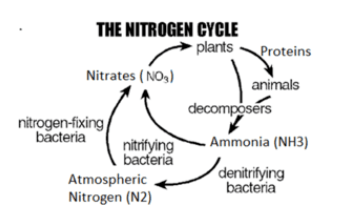
According to this diagram, plants use nitrogen to make _________________________

1

bacteria

2

animals

3

proteins

4

decomposers

66

Multiple Choice

Question image

According to this diagram, plants absorb

1

nitrates

2

nitrogen fixing bacteria

3

animals

4

decomposers

67

Multiple Choice

Question image

According to this diagram, animals get proteins from eating ________________________

1

decomposers

2

bacteria

3

plants

4

sunlight

68

Multiple Choice

Bacteria fix nitrogen from the atmosphere into a form plants can use.

1

True

2

False

69

Multiple Choice

Question image
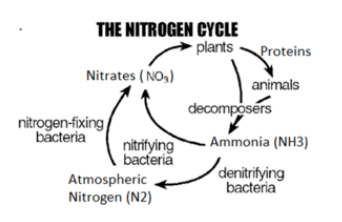
Organisms that break down dead plants & animals and release nitrogen back into atmosphere...
1
bacteria
2
plants
3
animals
4
producers

70

Multiple Choice

Plants and animals cannot use nitrogen directly from the air.
1

True

2

False

71

Multiple Choice

What happens when organisms die and decay? 
1

Their bodies are lifted up

2

Their nitrogen returns to the soil

3

they keep their nitrogen

4

They stay on earth forever

72

Multiple Choice

Question image

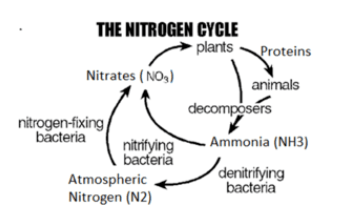
_____ is the conversion of organic nitrogen into ammonia

1

Nitrogen Fixation

2

Ammonification

3

Denitrification

4

Assimilation

73

Multiple Choice

Nitrification happens in the ______
1

Air 

2

Soil 

3

Ground Water 

4

Plants 

74

Multiple Choice

Question image

The process that convert nitrates (NO3-) back to nitrogen gas (N2) there by replenishing N2 in the atmosphere is called

1

Nitrogen fixation

2

Deamination

3

Denitrification

4

Nitrification

75

Multiple Choice

What functions do leaves perform?

1

Leaves perform transpiration and photosynthesis

2

Leaves give shade

3

Leaves do not function

76

Multiple Choice

What materials are produced by the plant as a result of photosynthesis?

1

Water and oxygen

2

Food(sugar) and oxygen

3

Leaves and stems

77

Multiple Choice

Inside each leaf, veins carry...

1

Air and Water

2

Water and Nutrients

3

Nutrients and Air

78

Multiple Choice

How do flowers help a plant complete its life cycle?

1

By absorbing water

2

Making the plant germinate

3

By pollination and making seeds

79

Multiple Choice

Which part of the plant allows it to take in most carbon dioxide?

1

Stem

2

Leaves

3

Seed

4

Flower

80

Multiple Choice

The male part of the flower is called the...

1

Stamen

2

Pistil

81

Multiple Choice

The female part of the flower is called the...

1

The stamen

2

The Pistil

82

Multiple Choice

After pollination, the content inside the pollen moves to the _____where fertilization occurs.

1

Stem

2

Ovaries

3

Leaves

83

Multiple Choice

Question image

The tubes and support that transport water

and nutrients up, down and around in plants

1

Vascular System

2

Shoot System

3

Root System

4

Reproductive System

84

Multiple Choice

Question image

Vascular tissue (tubes) responsible for the transportation of water and minerals up from the roots and around the plant.

1

Stomata

2

Transpiration

3

Phloem

4

Xylem

85

Multiple Choice

Question image

Vascular tissue (tubes) responsible for the transportation of glucose down and around in a plant.

1

Transpiration

2

Xylem

3

Phloem

4

Root Hairs

86

Multiple Choice

Question image

The process of water movement in plants

due to evaporation out the stomata

and absorption of water through the root hairs

1

Active Transport

2

Transpiration

3

Stomata

4

Guard Cells

87

Multiple Choice

Question image

Pores under leaves

that allow for transpiration

and gas exchange

1

Xylem

2

Stomata

3

Phloem

4

Transpiration

88

Multiple Choice

Question image

The parts of the plant (angiosperms) involved in producing gametes (pollen and eggs) and seeds (fertilized eggs)

1

Shoot System

2

Phloem

3

Xylem

4

Reproductive System

89

Multiple Choice

Question image

The plant hormone response to the

force of gravity

1

Phototropism

2

Gravitropism

3

Thigmotropism

4

Transpiration

90

Multiple Choice

Question image

The plant hormone response to light

1

Transpiration

2

Thigmotropism

3

Geotropism

4

Phototropism

91

Multiple Choice

Question image

The plant hormone response to touch

1

Thigmotropism

2

Geotropism

3

Phototropism

4

Transpiration

92

Multiple Choice

The process in which a seedling sprouts from a seed is known as

1

photosynthesis

2

spoutation

3

fermentation

4

germination

93

Multiple Choice

What is the function of the roots?

1

Anchor the plant

2

Transports water and nutrients to different parts of the plant

3

Make food for the plant through photosynthesis

4

Becomes the new plant

94

Multiple Choice

The tip of the style that has sticky hairs to trap pollen is the ___.
1

stamen

2

stigma

3

ovary

4

style

95

Multiple Choice

The ovary, style, and the stigma make up the female part of a plant called the ?
1

stamen

2

petals

3

stem

4

carpel (pistil)

96

Multiple Choice

Pollen grains are produced by ?

1

the anther

2

the stigma

3

the flowers

4

the leaves

97

Multiple Choice

What does phloem transport?

1

Water

2

Minerals

3

Fruit

4

Sugar

98

Multiple Choice

Question image

Pores under leaves

that allow for transpiration

and gas exchange

1

Xylem

2

Stomata

3

Phloem

4

Transpiration

99

Multiple Choice

The outermost layer of plant stems in dicotyledons consists of epidermal cells and guard cells that surround opening called stomata. The epidermal cells ate usually covered with a waterproof layer that provides protection for injury and water loss. The stomata allow gas exange. The epidermal cells and stomata have functions similar to those of which two humans body systems?

1

Skeletal and respiratory

2

cardiovascular and skeletal

3

integumentary and respiratory

4

cardovascular and integumentary

100

Multiple Choice

Question image

The response represented in the illustration would most likely be caused by-

1

a reduced supply of oxygen

2

long periods of rainfall

3

high concentrations of glucose

4

little available water

101

Multiple Choice

The fertilized ovary develops into a fruit.

1

True

2

False

102

Multiple Choice

The plant cuticle is a waxy coating on a plant that keeps water from evaporating.

1

True

2

False

103

Multiple Choice

Photosynthesis is _______________________.

1

how plants use sunlight to produce food

2

how plants release water to the air

3

how plants use sugars and oxygen to produce energy to grow

104

Multiple Choice

Small openings called ______ are found on the underside of must leaves and allow water vapor and other gases to enter or leave the plant cells.
1

Spores

2

Chloroplasts

3

Xylem

4

Stomata

105

Multiple Choice

POLLINATION is the process that delivers pollen to eggs.
1

True

2

False

106

Multiple Choice

Question image
The MALE part of the flower is called the ______.
1

Stigma

2

Stamen

3

Pistil

4

Anther

107

Multiple Choice

The reproductive material in plants that contains MALE GAMETES is called ______.
1

Stigma

2

Ovaries

3

Ovules

4

Pollen

108

Multiple Choice

Question image
Plant: What is label A?
1

Stem

2

Petal

3

Leaf

4

Flower

109

Multiple Choice

Question image
Plant: What is label D?
1

Stem

2

Root

3

Shoot

4

Flower

110

Multiple Choice

Question image
Plant: What is label C?
1

Stem

2

Petal

3

Leaf

4

Flower

111

Multiple Choice

Question image
Plant: What is label B?
1

Stem

2

Petal

3

Leaf

4

Flower

Unit 9: Ecosystems

  • Must complete this quizziz with a 70 or higher. If you finish it early, and scored below a 70 please retake.

  • Add your name when you start Quizziz so I can give you credit for completion

  • Must work on this individually, on your own laptop

Show answer

Auto Play

Slide 1 / 111

SLIDE