
- Resource Library
- Science
- Biology
- Skeletal System
- Lesson 4.5 : Common Injuries & Disorders Of The Skeletal System

Lesson 4.5 : Common Injuries & Disorders of the Skeletal System

Presentation
•
Science
•
10th Grade
•
Practice Problem
•
Hard

Racine Jolley
FREE Resource
77 Slides • 27 Questions
1

2

3
Multiple Choice
Which of the following is a consequence of osteoporosis?
Increased bone density
Decreased risk of fractures
Weakening of bones
Improved joint flexibility
4
Open Ended
Why is it important to understand common injuries and disorders of the skeletal system?
5

6

7
Multiple Choice
Which of the following is NOT a common bone injury?
Fractures
Avulsions
Epiphyseal injuries
Osteoporosis
8

9
Multiple Select
Which of the following statements about avulsion fractures are correct?
They occur when a tendon or ligament pulls away from its attachment to a bone.
They always involve the breaking of the entire bone.
They can be caused by explosive throwing and jumping movements.
They often result in a small chip of bone being pulled away.
10
Open Ended
Explain how avulsion fractures occur and provide an example of an activity that might cause this type of injury.
11

12
Fill in the Blanks
Mallet finger is an example of an
13

14

15
Multiple Select
Which of the following are common symptoms of a bone fracture?
Swelling and tenderness
Bruising and deformity
Bone protruding through the skin
Muscle cramps
16
Open Ended
Describe the typical symptoms and diagnostic methods for fractures.
17

18
Multiple Choice
Which type of fracture occurs when the bone ends remain within the surrounding soft tissues?
Simple fracture
Compound fracture
Comminuted fracture
Greenstick fracture
19

20
Multiple Select
Which of the following are types of fractures depicted in the diagrams?
Simple
Compound
Greenstick
Comminuted
21

22
Open Ended
Explain why greenstick fractures are more common in children than in adults.
23
24
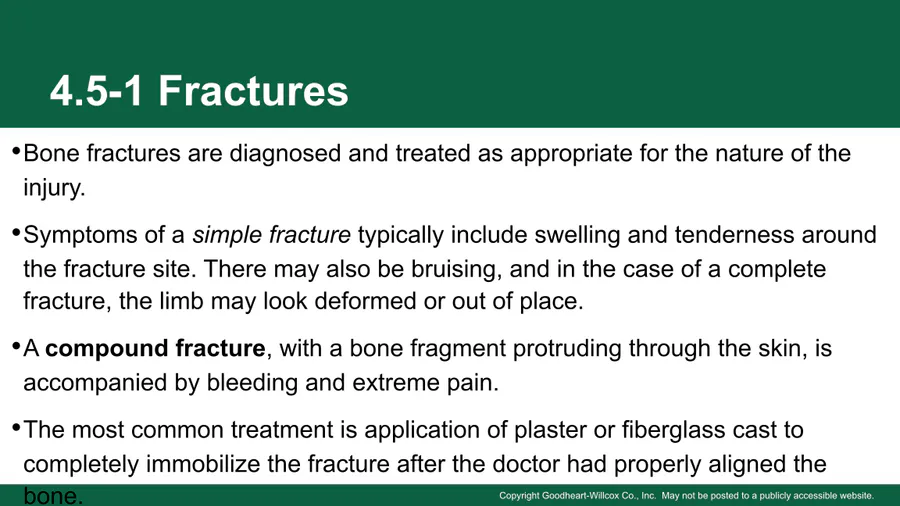
Multiple Choice
What is a common symptom of a simple fracture?
Swelling and tenderness around the fracture site
Bleeding and extreme pain
Bone fragment protruding through the skin
Complete immobilization of the fracture
25

26
Multiple Choice
A spiral fracture is caused by which of the following mechanisms?
Twisting a bone excessively
Direct impact to the bone
Bone ends protruding through the skin
Incomplete break on the convex surface
27

28
Fill in the Blanks
X-rays are an important diagnostic tool for finding bone
29

30

31
Open Ended
Explain the process by which bone responds to stress-related injury and how overuse can lead to stress fractures.
32

33
Multiple Select
Select all the sports in which athletes are particularly prone to stress fractures.
Soccer
Basketball
Swimming
Tennis
34
Multiple Choice
Which of the following is a common cause of stress fractures in athletes?
Sudden increase in activity
Consuming high calcium diet
Wearing supportive shoes
Decreased physical activity
35

36

37
Multiple Choice
Which bones are most commonly affected by stress fractures in runners and athletes?
Tibia and metatarsals
Femur and humerus
Radius and ulna
Pelvis and scapula
38
Fill in the Blanks
A stress fracture is a tiny, painful crack in the
39

40
Open Ended
What is an apophysis, and why are injuries to this area significant in young athletes?
41

42
Multiple Choice
Which of the following best describes the function of the apophysis in relation to the quadriceps muscle group?
It is the site where the quadriceps attaches to the tibia through a tendon.
It is the main site of bone growth in the femur.
It is responsible for nerve conduction in the thigh.
It is the attachment site for the hamstring muscles.
43
44

45
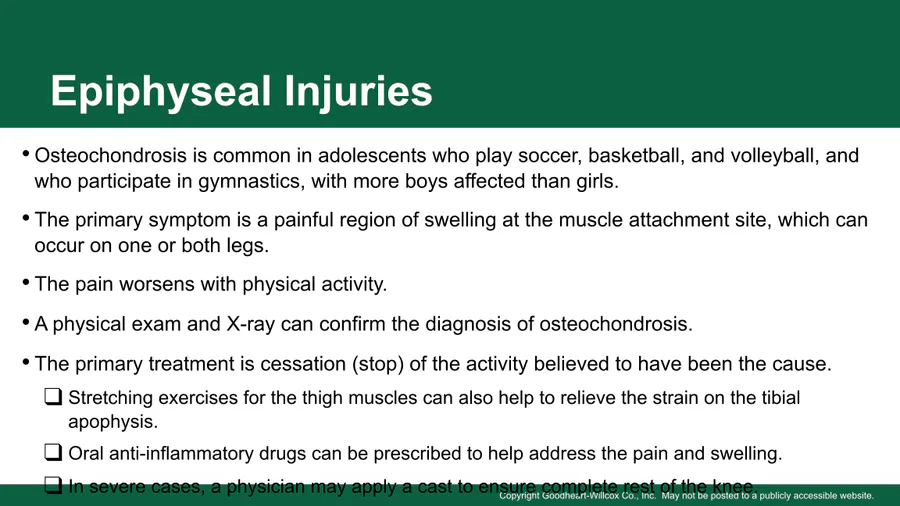
Multiple Choice
Which of the following are primary symptoms and diagnostic methods for osteochondrosis?
Painful swelling at the muscle attachment site and confirmation by X-ray
Loss of appetite and confusion, confirmed by blood test
Muscle weakness and confirmed by MRI
Shortness of breath and confirmed by ECG
46
Open Ended
Explain why adolescent athletes are at higher risk for developing epiphyseal injuries such as osteochondrosis.
47

48
Fill in the Blanks
The prominent swelling below the knee, as shown in the image, is characteristic of
49

50
Open Ended
Describe how the skeletal, endocrine, digestive, and urinary systems work together to maintain calcium homeostasis in the body.
51

52
Multiple Choice
Which of the following are possible effects of hypocalcemia and hypercalcemia?
Hypocalcemia can cause brittle bones and poor tooth health; hypercalcemia can cause slowed reflexes and confusion.
Hypocalcemia improves muscle strength; hypercalcemia increases appetite.
Hypocalcemia causes increased bone density; hypercalcemia causes rapid heartbeat.
Hypocalcemia leads to high blood pressure; hypercalcemia causes excessive sweating.
53

54

55

56

57

58
59

60

61

62

63

64

65

66

67

68

69

70

71

72

73
74

75
76

77
78

79

80

81

82

83

84

85

86

87

88

89

90

91

92

93

94

95
96

97

98

99

100

101

102

103
104
Open Ended
Reflecting on today's lesson about common injuries and disorders of the skeletal system, what is one new thing you learned that you found most interesting or important?
Show answer
Auto Play
Slide 1 / 104
SLIDE
Similar Resources on Wayground

103 questions
Unit 1 Geography Basics
Presentation
•
9th Grade
103 questions
Int Science SEM 1 FINAL REVIEW
Presentation
•
9th - 12th Grade
93 questions
F3 Family Ties L4
Presentation
•
9th - 10th Grade
100 questions
Chapter 4
Presentation
•
9th Grade
96 questions
Organelles & transport
Presentation
•
9th - 11th Grade
95 questions
KESEHATAN REPRODUKSI DI SMAN 1 CEPU
Presentation
•
10th Grade
99 questions
Science 8th Grade Benchmark (RC1, RC2, RC3
Presentation
•
8th Grade
97 questions
Petroski - Earth Science LEAP Review
Presentation
•
8th Grade
Popular Resources on Wayground
10 questions
Safety Day 2026 – Student Review

Quiz
•
9th Grade
21 questions
Continents and Oceans
Quiz
•
6th Grade
20 questions
Parts of Speech
Quiz
•
5th Grade
16 questions
Subject & Predicate
Quiz
•
5th Grade
25 questions
Multiplication Facts
Quiz
•
5th Grade
12 questions
Map Skills
Quiz
•
3rd Grade
22 questions
Continents and Oceans
Quiz
•
5th Grade
15 questions
Rounding Decimals
Quiz
•
5th Grade
Discover more resources for Science
10 questions
Exploring Chemical and Physical Changes

Interactive video
•
6th - 10th Grade
10 questions
Exploring the Electromagnetic Spectrum for Middle School Science
Interactive video
•
6th - 10th Grade
10 questions
Exploring Force and Motion Concepts
Interactive video
•
6th - 10th Grade
10 questions
Exploring Air Masses and Weather Fronts
Interactive video
•
6th - 10th Grade
10 questions
Exploring the States of Matter
Interactive video
•
6th - 10th Grade
10 questions
Exploring Forces: Net Force, Normal Force, Gravity, and Friction
Interactive video
•
6th - 10th Grade
10 questions
Differentiating Thermal Energy and Temperature
Interactive video
•
6th - 10th Grade
10 questions
Exploring the States of Matter and Thermal Energy
Interactive video
•
6th - 10th Grade