Cells Review
Presentation
•
Biology
•
9th - 12th Grade
•
Practice Problem
•
Medium
+7
Standards-aligned
Emily Ethridge
Used 5+ times
FREE Resource
43 Slides • 43 Questions
1
Multiple Choice
A scientist isolates a number of non-photosynthetic prokaryotes.
Which structure would be found in these cells?
Cell Walls
Chloroplasts
Gogli Body
Nucleus
2
Question Explanation
1. A scientist isolates a number of non-photosynthetic prokaryotes.
Which structure would be found in these cells?
A. cell walls
B. chloroplast- non-photosynthetic indicates that they don’t have chloroplasts.
C. golgi body- the golgi body is a membrane-bound organelle. Membrane-bound organelles are not found in prokaryotic cells.
D. nucleus- prokaryotic cells do not have nuclei.
3
Draw
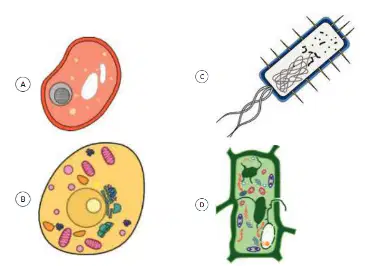
Identify which structures are present in animal cells and which structures are present in bacteria cells. Check the blank box next to a structure to mark it as present in each of the two cell types.
4
Question Explanation
Animal cells have no cell wall, just the membrane. Plant cells have a cell wall, and so do bacteria cells.
All cells have DNA.
Only eukaryotic cells have a nucleus.
All cells have ribosomes.
5
Dropdown
6
C is the correct answer because it shows the DNA floating around in the cytoplasm. It also depicts an absence of membrane bound organelles. You can also see the small dots representing ribosomes (an organelle without a membrane).
Question Explanation
7
Multiple Choice
Which pair of organelles works together to give structure and support in animal cells?
Cell Wall and Cytoplasm
Cytoskeleton and golgi complex
Cell membrane and cytoskeleton
Endoplasmic reticulum and cell membrane
8
Question Explanation
Remember that animal cells don’t have cell walls. Cell membrane is the boundary between the cell and the outside environment. Cytoskeleton is a network of proteins that hold the organelles in place.
9
Multiple Choice
A small, round structure that makes proteins for a cell.
Mitochondria
Chromosomes
Ribosomes
Lysosomes
10
Question Explanation
A small, round structure that makes proteins for a cell.
A. Mitochondria- powerhouse of the cell
B. Chromosomes- long DNA molecule
C. Ribosomes- produces proteins
D. Lysosomes- break down worn out cell parts
11
Multiple Choice
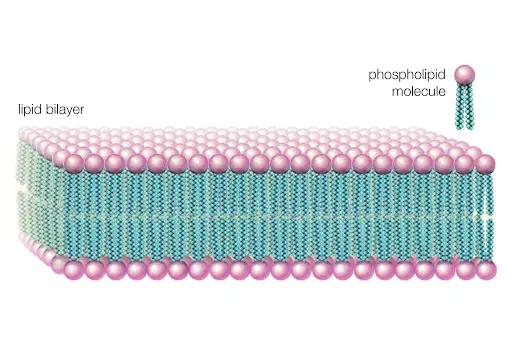
The phospholipid bilayer is part of what cell structure?
Cell Membrane
Wall
Ribosome
DNA
12
The phospholipid bilayer is part of what cell structure?
A. membrane- think back to all the coloring we did in class!
B. wall
C. DNA
D. ribosome
Question Explanation
13
Draw
Which of the following are functions of the cell membrane? Choose 3.
14
These functions are how the cell membrane helps our bodies maintain homeostasis, the stable/balanced internal conditions necessary for our survival!
Question Explanation
15
Draw
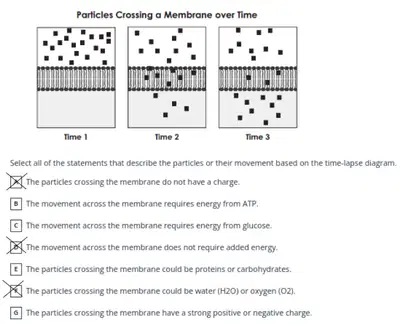
The diagram models the time-lapse movement of particles across a cell membrane. The particles have characteristics that allow them to pass freely across the membrane.
16
We know based on the phrasing of the question that these particles can pass through the membrane freely. This means that they are moving by passive transport. For passive transport, particles cannot have a charge. Charged particles are repelled by the membrane unless they have help getting across. Passive transport never requires any added energy. Passive transport only works with small particles. Protein and carbohydrates are large. Water is able to simply diffuse, and so are most gasses such as oxygen or carbon dioxide.
Question Explanation
17
Multiple Choice
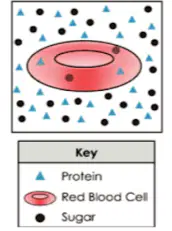
A red blood cell is placed into an aqueous solution. The red blood cell has a lower concentration of protein and sugar than the aqueous solution, as shown in the diagram. In the diagram, the volume of the cell is equal to the volume outside the cell.
What is most likely to occur?
Water from the solution will diffuse into the red blood cell.
Water from the red blood cell will diffuse into the solution.
Protein and sugar from the solution will diffuse into the red blood cell.
Protein and sugar from the red blood cell will diffuse into the solution.
18
Sugar is a solute, meaning it can dissolve in water. This cell is in an aqueous solution, which means a water based solution. Water is able to simply diffuse across the cell membrane in a process called osmosis, and it always moves in the direction of more solute.
Question Explanation
Therefore, water from the red blood cell will diffuse into the solution, where there is more sugar. Also, it is important to note that protein is not a solute. Proteins are also large. They cannot simply diffuse through the cell; they would need help getting in and out.
19
Multiple Choice
For normal nerve transmission in mammals, nerve cells maintain specific concentrations of potassium (K+) and sodium (Na+) ions. Concentrations of Na+ ions are normally higher outside the cell and lower inside the cell, while K+ Ions are normally lower outside the cell and higher Inside the cell. However, cell membranes are Impermeable to Na+ and K+ ions. The diagram shows the relative concentrations of ions In solution inside and outside the cell. Which process describes how a nerve cell maintains homeostasis In regards to the Na+ and K+ ion concentrations?
by converting the sodium ions present inside the cell into potassium ions
by blocking both types of ions from moving into or out of the cell membrane
by transporting both types of ions through protein pumps within the cell membrane
by producing more potassium ions inside the cell and eliminating sodium ions as waste
20
The sodium potassium pump is moving charged ions, which means it requires energy and is a form of active transport. The charged ions get through the cell membrane with the help of a protein pump (powered by ATP).
Question Explanation
21
Multiple Choice
The sodium potassium pump is a form of active transport. This means __________ is required.
Glucose
ATP
Water
Oxygen
22
ATP is the form of energy that cells can use.
Question Explanation
23
Multiple Choice
Molecules that are too large to be moved through the membrane can be transported into the cell by
Osmosis
Endocytosis
Exocytosis
Lipid Carriers
24
Endo= into
Exo= Exit
Osmosis is the
diffusion of water.
We never discussed lipid
carriers.
Question Explanation
25
Multiple Choice
The cell in beaker B would be
Hypertonic
Hypotonic
Isotonic
Neutral
26
There is more solute in the cell than there is in the solution. Water diffuses in the direction of MORE SOLUTE. When water moves into the cell, we consider the solution HYPOTONIC.
QUESTION EXPLANATION
27
Multiple Choice
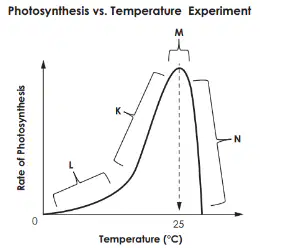
Students in a biology class conduct an experiment to determine the effect of temperature on the rate of photosynthesis in a plant. They place an Elodea plant into a tube filled with water. Then, the students place the test tube under a light and slowly increase the temperature of the water. They record their results and display them on a graph as shown.
The rate of oxygen production is lowest in section M.
The rate of oxygen production is greatest in section M.
The production of water molecules is greatest in section L.
The number of carbon dioxide molecules in the beaker is greatest in section K.
28
Section M is the height of the graph, showing us where the rate of photosynthesis is at its greatest point. Oxygen is a product of photosynthesis, so if there is more photosynthesis, there is more oxygen being produced.
Question Explanation
29
Multiple Choice
Which statement explains the effect of temperature on the rate of photosynthesis?
Oxygen molecules break down at temperatures above 25°C.
The rate of photosynthesis is unaffected by the temperature of the water.
The number of chloroplasts in the cell decreases as temperature increases.
Enzymes involved with plant photosynthesis are disrupted at temperatures above 25°C.
30
We see on the graph that temperature increases the rate of photosynthesis up to a certain point, and then we see a sharp decline. Oxygen molecules, referenced in option A, are irrelevant because they are not needed for photosynthesis. Rather, they are produced by photosynthesis. Option B is clearly wrong as temperature has an affect on photosynthesis.
Question Explanation
31
Multiple Choice
How is chemosynthesis different from photosynthesis?
Chemosynthesis does not require enzymes.
Chemosynthesis can occur in environments without sunlight.
Chemosynthesis does not require reactants from outside the cell.
Chemosynthesis produces sugars that organisms use as an energy source.
32
Chemosynthesis is how autotrophs (organisms that make their own food) produce glucose. The organisms that do this live way down deep in the ocean, in hydrothermal vents, that have no access to sunlight.
Question Explanation
33
Multiple Choice
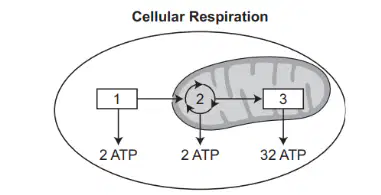
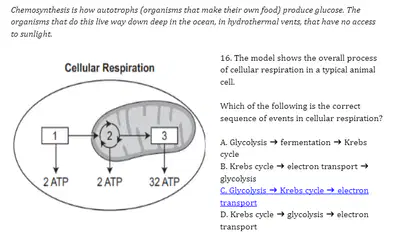
The model shows the overall process of cellular respiration in a typical animal cell.
Glycolysis ➜ fermentation ➜ Krebs cycle
Krebs cycle ➜ electron transport ➜ glycolysis
Glycolysis ➜ Krebs cycle ➜ electron transport
Krebs cycle ➜ glycolysis ➜ electron transport
34
Glycolysis occurs in the cytosol, breaking down glucose, but the Krebs cycle and electron transport chain occur inside the mitochondria. Electron carriers such as NADH produced during glycolysis and the Krebs cycle pass their electrons to the electron transport chain, which results in synthesis of a lot of ATP.
Question Explanation
35
Multiple Choice
Which of the following is true of cellular respiration?
It occurs in all cells
It occurs only in animal cells
It occurs in plant cells
It occurs in the chloroplasts
36
All cells need to convert food energy (glucose) into an energy form that cells can use (ATP). This is done through the process of photosynthesis.
Question Explanation
37
Multiple Choice
Which organelle converts the chemical energy stored in food into compounds that are more convenient for the cell to use?
chloroplast
Golgi body
endoplasmic reticulum
mitochondria
38
The mitochondria is the “powerhouse” of the cell and the organelle that you should associate with the process of cellular respiration.
Question Explanation
39
Multiple Choice
A student is collecting the gas given off from a plant in bright sunlight at a temperature of 27°C the gas being collected is most likely
Oxygen
Carbon Dioxide
ATP
Vaporized Water
40
Oxygen is the gas that is the product of photosynthesis.
Question Explanation
41
Multiple Choice
Because most nerve cells do not typically undergo mitosis, they are generally not capable of which of the following?
Producing enzymes
Generating more nerve cells
Performing cellular respiration
Transporting molecules against the concentration gradient
42
Mitosis is the division of body cells. It’s how you get more body cells. Nerve cells are body cells. If they aren’t mitosis, they can’t generate any more nerve cells through cell division.
Question Explanation
43
Multiple Choice
One difference between a cancer cell and a normal cell is that
Cancer cells divide uncontrollably
Cancer cells cannot make copies of DNA
Normal cells divide uncontrollably
Normal cells cannot make copies of DNA
44
The definition of cancer is a mass of cells that are dividing uncontrollably. Normal cells have regulatory mechanisms that determine when and how much they divide.
Question Explanation
45
Multiple Choice
During meiosis, homologous chromosomes exchange genetic material. This exchange of genetic material —
increases the genetic variation of the gametes that are formed
reduces the diploid number of chromosomes to the haploid number
leads to the production of gametes that are genetically identical
reduces the probability of mutations
46
One of the unique features of meiosis is that crossing over occurs, exchanging genetic material between homologous chromosomes (chromosomes containing the same type of genes from mom and from dad). This explains why even though you may have siblings with the same parents, your sibling doesn’t have the exact same DNA as you.
Question Explanation
47
Multiple Choice
The first three phases of the cell cycle (G1, S, G2) are collectively known as
mitosis
cell respiration
interphase
meiosis
48
A cell spends most of its time in what is called interphase, and during this time it grows, replicates its chromosomes, and prepares for cell division.
Question Explanation
49
Multiple Choice
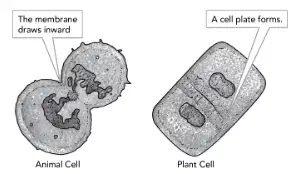
The diagram models a process as it occurs in an animal cell and a plant cell. What has occurred in both cells immediately before this process?
A cell nucleus has divided by mitosis.
Two cells have migrated to join together.
A cell has grown larger, without mitosis occurring.
The cytoplasm has gradually solidified.
50
This animal cell and plant cell are about to finish cytokinesis and divide into two. They already have two nuclei.
Question Explanation
51
Open Ended
What are 3 differences between prokaryotic and eukaryotic cells?
52
When your skin makes new cells, are the cells replaced by mitosis or meiosis?
Question Explanation
Mitosis is the division of body cells. When skin makes new cells, the cells are replaced by mitosis.
53
Open Ended
What are 3 things a plant cell has that an animal cell does not? What does each of those organelles do for the cell?
54
What are 3 things a plant cell has that an animal cell does not? What does each of those organelles do for the cell?
Question Explanation
1. Large Vacuole- store more food and water
2. Cell Wall- additional protection, rigidity
3. Chloroplasts- photosynthesis (make food)
55
Open Ended
What do ALL cells have in common?
56
What do ALL cells have in common?
Question Explanation
1. Cell membrane
2. DNA
3. Ribosomes
4. Cytoplasm
5. Cellular respiration
6. They come from other cells
57
Open Ended
How does the cell membrane help cells maintain homeostasis?
58
How does the cell membrane help cells maintain homeostasis?
Question Explanation
Homeostasis includes anything that the body does to help maintain internal stability/balance. The cell membrane helps maintain homeostasis because it regulates what goes in and out of the cell. There are things cells need to keep out and things cells need to bring in.
59
Draw
What is the equation for photosynthesis? Circle the REACTANTS put a square around the PRODUCTS.
60
What is the equation for photosynthesis? Circle the REACTANTS put a square around the PRODUCTS.
61
Draw
What is the equation for cellular respiration? Circle the REACTANTS put a square around the PRODUCTS.
62
What is the equation for cellular respiration? Circle the REACTANTS put a square around the PRODUCTS.
63
Labelling
On the diagram below, determine where the words glucose, CO2, H2O, and O2 should be written.
64
On the diagram below, determine where the words glucose, CO2, H2O, and O2 should be written.
65
Open Ended
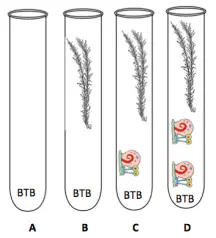
Carbon and oxygen cycle through the ecosystem via photosynthesis and cell respiration. In an experiment to observe this phenomenon, a student set up 4 test tubes with oxygenated water. Elodea and snails were added as shown. An indicator known as bromothymol blue (BTB), which is non-toxic, was added to determine levels of carbon dioxide. Which test tube would have the most carbon dioxide? Why? Which test tube would have the most oxygen? Why? Which test tube would have equal amounts of carbon dioxide and oxygen?
66
Carbon and oxygen cycle through the ecosystem via photosynthesis and cell respiration. In an experiment to observe this phenomenon, a student set up 4 test tubes with oxygenated water. Elodea and snails were added as shown. An indicator known as bromothymol blue (BTB), which is non-toxic, was added to determine levels of carbon dioxide. Which test tube would have the most carbon dioxide? Why? Which test tube would have the most oxygen? Why? Which test tube would have equal amounts of carbon dioxide and oxygen?
Question Explanation
D= most carbon dioxide (more snails, which exhale carbon
dioxide)
C= equal amounts (roughly, because of what we know about
the gas exchange that would be occurring)
B= most oxygen (the elodea plant would be doing
photosynthesis, taking in carbon dioxide and releasing
oxygen)
A= control tube (showing us the baseline)
67
Open Ended
When your skin makes new cells, are the cells replaced by mitosis or meiosis?
68
When your skin makes new cells, are the cells replaced by mitosis or meiosis?
Question Explanation
Mitosis is the division of body cells. When skin makes new cells, the cells are replaced by mitosis.
69
Open Ended
If you started with 50 parental cells and each went through mitosis, how many
daughter cells would be produced? How many gametes would be produced if
the 50 parental cells went through meiosis?
70
Question Explanation
If you started with 50 parental cells and each went through mitosis, how many daughter cells would be produced? How many gametes would be produced if the 50 parental cells went through meiosis?
Starting with mitosis, 50 parental cells would produce 100 daughter cells. For each parental cell that divides during mitosis, two daughter cells are created.
50 parental cells going through meiosis would produce 200 daughter cells. Each parental cell during meiosis actually divides twice, creating four daughter cells.
71
Open Ended
Explain how stem cells are like blank slates.
72
Explain how stem cells are like blank slates.
Question Explanation
Stem cells are like blank slates because they can become specialized cells by turning on/off portions of DNA.
73
Fill in the Blanks
Type answer...
74
1. According to cell theory, all cells come from previously existing CELLS.
75
Fill in the Blanks
Type answer...
76
2. Depending on whether they have a NUCLEUS, organisms are classified as either eukaryotes or prokaryotes.
77
Fill in the Blanks
Type answer...
78
3.Cells that need to make a lot of protein are expected to have a large number of RIBOSOMES.
79
Fill in the Blanks
Type answer...
80
4. Molecules tend to move from an area where they are more concentrated to an area where they are less concentrated. This process is called DIFFUSION.
81
Fill in the Blanks
Type answer...
82
Large molecules, such as glucose, that cannot cross the membrane can still move across the membrane through a type of passive transport called FACILITATED DIFFUSION.
83
Fill in the Blanks
Type answer...
84
Some materials can move across the cell membrane against a concentration gradient by ACTIVE TRANSPORT.
85
Fill in the Blanks
Type answer...
86
A cell’s relatively constant internal physical and chemical conditions are called HOMEOSTASIS.
A scientist isolates a number of non-photosynthetic prokaryotes.
Which structure would be found in these cells?
Cell Walls
Chloroplasts
Gogli Body
Nucleus
Show answer
Auto Play
Slide 1 / 86
MULTIPLE CHOICE

Similar Resources on Wayground
83 questions
fluids
Presentation
•
9th - 12th Grade
79 questions
Les nombres 61-100
Presentation
•
9th - 12th Grade
79 questions
Introduction to Ecology
Presentation
•
10th - 12th Grade
78 questions
N5 3.5 Food Production
Presentation
•
10th - 12th Grade
79 questions
Chapter 1B Review Assignment Week 26 2/25 & 2/26
Presentation
•
9th - 12th Grade
80 questions
Nature of Gases, Kinetic Molecular Theory and Gas Laws
Presentation
•
9th - 12th Grade
82 questions
Masque Vocabulary
Presentation
•
9th - 12th Grade
80 questions
PERT Math Review: Developmental Math
Presentation
•
9th - 12th Grade
Popular Resources on Wayground
20 questions
Math Review
Quiz
•
3rd Grade
15 questions
Fast food
Quiz
•
7th Grade
20 questions
Context Clues
Quiz
•
6th Grade
20 questions
Inferences
Quiz
•
4th Grade
19 questions
Classifying Quadrilaterals
Quiz
•
3rd Grade
20 questions
Figurative Language Review
Quiz
•
6th Grade
20 questions
Equivalent Fractions
Quiz
•
3rd Grade
10 questions
Identify Fractions, Mixed Numbers & Improper Fractions
Quiz
•
3rd - 4th Grade
Discover more resources for Biology
15 questions
Biology EOC Review P2
Quiz
•
10th Grade
20 questions
Biology EOC Review 1
Quiz
•
10th Grade
33 questions
Sustainability Unit Review
Quiz
•
9th Grade
36 questions
Biology Regents Review
Quiz
•
9th - 10th Grade
50 questions
NC EOC Biology Review part 1
Quiz
•
9th - 12th Grade
144 questions
Bio 2nd Semester Final Review
Quiz
•
9th Grade
60 questions
Biology Regents Review
Quiz
•
9th Grade
40 questions
Biology EOC Review
Quiz
•
11th Grade