

Geotime

Presentation
•
Science
•
10th Grade
•
Practice Problem
•
Hard
Standards-aligned

Jordy Struck
Used 7+ times
FREE Resource
17 Slides • 5 Questions
1


Use Figure 12-2 to determine the age of a
rock sample that contains a parent isotope
with a half-life of 100 million years and
contains 1/4 of the parent isotope.
A sample is brought to the laboratory and it is
determined that 1/16 of the original parent
isotope remains in the sample. Use Figure
12-2 to determine the age of the sample if the
half-life of the material is 60 million years.
Practice Problem #1
Practice Problem #2
2

Geologic Time Must knows:
• Radiocarbon dating can be used up to 75000 years
• Phanerozoic means “visible life”.
• Paleozoic mean “ancient life”.
• After the Precambrian was the Paleozoic
• In the Paleozoic life was mainly from the seas
• Pangaea was formed by the end of the Paleozoic
• Pangaea broke up during the Mesozoic
• Dinosaurs dominated the Mesozoic Era
• Deovnian was the “age of Fish”.
• First fossils appeared 540 MYA
• Meteorite caused the death of dinosaurs and many plants.
3

Get out a piece of paper and tell me as much as possible about the practice problems
you see today.
Put phones up, headphones out and be ready!
Things to look for / talk about:
• Put in order from oldest to youngest (we have already done most of these).
• Are there any intrusions?
• Are there any inclusions?
• What laws / principles are you using to put the layers in the correct order?
• Are there any conformities?
• Are there any fault lines?
4


#1
“D” is intruding into layer “A”
What did mother earth
do at this point?
What could be said about
this conformity?
5

Example:
•Put in order from oldest to youngest (we have already done most of these).
•C,B,E,A & D
•Are there any intrusions?
•Yes, D is an intrusion and more than likely it is an igneous intrusion
•Are there any inclusions?
•No
•What laws / principles are you using to put the layers in the correct order?
•Law of Superposition for all except D (Principle of Cross-cutting)
•Are there any conformities?
•Yes, B is a conformity (Mother Earth hit pause on building rock layers and erosion took over)
•Yes, C is an angular conformity (Something caused the layers to be tilted at an angle)
•Are there any fault lines?
•None that I can see!
6


#2
7
Fill in the Blanks
Write the correct order from oldest to youngest.
(Write it like this: A,B,C,etc)
Type answer...
8


#3
9
Fill in the Blanks
Write the correct order from oldest to youngest.
(Write it like this: A,B,C,etc)
Type answer...
10


#4
11
Fill in the Blanks
Write the correct order from oldest to youngest.
(Write it like this: A,B,C,etc)
Type answer...
12


#5
13
Fill in the Blanks
Write the correct order from oldest to youngest.
(Write it like this: A,B,C,etc...REMEMBER F1 & F2)
Type answer...
14


#6
15
Fill in the Blanks
Write the correct order from oldest to youngest.
(Write it like this: A,B,C,etc)
Type answer...
16
17


18

19


#7
20

Write a few paragraphs about the last slide:
• Put in order from oldest to youngest (we have already done most of these).
• Are there any intrusions?
• Are there any inclusions?
• What laws / principles are you using to put the layers in the correct order?
• Are there any conformities?
• Are there any fault lines?
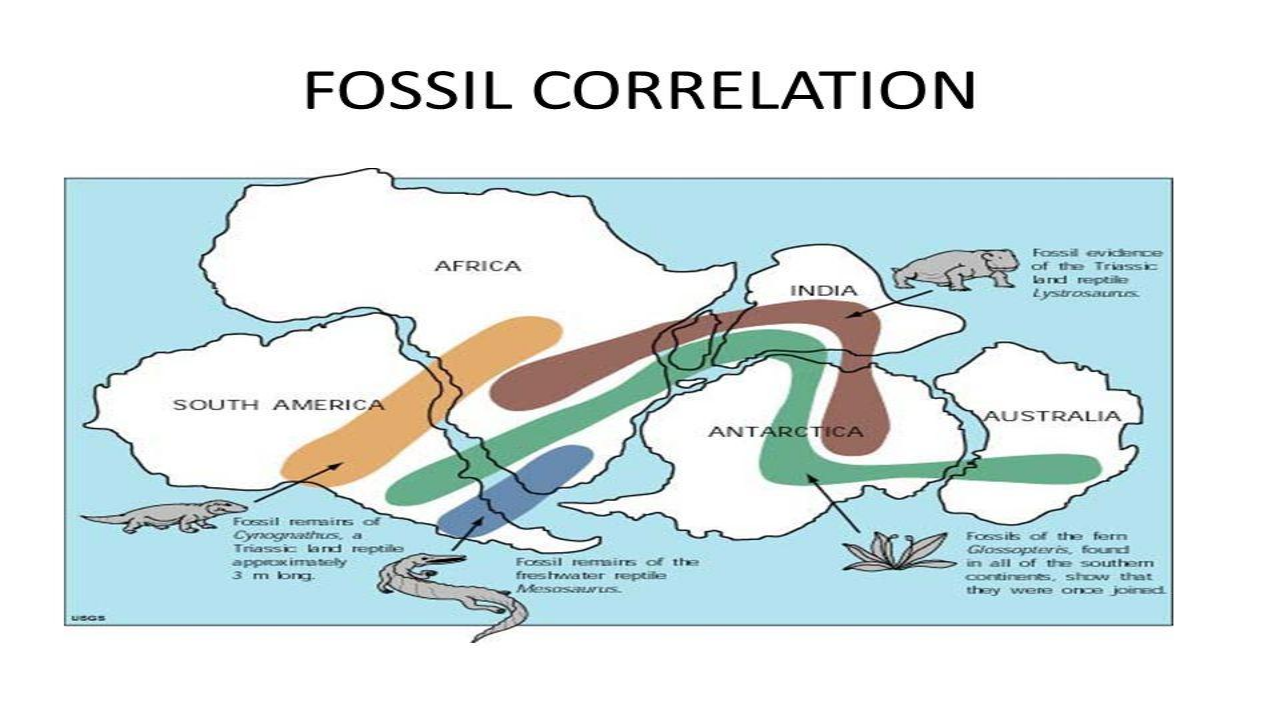
• Is there correlation?
• What time periods did they contain?
• Are there any intrusions not labeled in the graph?
• Any type of weathering or erosion being shown in the graph?
21


22

SES4. Obtain, evaluate, and communicate information to understand how rock relationships and
fossils are used to reconstruct the Earth’s past.
b. Construct an argument applying principles of relative age (superposition, original horizontality,
cross-cutting relations, and original lateral continuity) to interpret a geologic cross-section and
describe how unconformities form.
d. Construct an explanation applying the principle of uniformitarianism to show the relationship
between sedimentary rocks and their fossils to the environments in which they were formed.
e. Construct an argument using spatial representations of Earth data that interprets major
transitions in Earth’s history from the fossil and rock record of geologically defined areas.
(Clarification statement: Students should use maps and cross-sections with a focus on Georgia.)
Use Figure 12-2 to determine the age of a
rock sample that contains a parent isotope
with a half-life of 100 million years and
contains 1/4 of the parent isotope.
A sample is brought to the laboratory and it is
determined that 1/16 of the original parent
isotope remains in the sample. Use Figure
12-2 to determine the age of the sample if the
half-life of the material is 60 million years.
Practice Problem #1
Practice Problem #2
Show answer
Auto Play
Slide 1 / 22
SLIDE
Similar Resources on Wayground

17 questions
Polar vs Nonpolar
Presentation
•
10th Grade
19 questions
Dihybrid Cross Lesson
Presentation
•
9th - 10th Grade
17 questions
Renewable & Non-Renewable Resources
Presentation
•
9th Grade
16 questions
Ecological Stability: Cause and Effect
Presentation
•
9th Grade
16 questions
9th Grade Biology
Presentation
•
9th Grade
17 questions
Fiber Friday
Presentation
•
10th Grade
17 questions
Aqueous Solution
Presentation
•
10th Grade
17 questions
Electricity
Presentation
•
10th Grade
Popular Resources on Wayground
10 questions
Safety Day 2026 – Student Review

Quiz
•
9th Grade
21 questions
Continents and Oceans
Quiz
•
6th Grade
20 questions
Parts of Speech
Quiz
•
5th Grade
16 questions
Subject & Predicate
Quiz
•
5th Grade
25 questions
Multiplication Facts
Quiz
•
5th Grade
12 questions
Map Skills
Quiz
•
3rd Grade
22 questions
Continents and Oceans
Quiz
•
5th Grade
15 questions
Rounding Decimals
Quiz
•
5th Grade
Discover more resources for Science
10 questions
Exploring Chemical and Physical Changes

Interactive video
•
6th - 10th Grade
10 questions
Exploring the Electromagnetic Spectrum for Middle School Science
Interactive video
•
6th - 10th Grade
10 questions
Exploring Force and Motion Concepts
Interactive video
•
6th - 10th Grade
10 questions
Exploring Air Masses and Weather Fronts
Interactive video
•
6th - 10th Grade
10 questions
Exploring the States of Matter
Interactive video
•
6th - 10th Grade
10 questions
Exploring Forces: Net Force, Normal Force, Gravity, and Friction
Interactive video
•
6th - 10th Grade
10 questions
Differentiating Thermal Energy and Temperature
Interactive video
•
6th - 10th Grade
10 questions
Exploring the States of Matter and Thermal Energy
Interactive video
•
6th - 10th Grade