forces and motion
Presentation
•
Science
•
8th Grade
•
Practice Problem
•
Medium
+2
Standards-aligned

Alex Davila
Used 5+ times
FREE Resource
11 Slides • 24 Questions
1
SWBAT: UNDERSTAND CONCEPTS OF FORCE AND REMEMBER FOR EXAM
2
Kinetic energy is the energy of motion.
There is more kinetic at the lowest point.
Kinetic Energy
Potential energy is energy that is stored.
There is more potential at the highest point.
Potential Energy
3
Multiple Choice
Potential or kinetic? An electrical current flows in order to provide power to a lamp.
Potential
Kinetic
4
Multiple Choice
Potential or kinetic? A book sitting on a shelf
Potential
Kinetic
5
Hotspot
Where would you find the highest potential energy?
6
Unbalanced forces are UNEQUAL forces that:
cause movement
cause an object to change speed or direction
Unbalanced Forces
Balanced forces are EQUAL forces that either:
do not cause movement
cause an object to keep moving at the same speed and in the same direction
Balanced Forces
7
Balanced force
Unbalanced force
Are there forces acting upon it?
8
Multiple Choice
Balanced or unbalanced? Sliding a box.
Balanced
Unbalanced
9
Multiple Choice
Balanced or unbalanced? the picture on the wall
balanced
unbalanced
10
To calculate speed:
Speed= Distance/Time
D
______________
S T
11
Multiple Choice
A man was training for a marathon. One afternoon he jogged 18 miles in 3 hours. Find the speed by calculating distance divided by time.
20 mph
15 mph
54 mph
6 mph
12
Multiple Choice
Energy of motion.
Mechanical
Electrical
Kinetic
13
Imagine two siblings pushing on each side of a door
One person is trying to open it, and the other to keep it closed
But the big sibling, being in high school, is stronger than the other
The older kid pushes closed with a force of 60N, while the younger kid pushes open with a force of 40N
Because the forces are going in opposite directions, they cancel-ish.
Opposite forces subtract: 60N-40N= 20 N
The door was pushed closed with a net force of 20 N.
14
Multiple Choice
60N, Left
40N, Right
0N
60N, Right
15
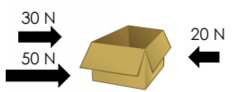
Multiple Choice
20 N
0 N
400 N
40 N
16
Inertia is the tendency of objects to resist acceleration (acceleration is a change in motion, as in speeding up or slowing down).
The amount of inertia an object has depends on its mass.
Just like with gravity, more mass means more inertia.
Because of inertia, objects at rest (not moving) tend to remain not moving, and objects that are moving tend to keep moving, unless acted on by a force.
On earth there is usually forces acting against motion (friction)
17
Multiple Choice
18
Multiple Choice
rest
a constant speed
school
inertia
19
Multiple Choice
speed
mass
temperature
friction
20
Multiple Choice
inertia
kinetic energy
vector
net force
21
Newtons 2nd Law
F=MxA
Force - 10N
Mass -5kg
A?
F
M A
22
Multiple Choice
Which object would require the most amount of energy, or force, to set it into motion?
a small plant
a refrigerator
a school bus
a bowling ball
23
Multiple Choice
What is the name of the unit you use to measure force?
neutron
newton
nucleus
norton
24
Multiple Choice
What is an example of friction?
slipping on a patch of ice
dropping a book on the floor
working on a computer
wind blowing against you as you walk
25
Multiple Choice
How is velocity different from speed?
Velocity is when an object goes in reverse.
Velocity is the direction an object moves in, and it has nothing to do with speed.
Velocity is speed and direction together.
Velocity is not at all different from speed
26
Multiple Choice
What does friction do to a moving object?
makes it rise
slows it down
speeds it up
all the above
27
The weight of an object will change how much force is needed for it to move or accelerate.
Example:
If you push against a feather and a rock with the same force, the feather will go a farther distance since it is lighter. The rock would need more force to go the same distance.
28
29
Multiple Choice
What object would need more force to accelerate?
A bowling ball
A golf ball
A bouncy ball
A baseball
30
Every action has an equal and opposite reaction.
Example:
When a person pushes against a wall, the wall will push back with an equal force in the opposite direction
31
Multiple Choice
As a car's tires push against the road, what pushes back on the car's tires?
The driver
The road
Gravity
32
Multiple Choice
Newton's 1st Law
Newton's 2nd Law
Newton's 3rd Law
33
Multiple Choice
more
less
34
Multiple Choice
What is Newton's 2nd Law?
Every action has an equal and opposite reaction
An object at rest stays at rest, an object in motion stays in motion.
F = ma
Friction
35
Multiple Choice
F=ma
Every action has an equal and opposite reaction
An object at rest stays at rest, an object in motion stays in motion.
Friction
SWBAT: UNDERSTAND CONCEPTS OF FORCE AND REMEMBER FOR EXAM
Show answer
Auto Play
Slide 1 / 35
SLIDE

Similar Resources on Wayground
28 questions
Wave Interactions
Presentation
•
8th - 9th Grade
25 questions
Water Quality EOG Review
Presentation
•
8th Grade
26 questions
Sexual Reproduction in Plants
Presentation
•
7th - 8th Grade
30 questions
Nature of Science Review
Presentation
•
8th Grade
28 questions
Rock Cycle
Presentation
•
8th Grade
27 questions
Moon Phases
Presentation
•
8th Grade
26 questions
8th Grade 1-7: Using Graphs in Science
Presentation
•
8th Grade
31 questions
Forces: Inertia and Gravity
Presentation
•
8th Grade
Popular Resources on Wayground
10 questions
How much do you know about our Portrait of an Eagle?
Quiz
•
10th Grade
10 questions
Fast Food Slogans
Quiz
•
6th - 8th Grade
21 questions
Continents and Oceans
Quiz
•
6th Grade
20 questions
Parts of Speech
Quiz
•
5th Grade
16 questions
Subject & Predicate
Quiz
•
5th Grade
25 questions
Multiplication Facts
Quiz
•
5th Grade
12 questions
Map Skills
Quiz
•
3rd Grade
22 questions
Continents and Oceans
Quiz
•
5th Grade
Discover more resources for Science
20 questions
Scientific Method and Variables
Quiz
•
8th Grade
20 questions
Scientific method and variables
Quiz
•
8th Grade
27 questions
Counting Atoms - Subscripts
Quiz
•
8th Grade
20 questions
Claim, Evidence and Reasoning (CER)
Quiz
•
6th - 8th Grade
18 questions
Counting Atoms
Quiz
•
7th - 8th Grade
20 questions
Elements, Compounds and Mixtures
Quiz
•
8th Grade
10 questions
Exploring Chemical and Physical Changes
Interactive video
•
6th - 10th Grade
10 questions
Decoding the Periodic Table of Elements
Interactive video
•
6th - 10th Grade