

Polarity of Molecules

Presentation
•
Science
•
11th Grade
•
Practice Problem
•
Hard

TERESITA MORENO
Used 1+ times
FREE Resource
31 Slides • 0 Questions
1

Mrs. Teresita B. Moreno
Physical Science
Polarity of
Molecules
Week 2_Q3
2

3

MELC
•Determine if a
molecule is polar or
non - polar
4

Objectives
1. differentiate polar and nonpolar
bonds;
2. determine the polarity of chemical
bonds between atoms using the
concept of electronegativity;
3. familiarize with the different shapes
of molecules;
4. explain how polarity of bonds and
molecular geometry affects the
polarity of molecules
5

6

7


8

9

Tell whether the compound is an ionic (IC) or
covalent (CC ) based on the type of chemical bond
present
______1. NaCl
______2. CO2
______3. CaCl2
______4. CCl4
______5. Fe2O3
______6. N2O
______7. PCl5
______8. KBr
______9. HCl
______10. AlCl3
IC
CC
IC
CC
IC
CC
CC
IC
CC
IC
10

Activity 1: Polarity Experiment
Materials:
Water
Vinegar
Oil
Alcohol
6 disposable glasses
spoon
Procedure:
1.
Obtain 6 clean disposable glasses
and prepare the following set-up.
Set-up 1: 1 cup water + 5 tablespoons vinegar
Set-up 2: 1 cup water + 5 tablespoons oil
Set-up 3: 1 cup water + 5 tablespoons alcohol
Set-up 4: 1 cup vinegar + 5 tablespoons oil
Set-up 5: 1 cup vinegar + 5 tablespoons
alcohol
Set-up 6: 5 tablespoon oil + 5 tablespoons
alcohol
11

2. Thoroughly stir each mixture and observe carefully.
Note: •Do not forget to wash and dry the spoon after each
use.
• Properly label each set-up.
• Samples with oil should first be mixed with dishwashing
liquid before disposing down the sink
Guide Question:
a. Which of the following set-up mixed well? Which did
not?
b. What can you infer from the result of this activity?
12

• Electronegativity
(EN) measures the
relative tendency
of an atom to
attract electrons
to itself when
chemically
combined with
other atom.
https://images.app.goo.gl/MGHPuB98MGraQLsG6
13

Table 1. Type of bond based on electronegativity
difference (∆EN) of bonded atoms
Type of Bond
Electronegativity
Difference (∆EN)
Ionic
≥1.7
Polar Covalent
0.5 to 1.6
Nonpolar covalent
≤ 0.4
14

• Calculate the electronegativity difference and give the type of bond
that exists between the atoms in each of the following pairs.
Molecule
EN of the
first atom
EN of the
second
atom
∆ EN
Type of
Bond
1. CaF2
1.0
4.0
3
ionic
2. Mg Br2
1.2
2.8
1.6
polar
covalent
3. CH4
2.5
2.1
0.4
non polar
4. H2
2.1
2.1
0
non polar
5. NO3
3.0
3.5
0.5
polar
15

For example, you are asked to predict what type of bond is
present between the following pairs of atoms by determining
their electronegativity difference
1. Ca and Cl
2. Cl and Cl
3. H and Cl
4. S and O
5. C and N
16


For example, you are asked to predict what type of bond is
present between the following pairs of atoms by determining
their electronegativity difference
1. Ca and Cl
Solution
ENCa = 1.0
ENCl = 3. O
(∆EN) = 1.0 -3.0 = l-2.0 l =2.0
* Ionic bond*
17


For example, you are asked to predict what type of bond is
present between the following pairs of atoms by determining
their electronegativity difference
2. Cl and Cl
Solution
ENCl = 3.0
ENCl = 3. O
(∆EN) = 3.0 -3.0 = 0
* Nonpolar covalent bond*
18


For example, you are asked to predict what type of bond is
present between the following pairs of atoms by determining
their electronegativity difference
3. H and Cl
Solution
ENH = 2.1
ENCl = 3. O
(∆EN) = 2.1 -3.0 = l-0.9 l =0.9
* Polar covalent bond*
19


For example, you are asked to predict what type of bond is
present between the following pairs of atoms by determining
their electronegativity difference
4. S and O
Solution
ENS = 2.5
ENO = 3. 5
(∆EN) = 2.5 -3.5 = l-1.0 l =1.0
* Polar covalent bond*
20


For example, you are asked to predict what type of bond is
present between the following pairs of atoms by determining
their electronegativity difference
5. C and N
Solution
ENC = 2.5
ENN = 3. 0
(∆EN) = 2.5 -3.0 = l-0.5 l =0.5
* Polar covalent bond*
21


• A polar covalent
bond is formed when
electrons are shared
unequally by two
atoms in a
compound.
• The bonded pair of
atoms form an
electric dipole
(represented by ).
https://images.app.goo.gl/MeK1MLb8pYqZRwb48
22


https://images.app.goo.gl/swFedU7Sm1kUTT4Q8
• A nonpolar covalent bond
develops if both atoms
equally share a pair of
electrons between them.
• occurs when the bonding
atoms have
approximately equal EN
value or equal
ability to attract electrons
to each side
23

B. Polarity of Molecules and Geometry
You can predict the shape or molecular geometry of a substance using the
following steps:
Step 1: Determine the central atom of a molecule. The central atom is the least
electronegative element.
Step 2: Draw the appropriate Lewis dot structure for the molecule.
Step 3: Count the number of bonding pairs of electrons and non-bonding (or
lone pairs) around the central atom.
Step 4: Determine the electron pair orientation using the total number of
electron pairs.
Step 5: Identify the shape of the molecule of based on the location of the atoms.
24


Different Molecular Shape
https://images.app.goo.gl/8Nnjqw8CwFtR3H6h9
25

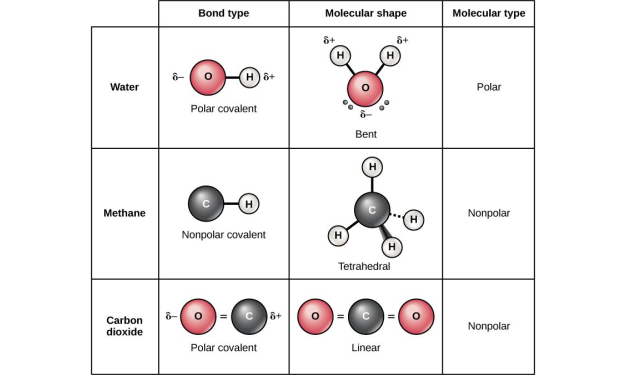
https://images.app.goo.gl/mBMVbfNkDsZwrTQ46
Example:
26


Example 1:
Predict the molecular geometry of BCl3
• Step 1: ENB = 2.0 ENCl= 3.0
•
Step 3: The central atom has three electron pairs: 3 bonded pairs and no
lone pair
• Step 4: The electron pair orientation for three electrons is trigonal planar.
• 5: The molecular shape of BCl3 is trigonal planar.
27


Example 2:
Predict the molecular geometry of CO2
• Step 1: ENC= 2.5ENO= 3.0
•
Step 3: For the purpose of determining the position of the bonding pairs, let us
count the double bonds as one bonding pair. Therefore, CO2 has two bonding
pairs of electron.
• 4: The electron pair orientation for two electron pairs is linear.
• Step 5: The molecular shape of CO2 is linear
28


Example 3:
Predict the molecular geometry of CHCl3.
• Step 1: ENC = 2.5, ENH= 2.1 and ENCl= 3.0. Because carbon is less electronegative
than chlorine and hydrogen is normally terminal atom, C must be the central
atom.
• Step 2:
•
Step 3: There are four bonding electron pairs.
• Step 4: The electron pair orientation for four electron pairs is tetrahedral.
• Step 5: The molecular shape of CHCl3 is linear.
29

30

31

Molecular
Shape
Mrs. Teresita B. Moreno
Physical Science
Polarity of
Molecules
Week 2_Q3
Show answer
Auto Play
Slide 1 / 31
SLIDE
Similar Resources on Wayground

23 questions
Waves Review
Presentation
•
11th Grade
25 questions
Physical and Chemical Changes Review
Presentation
•
8th Grade
22 questions
Free Body Diagrams
Presentation
•
11th Grade
24 questions
Government Response to the Great Depression
Presentation
•
11th Grade
23 questions
Water Resources
Presentation
•
10th - 12th Grade
24 questions
Spanish present perfect tense
Presentation
•
11th Grade
25 questions
Parallelism
Presentation
•
11th Grade
26 questions
Unit 4: Appendicular Skeleton, Part 1
Presentation
•
11th - 12th Grade
Popular Resources on Wayground
10 questions
Impact of 9/11 and the War on Terror

Interactive video
•
10th - 12th Grade
21 questions
Continents and Oceans

Quiz
•
6th Grade
5 questions
9/11
Interactive video
•
9th Grade
20 questions
Parts of Speech
Quiz
•
5th Grade
16 questions
Subject & Predicate
Quiz
•
5th Grade
10 questions
Riddles Riddles fun Riddles
Quiz
•
6th - 12th Grade
21 questions
Lab Safety
Quiz
•
10th Grade
6 questions
PRIDE in the Hallways and Bathrooms
Presentation
•
12th Grade
Discover more resources for Science
26 questions
Introduction to Anatomy and Physiology
Quiz
•
11th Grade
20 questions
Reading Graphs in Science
Quiz
•
9th - 12th Grade
30 questions
Identifying Artificially Generated Images
Quiz
•
9th - 12th Grade
12 questions
Cell Membrane
Presentation
•
9th - 12th Grade
38 questions
Water Cycle and Groundwater
Quiz
•
9th - 12th Grade
6 questions
Solar System Basics 1
Interactive video
•
9th - 12th Grade
5 questions
Ch 14 - Ecology
Quiz
•
9th - 12th Grade
16 questions
Understand Water's Essential Characteristics
Quiz
•
9th - 12th Grade