

Biomolecules Part 2

Presentation
•
Science
•
9th Grade
•
Practice Problem
•
Easy

Michelle Baldevarona
Used 3+ times
FREE Resource
43 Slides • 13 Questions
1

Biomolecules
LC: Recognize the major categories of biomolecules such as
carbohydrates, lipids, proteins, and nucleic acids
References:
Exploring Life Through Science
Breaking Through Science
Science for the 21st Century Learner
2

YELLOW HIGHLIGHTER: DEFINE PROTEINS,
CARBOHYDRATES, LIPIDS, NUCLEIC ACIDS AND OTHER
TERMS RELATED TO BIOMOLECULES
ORANGE HIGLIGHTER: What is the general
formula for the group?
PINK HIGHLIGHTER: for the primary roles of
these molecules in living organisms
The blue highlighter: monomers and
polymers of the group
•The green highlighter is used for: names of some
specific examples of the group of molecules and
where they would be found.
TERMS
FORMULA
ROLES
MONOMERS/POLYMERS
EXAMPLES
COLOR-CODING STRATEGY
3

1. I can compare the structures and functions
of carbohydrates, lipids, proteins and
nucleic acid.
2. I can explain how small building blocks can
be used to make a great variety of
molecules that are needed to perform life’s
functions.
3. I can identify common forms of
biomolecules and their functions.
4. I can show appreciations for the
applications of biomolecules to the society
and take actions on how to conserve
world’s resources.
Where are you now in these learning targets?
4


Hi! You can use this kind of
strategy if you’re doing some
note-taking. This helps you
remember terms.
5


Families of Biomolecules
• Carbohydrates
•Lipids
•Proteins
•Nucleic Acids
6

Helpful Mnemonics for you! This represents the
elements mostly found in each biomolecule family.
7


Food such as milk, meat, fish,
and beans are composed mainly
of proteins.
Proteins are one of the most
important groups of biomolecules
in living cells; they help build and
repair body parts.
The word protein came from the
Greek word proteis, meaning
"first place," which suggests the
importance of these molecules in
living systems.
8


Proteins are complex biomolecules that contain amino acids linked through the peptide bonds,
They have molecular weight ranging from about 6,000 to over 1 are considered as the most
versatile biomolecules since they serve numerous essential functions in the biological processes.
In fact, they are the primary constituents of living organisms. In addition to carbon, hydrogen,
and oxygen, proteins also contain nitrogen (N). These additional components separate proteins
from carbohydrates. Among the foods rich in protein are animal meat, tuna, cheese, tofu, and
beans.
9

The
ROLE of
PROTEINS
10
Open Ended
What are the role of proteins in living organisms?
11


12


Proteins play a wide variety of functional roles as represented by the image
below:
13


Building Blocks of Proteins
Amino Acids
•
Amino acids (monomers) are
linked together to form proteins
(polymers)
–
Each unique sequence of
amino acids forms a different
protein
–
All living things (even viruses)
use the same 20 amino acids
•
20 different Amino Acids
–
Amino end (NH2)
–
Carboxyl end (COOH)
–
Hydrogen
–
R group – variable component
Generally, proteins are made up of monomers called amino acids.
14
Multiple Choice
What is the monomer of proteins?
polypeptides
amino acids
nucleotides
monosaccharides
15


Thousands of amino acids can be synthesized in the laboratory, but only 20
amino acids make up the proteins. Below is the structural formula of amino
acids. Nineteen amino acids have the following general formula, except for
proline.
The four components of an amino
acid:
1.
A central carbon atom with one
nitrogen
2.
One carboxyl group (-COOH)
3.
One amino group (-NH2)
4.
A functional group or side chain ( R )
The side chain, R, consists of
different atoms gives each 20 amino
acids its unique specific properties.
16
Multiple Choice
What is the name of the bond that joins two amino acids together?
Peptide bond
Nucleic bond
Glycosidic bond
Ester bond
17


Amino acids can be classified into essential
and nonessential. The 10 essential amino
acids are not produced by the body, and
include arginine, histidine, isoleucine,
leucine, lysine, methionine, phenylalanine,
threonine, tryptophan, and valine.
We have to eat certain protein-rich foods
to obtain these amino acids. The remaining
10 of the common amino acids are
nonessential and can be produced by the
body.
Because of the biological functions of
amino acids, they are important. in
nutrition and are commonly used in food
supplements and in food technology.
Glycine is the simplest amino acid. Its side chain consists only of a hydrogen atom.
Alanine the next simple amino acid, has a methyl group for its side chain.
18


The function of a protein is greatly affected by its
shape and how the amino acids were put together.
Proteins have four levels of structures, with each more
complex than the last.
What dictates their structure is simply the sequence of the
amino acids. According to complexity, protein structure can be
primary, secondary, tertiary, and quaternary. Figure
Image on the left shows the four different protein
structures. How does one differ from the other?
As you noticed, primary structure is the linear sequence of
amino acids that form a protein. Meanwhile, the secondary
structure is the spatial arrangement of the polypeptide chain
of a protein. It has two types: the alpha helix and the beta
pleated sheet. As you can see in the figure, in a helix, the
chain is coiled like a spring. The helix is held together by
hydrogen bonds between the loops of a coil. On the other
hand, in the pleated sheet, chains are held together by
hydrogen bonds between adjacent chains.
These structures of the protein secondary structures were
suggested by Linus Pauling and his colleagues in 1951.
Looking at the tertiary structure, it refers to the final
three-dimensional shape of a single polypeptide molecule
where the alpha helix and the pleated sheet are folded
forming a globular protein. It is termed globular since proteins
are approximately spherical
19
Multiple Choice
Which protein structure describes a protein's three-dimensional shape?
Primary
Secondary
Quaternary
Tertiary
20
Multiple Choice
Which protein structure is only found in proteins with more than one polypeptide chain?
Primary
Secondary
Tertiary
Quaternary
21

22
Multiple Choice
Proteins have four significant levels of structure.
TRUE
FALSE
23


24
Multiple Choice
Many proteins function as enzymes. An enzyme is a molecule that catalyzes
or speeds up chemical reactions in the body.
TRUE
FALSE
25

26
Multiple Choice
Proteins are biomolecules composed of amino acid units.
TRUE
FALSE
27


Nucleic Acid
The building blocks of living
organisms are the nucleic acids.
Just like proteins, nucleic acids are
the most important biomolecules.
They serve as the blueprint of life.
They are responsible in encoding,
transmitting, and expressing genetic
information.
28


Friedrich Miescher in 1869
•Isolated what he called
nuclein from the nuclei of
pus cells
•Nuclein was shown to have
acidic properties, hence it
became called nucleic acid
•Thus, he was the first to
identify DNA.
© 2016 Paul Billiet ODWS
29


There are two types of nucleic acids. These are the deoxyribonucleic acid (DNA) and the
ribonucleic acid (RNA). How does one differ from the other? Look at their comparison in
the image below. Both will be discussed in details as the lesson progresses.
Can you differentiate the two types of nucleic acids?
30


The distribution of nucleic acids in the eukaryotic
cell
• DNA is found in the nucleus
with small amounts in
mitochondria and chloroplasts
• RNA is found throughout the
cell
© 2016 Paul Billiet ODWS
31


NUCLEIC ACID STRUCTURE
•Nucleic acids are
polynucleotides
•Their building blocks
are nucleotides
© 2016 Paul Billiet ODWS
32
Multiple Choice
What's the monomer of a nucleic acid?
DNA
nucleotide
RNA
amino acid
33
Multiple Choice
What is the function of nucleic acids?
store genetic information
build skin, hair, nails, muscles
store energy (long-term)
store energy (short-term)
34
Multiple Choice

From the nucleotide on the right, which part is labeled 2?
Sugar
Phosphate
Nitrogenous Base
Phosphorous
35

NUCLEOTIDE STRUCTURE
PHOSPHATE
SUGAR
Ribose or
Deoxyribose
NUCLEOTIDE
BASE
PURINES
PYRIMIDINES
Adenine (A)
Guanine(G)
Cytocine (C)
Thymine (T)
Uracil (U)
© 2016 Paul Billiet ODWS
36

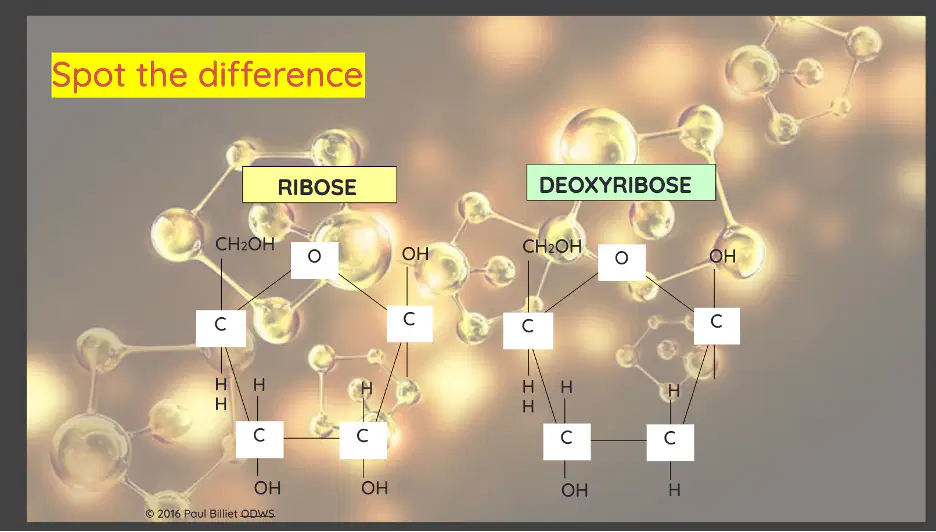
Ribose is a pentose.
C1
C5
C4
C3
C2
O
© 2016 Paul Billiet ODWS
37

RIBOSE
DEOXYRIBOSE
CH2OH
H
OH
C
C
OH
OH
C
O
H
H
H
C
CH2OH
H
OH
C
C
OH
H
C
O
H
H
H
C
Spot the difference
© 2016 Paul Billiet ODWS
38
Open Ended
39

THE SUGAR-PHOSPHATE
BACKBONE
•The nucleotides are all
orientated in the same
direction
•The phosphate group joins
the 3rd Carbon of one
sugar to the 5th Carbon of
the next in line.
P
P
P
P
P
P
© 2016 Paul Billiet ODWS
40

ADDING IN THE BASES
•The bases are attached to the 1st
Carbon
•Their order is important
It determines the genetic information
of the molecule
P
P
P
P
P
P
G
C
C
A
T
T
© 2016 Paul Billiet ODWS
41

DNA IS MADE OF
TWO STRANDS OF
POLYNUCLEOTIDE
P
P
P
P
P
P
C
G
G
T
A
A
P
P
P
P
P
P
G
C
C
A
T
T
Hydrogen bonds
© 2016 Paul Billiet ODWS
42

DNA IS MADE OF TWO STRANDS OF
POLYNUCLEOTIDE
•The sister strands of the DNA molecule run in opposite
directions (antiparallel)
•They are joined by the bases
•Each base is paired with a specific partner:
A is always paired with T
G is always paired with C
Purine with Pyrimidine
•Thus the sister strands are complementary but not
identical
•The bases are joined by hydrogen bonds, individually
weak but collectively strong.
© 2016 Paul Billiet ODWS
43


The Double Helix (1953)
www.chem.ucsb.edu/.../images/WatsonCrick.jpg
© 2016 Paul Billiet ODWS
James Watson, Francis Crick, and
Maurice Wilkins won the 1962 Nobel
Prize in Medicine for their discovery of
the molecular structure of DNA.
Published in April 1 953, their
discovery showed that a DNA molecule
has two strands coiled around each
other in a double helix.
Through this model, scientists were
able to understand DNA replication
and the transmission of genetic
information. Other developments in
the field of molecular biology followed
as well, such as the Human Genome
Project which Watson directed. The
project sequenced the 3 billion bases
of the human DNA and led to better
understanding of genetic diseases and
disorders.
44


So, can you now differentiate the two nucleic acids?
45


Please feel free to
message your Science
Teacher for clarification!
46

PROCESS QUESTIONS:
WHY
BIOMOLECULES
IMPORTANT?
47
Open Ended
WHY BIOMOLECULES ARE IMPORTANT?
48

As a
Lasallian,
how can
you translate
what you had
learned into
something
useful?
49

1. I can compare the structures and functions
of carbohydrates, lipids, proteins and
nucleic acid.
2. I can explain how small building blocks can
be used to make a great variety of
molecules that are needed to perform life’s
functions.
3. I can identify common forms of
biomolecules and their functions.
4. I can show appreciations for the
applications of biomolecules to the society
and take actions on how to conserve
world’s resources.
What did you accomplish from the list of the
learning targets?
Note: Use these learning targets to self-evaluate. When
you read and do activities, always go back to these goals
to check if you have achieved it.
50

(Picture of the food label here.)
What is the food you ate made up of?
Why do you think we eat those food?
Worksheet #2
Select one food label from the food that you consumed for the day. Inspect the food label. What is the
food that you ate made up of? Write this down. Why do you think we eat those food? Use the table
below for your answer.
51

Worksheet #1
How are nucleic acids
linked to heredity?
(In answering worksheets, make sure
to write the question first, then give
the answers.
52


For Learning Target # 1, below is the summary of lessons discussed:
I can compare the structures and functions of carbohydrates, lipids, proteins
and nucleic acid.
53


I can explain how small building blocks can be used to make a great variety of molecules that are needed to
perform life’s functions.
54


I can identify common forms of biomolecules and their
functions.
55


I can show appreciations for the applications of biomolecules to the society
and take actions on how to conserve world’s resources
The activities below and the lessons gave you opportunities to reflect on how biomolecules are used in the
society. You were asked as well to translate your learnings into something useful.
56

The End
Biomolecules
LC: Recognize the major categories of biomolecules such as
carbohydrates, lipids, proteins, and nucleic acids
References:
Exploring Life Through Science
Breaking Through Science
Science for the 21st Century Learner
Show answer
Auto Play
Slide 1 / 56
SLIDE
Similar Resources on Wayground

51 questions
Physical Science Review
Presentation
•
8th Grade
49 questions
Leaves Live
Presentation
•
9th Grade
49 questions
Big Energy Test Review
Presentation
•
9th Grade
50 questions
Latin America Map 2
Presentation
•
9th Grade
49 questions
Photosynthesis Lecture
Presentation
•
9th Grade
51 questions
Evolution Unit Overview
Presentation
•
8th Grade
50 questions
Water Properties Review
Presentation
•
8th Grade
53 questions
Law of Conservation of Mass
Presentation
•
8th Grade
Popular Resources on Wayground
6 questions
Secondary Safety Quiz
Presentation
•
9th - 12th Grade
10 questions
MyPath Diagnostic Overview
Presentation
•
6th - 8th Grade
20 questions
Lab Safety Quiz

Quiz
•
6th Grade
21 questions
Continents and Oceans
Quiz
•
6th Grade
20 questions
Adding and Subtracting Decimals
Quiz
•
5th Grade
20 questions
Parts of Speech
Quiz
•
5th Grade
16 questions
Subject & Predicate
Quiz
•
5th Grade
21 questions
Lab Safety
Quiz
•
10th Grade
Discover more resources for Science
10 questions
Scientific Method (The scientific method)

Interactive video
•
9th Grade
9 questions
Scientific method
Interactive video
•
9th - 12th Grade
10 questions
Lab Safety Essentials
Interactive video
•
6th - 10th Grade
10 questions
Essential Guidelines for Science Lab Safety
Interactive video
•
6th - 10th Grade
10 questions
Exploring Scientific Variables and Their Roles
Interactive video
•
6th - 10th Grade
15 questions
counting significant figures
Quiz
•
9th Grade
10 questions
Structure of Water and Hydrogen Bonding
Quiz
•
9th - 12th Grade
20 questions
Quiz #1: Lab Safety and Scientific Method
Quiz
•
9th - 12th Grade