

Evolutionary History 3.1 & 3.2

Presentation
•
Science
•
8th Grade
•
Practice Problem
•
Easy
+23
Standards-aligned

Kimberly Knotts
Used 15+ times
FREE Resource
57 Slides • 15 Questions
1

© The Regents of the University of California. All rights reserved.
Evolutionary History
Lesson 3.1: Exploring
Relatedness
2


© The Regents of the University of California. All rights reserved.
Activity 1
Warm-Up
Page 79
10 MIN
Evolutionary History: Lesson 3.1
3


© The Regents of the University of California. All rights reserved.
Investigation Notebook pg 79
Activity 1 - Screen 1
Evolutionary History: Lesson 3.1
4

© The Regents of the University of California. All rights reserved.
Activity 1 - Screen 2
Evolutionary History: Lesson 3.1
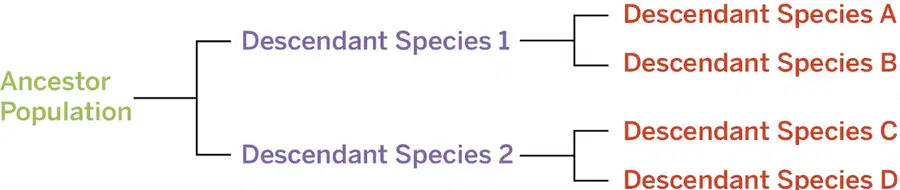
What new features did you notice in this
evolutionary tree from the Warm-Up?
5
Poll
Which group of descendant species is most likely to have body structures that are the most different from the ancestor population?
Descendant Species 1 & 2
Descendant Species A, B, C, & D
6
Multiple Choice
Which descendant species is most likely to have body structures that are the most different from Descendant Species B?
Descendant Species 1
Descendant Species C
Descendant Species A
7
Complete page 79 NOW with the information you just entered for the previous questions
8


© The Regents of the University of California. All rights reserved.
Evolutionary History: Lesson 3.1
Remember, we are trying
to place the Mystery
Fossil in the museum,
and the museum’s
exhibits are set up so
that related organisms
are grouped together.
Activity 1 - Screen 2
9


© The Regents of the University of California. All rights reserved.
Chapter 3 Question
Evolutionary History: Lesson 3.1
How can we tell if the Mystery Fossil is more
closely related to wolves or to whales?
Activity 1 - Screen 2
10


© The Regents of the University of California. All rights reserved.
Evolutionary History: Lesson 3.1
What does it mean to be related to someone?
How do most people define this word?
Let’s discuss how we use the word “related” in everyday life.
Activity 1 - Screen 2
11
Open Ended
What does it mean to be related to someone? How do most people define this word?
12


© The Regents of the University of California. All rights reserved.
Vocabulary
Evolutionary History: Lesson 3.1
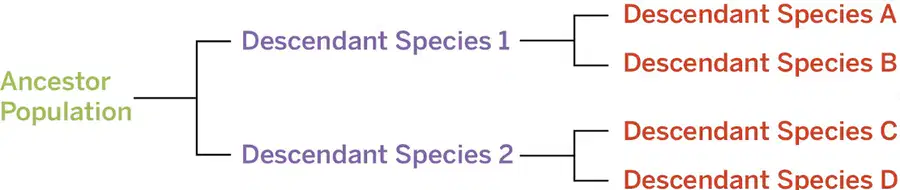
sharing a common ancestor population
related
Activity 1 - Screen 2
13

© The Regents of the University of California. All rights reserved.
Evolutionary History: Lesson 3.1
On an evolutionary tree, two species that
branched off more recently are more closely
related.
Activity 1 - Screen 2
14



© The Regents of the University of California. All rights reserved.
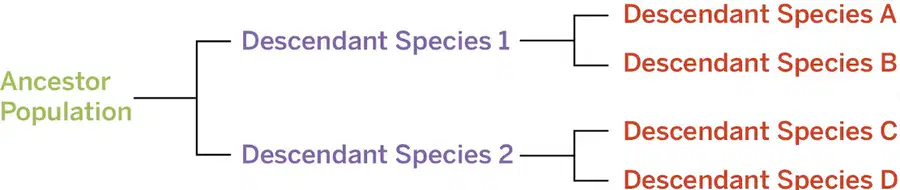
Which two species are most closely related
among Descendant Species A, B, and C?
Evolutionary History: Lesson 3.1
Activity 1 - Screen 2
15
Multiple Choice
Which two are most closely related between A, B, & C?
A & B
B & C
A & C
16


© The Regents of the University of California. All rights reserved.
Key Concept
Evolutionary History: Lesson 3.1
6. Among any three species, the two species
that separated most recently are the most
closely related to each other.
Activity 1 - Screen 2
17


© The Regents of the University of California. All rights reserved.
Activity 3
Modeling Shared
Structures in Common
Ancestors
Page 83
15 MIN
Evolutionary History: Lesson 3.1
18


© The Regents of the University of California. All rights reserved.
Activity 3
Evolutionary History: Lesson 3.1
Next, you’ll use the
Modeling Tool to share
your ideas about how to
tell which species are
more closely related to
each other than to other
species.
19


© The Regents of the University of California. All rights reserved.
Activity 3
20


© The Regents of the University of California. All rights reserved.
Activity 3
Evolutionary History: Lesson 3.1
You will be given three
imaginary species and
practice using shared
structures to place them
on an evolutionary tree.
21


© The Regents of the University of California. All rights reserved.
Activity 3
Evolutionary History: Lesson 3.1
You’ll use the New
Structure panel to show
when a new structure
appeared on the tree.
You can select the row
with that structure
highlighted in blue.
22
23


© The Regents of the University of California. All rights reserved.
Activity 3
Evolutionary History: Lesson 3.1
Next, we’ll discuss and
complete the Modeling
Tool as a class.
As we place the species,
we’ll share our thinking.
24


© The Regents of the University of California. All rights reserved.
Activity 3
25


© The Regents of the University of California. All rights reserved.
Investigation Notebook pg 83
Activity 3
Evolutionary History: Lesson 3.1
26
Multiple Choice
From Species C, D, & E, which pair of species is most closely related?
C & D
D & E
C & E
27
Complete page 83 NOW with the information you just entered for the previous question.
28

© The Regents of the University of California. All rights reserved.
Activity 3
Evolutionary History: Lesson 3.1
When trying to decide the relationships
between species, paleontologists look for
structures that are shared by one pair or group
of species but not by other species.
They sometimes call these diagnostic shared
structures because they help scientists make
decisions about relatedness.
29


© The Regents of the University of California. All rights reserved.
Activity 3
Evolutionary History: Lesson 3.1
In this example, back limbs (legs) could be
called a diagnostic shared structure. They
helped us diagnose that Species C and E
share a more recent common ancestor with
each other than with Species D.
30


© The Regents of the University of California. All rights reserved.
Activity 3
Evolutionary History: Lesson 3.1
Species share diagnostic
structures because they
are all descendants from
a common ancestor with
this structure.
31


© The Regents of the University of California. All rights reserved.
Activity 4
Homework
Page 84
Evolutionary History: Lesson 3.1
32


© The Regents of the University of California. All rights reserved.
Activity 4 - Screen 1
Evolutionary History: Lesson 3.1
For this activity, you will:
● compare two models
of evolutionary trees.
33


© The Regents of the University of California. All rights reserved.
Investigation Notebook pgs 84–85
Activity 4 - Screen 1
Evolutionary History: Lesson 3.1
34
Poll
Which model do you think is correct?
Model 1
Model 2
35
Open Ended
Explain how the two trees are different and why you think the model you indicated above is the correct one. (Hint: Use these words in your explanation: shared structure, related, inherit, descendant species, ancestor population)
36
Complete page 84 NOW with the information you just entered for the previous questions.
37

© The Regents of the University of California. All rights reserved.
Evolutionary History
Lesson 3.2: Determining Species
Relatedness
38


© The Regents of the University of California. All rights reserved.
Activity 1
Warm-Up
Page 87
5 MIN
Evolutionary History: Lesson 3.2
39


© The Regents of the University of California. All rights reserved.
Investigation Notebook pg 87
Activity 1
Evolutionary History: Lesson 3.2
40
Multiple Choice
Where should Species C be placed on the tree?
Space 1
Space 2
41
Multiple Choice
What is the BEST body structure to use to make your decision?
skull
backbone
tail
front limb
back limb
42
Open Ended
Explain how this body structure helped you make your decision.
43
Complete page 87 NOW with the information you just entered for the previous questions.
44


© The Regents of the University of California. All rights reserved.
Activity 2
Investigating the
Relatedness of Extinct
Whales
Page 88-89
25 MIN
Evolutionary History: Lesson 3.2
45


© The Regents of the University of California. All rights reserved.
Remember, we’re investigating this question:
Activity 2
Evolutionary History: Lesson 3.2
Investigation Question:
When you compare different species, how can you tell
which species are more closely related than others?
46


© The Regents of the University of California. All rights reserved.
Activity 2
Evolutionary History: Lesson 3.2
Let’s think back to the model you
created yesterday.
What ideas do you have
so far about how
paleontologists decide
how closely species are
related?
47


© The Regents of the University of California. All rights reserved.
Activity 2
Evolutionary History: Lesson 3.2
We are working to place
the Mystery Fossil in a
section of the museum
where it will be near other
types of organisms that it
is closely related
to—either whales or
wolves.
48


© The Regents of the University of California. All rights reserved.
Activity 2
Evolutionary History: Lesson 3.2
Knowing the process
paleontologists use to
tell how closely species
are related will help us
place the Mystery Fossil.
Let’s watch a video about
this process.
49

© The Regents of the University of California. All rights reserved.
50


© The Regents of the University of California. All rights reserved.
Activity 2
Evolutionary History: Lesson 3.2
Next, you’ll use the Sim
to practice the process
paleontologists use to
place species on an
evolutionary tree.
51


© The Regents of the University of California. All rights reserved.
Activity 2
Evolutionary History: Lesson 3.2
This time, you’ll launch
the Sim in a new mode
called Cetaceans.
Then, you’ll open Tree
View and use the Tree
Navigation menu to go to
the Cetaceans branch.
52


© The Regents of the University of California. All rights reserved.
Activity 2
Evolutionary History: Lesson 3.2
Remember, cetaceans is
the group that includes
whales.
You’ll begin by studying
the structures of two
living whales: blue
whales and orcas.
53


© The Regents of the University of California. All rights reserved.
Activity 2
Evolutionary History: Lesson 3.2
Then, you’ll place these
five cetacean species on
the evolutionary tree by
deciding which species
are more closely related.
54


© The Regents of the University of California. All rights reserved.
Investigation Notebook pg 88
Activity 2
Evolutionary History: Lesson 3.2
The empty spaces on the
evolutionary tree are
numbered from 1 to 5.
These are the locations
where you’ll place the
species.
55


© The Regents of the University of California. All rights reserved.
Investigation Notebook pg 88
Activity 2
Evolutionary History: Lesson 3.2
For each empty space on
the tree, you’ll consider
two species and decide
which one to place there.
There are hints about
which body structures to
study.
56


© The Regents of the University of California. All rights reserved.
Activity 2
Evolutionary History: Lesson 3.2
To study the structures
and make your decision,
you’ll need to open the
Study windows for both
species and look at the
Structures tab.
57


© The Regents of the University of California. All rights reserved.
Activity 2
Evolutionary History: Lesson 3.2
Let’s consider Location 1
together.
We’ll discuss whether to
place Dorudon or
Kutchicetus on that
branch of the
evolutionary tree.
58


© The Regents of the University of California. All rights reserved.
Activity 2
59


© The Regents of the University of California. All rights reserved.
Activity 2
Evolutionary History: Lesson 3.2
Now, you and your
partner will discuss and
place all five cetacean
species on the
evolutionary tree.
Remember to use the
Study windows for help.
60


© The Regents of the University of California. All rights reserved.
Investigation Notebook pgs 88–89
Activity 2
Evolutionary History: Lesson 3.2
61


© The Regents of the University of California. All rights reserved.
Investigation Notebook pg 89
Activity 2
Evolutionary History: Lesson 3.2
Discuss the reflection
question, and then write
your answers.
62
63


© The Regents of the University of California. All rights reserved.
Investigation Notebook pg 94
Activity 2
Evolutionary History: Lesson 3.3
What are the diagnostic
structures in both whales
and wolves?
What structures do they
not share?
64
Multiple Choice
Which of these two species belongs in Location 1?
Dorudon
Kutchicetus
65
Multiple Choice
Which of these two species belongs in Location 2?
Pakicetus
Kutchicetus
66
Multiple Choice
Which of these two species belongs in Location 3?
Indohyus
Ambulocetus
67
Multiple Choice
Which of these two species belongs in Location 4?
Pakicetus
Indohyus
68
Open Ended
Which species is dorudon more closely related to: the blue whale or Ambulocetus? Which diagnostic structure(s) could you use to show this?
69
Complete page 88 & 89 NOW with the information you just entered for the previous questions.
70


© The Regents of the University of California. All rights reserved.
Activity 3
Evolutionary History: Lesson 3.2
Key Concept
7. When two species share a structure that is
not shared with a third species, this can be
evidence that the first two species are more
closely related to each other than to the
third species.
71
You should have these pages completed in your workbook by the end of this lesson:
79
83
84
87
88
89
72


© The Regents of the University of California. All rights reserved.
End of Lesson
Published and Distributed by Amplify. www.amplify.com
Evolutionary History: Lesson 3.2
© The Regents of the University of California. All rights reserved.
Evolutionary History
Lesson 3.1: Exploring
Relatedness
Show answer
Auto Play
Slide 1 / 72
SLIDE
Similar Resources on Wayground

69 questions
Phase Change 1.2
Presentation
•
8th Grade
64 questions
Force and Motion Test Recap
Presentation
•
8th Grade
70 questions
SISTEM PEREDARAN DARAH
Presentation
•
8th Grade
64 questions
Pre-Skills 8.G.A.2
Presentation
•
8th Grade
69 questions
CH. 16-Reconstruction
Presentation
•
8th Grade
63 questions
Force Body Diagrams 2025
Presentation
•
8th Grade
63 questions
Chemistry Calculations Review
Presentation
•
8th Grade
64 questions
The Eye
Presentation
•
9th Grade
Popular Resources on Wayground
16 questions
Grade 3 Simulation Assessment 2

Quiz
•
3rd Grade
19 questions
HCS Grade 5 Simulation Assessment_1 2526sy
Quiz
•
5th Grade
10 questions
Cinco de Mayo Trivia Questions

Interactive video
•
3rd - 5th Grade
17 questions
HCS Grade 4 Simulation Assessment_2 2526sy
Quiz
•
4th Grade
24 questions
HCS Grade 5 Simulation Assessment_2 2526sy
Quiz
•
5th Grade
13 questions
Cinco de mayo
Interactive video
•
6th - 8th Grade
20 questions
Math Review
Quiz
•
3rd Grade
30 questions
GVMS House Trivia 2026
Quiz
•
6th - 8th Grade
Discover more resources for Science
16 questions
Interactions within Ecosystems
Presentation
•
6th - 8th Grade
30 questions
GMAS Physical Science Review
Quiz
•
8th Grade
10 questions
Exploring the Rock Cycle
Interactive video
•
6th - 8th Grade
18 questions
Carbon Cycle
Quiz
•
8th Grade
10 questions
Exploring Earth's Seasons and Their Causes
Interactive video
•
6th - 8th Grade
26 questions
Amplify Chemical Reactions
Quiz
•
6th - 8th Grade
10 questions
Evidence of Evolution
Presentation
•
6th - 8th Grade
20 questions
8th Grade Science NC EOG Review
Quiz
•
8th Grade