Solutions and Solubility Review Lesson
Presentation
•
Science
•
9th - 12th Grade
•
Medium
+3
Standards-aligned
Christine Ruberti
Used 2+ times
FREE Resource
26 Slides • 22 Questions
1
2
3
4
Hotspot
Which of the following solutions are heterogenous?
5
6
7
Match
Identify a solute, the solvent, and the solution in a carbonated drink (like soda).
Carbon Dioxide (dissolved in the drink)
Water
The Carbonated Drink
Solute
Solvent
Solution
Solute
Solvent
Solution
8
9
Fill in the Blank
Type answer...
10
11
12
13
14
15
16
Multiple Choice
When McDonald's sweet tea is really sweet, did they add too much solute or solvent?
too much solute
too much solvent
17
Multiple Choice
How can we dilute the sweet tea?
add more sugar (solute)
add more water (solvent)
18
Factors affecting rate of solubility
rate of solubility - time taken for a substance to completely dissolve in another substance
19
Factors affecting rate of solubility
Temperature
Rate of strirring
Size of solute
20
By crushing the solute to smaller pieces the amount of surface area for the solute to contact the solvent INCREASES.
The more solute/solvent interactions that occur the faster will be the rate of dissolution!
This is why Kool-aid is such a fine powder!
***Important to note that molecular bonds are NOT being broken, the molecules are just in smaller pieces.
Size of solute - explained
21
Open Ended
Write an explanation of WHY it will dissolve the most quickly using the terms "surface area", "solvent" and "solute"
22
Draw
Circle the seltzer that will dissolve the most quickly. Then, write an explanation of WHY it will dissolve the most quickly using the terms "surface area", "solvent" and "solute"
23
Agitation - Recap
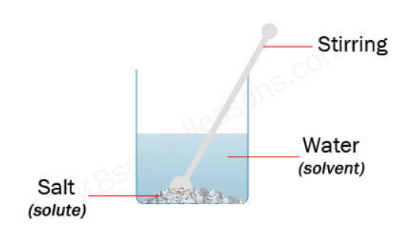
Stirring or agitating a solution increases the amount of solute/solvent interactions mechanically.
Increasing solute/solvent interactions increases rate of dissolution.
This is why you stir the Kool-aid when you add it to the water.
24
Open Ended
Write a description about how agitation is effecting the rate of dissolution.
25
Temperature - Recap
Increasing kinetic energy (energy of motion) increases the number of solute/solvent interactions.
Increasing the number of solute/solvent interactions increases the rate of dissolution.
AGAIN NOTE that for gases, they are actually more soluble in liquids at lower temperatures, because they boil out when the temperature is too high.
26
Draw
Circle the container with the most kinetic energy. Then, write a description about the effect of increasing kinetic energy on the rate of dissolution.
27
Multiple Choice
Which of the following can increase the dissolving rate of a substance the most?
mixing
freezing
heating it up
adding more substance.
28
Match
Match the following terms:
Increasing agitation
Crushing solute
Temperature increase
Mechanically increases number of solute/solvent interactions to increase rate of dissolution
Increases surface area of solute to interact with solvent to increase the rate of dissolution
Increases kinetic energy of solute and solvent particles to increase rate of dissolution
Mechanically increases number of solute/solvent interactions to increase rate of dissolution
Increases surface area of solute to interact with solvent to increase the rate of dissolution
Increases kinetic energy of solute and solvent particles to increase rate of dissolution
29
Multiple Choice
Which is not a factor affecting solubility?
Agitating (mixing, stirring, shaking) the mixture
Increasing the surface area of the mixture
Increasing the volume of the mixture
Increasing the temperature of the mixture
30
31
32
33
Multiple Choice
When 42 grams of potassium chloride, is dissolved in 100 grams of water at 50 ºC, the solution can be correctly described as:
supersaturated
saturated
unsaturated
34
Multiple Choice
When 50 grams of KCl is dissolved in 100 grams of water at 50 ºC, the solution can be correctly described as:
supersaturated
unsaturated
saturated
35
Multiple Choice
When 20 grams of potassium chlorate, KClO3, is dissolved in 100 grams of water at 80 ºC, the solution can be correctly described as:
supersaturated
saturated
unsaturated
36
37
38
39
40
41
42
Multiple Choice
Which solute is the least soluble at 90 ⁰C?
SO2
KClO3
KI
HCl
43
Multiple Choice
Which solute is the most soluble at 10 ⁰C?
KI
KClO3
NH4Cl
NH3
44
Multiple Choice
Which substance is MOST soluble at 0 ºC?
KI
NaNO3
NaCl
Ce2(SO4)3
45
Multiple Choice
How many grams of K2Cr2O7, are soluble in 100 g of water at 90 ºC?
85 grams
70 grams
40 grams
15 grams
46
Multiple Choice
25 grams of NaCl are dissolved in 100 mL of water at 60 C. How many more grams need to be dissolved for the solution to be saturated?
13 grams
25 grams
6 grams
38 grams
47
Multiple Choice
At approximately what temperature does the solubility of sodium chloride, NaCl, match the solubility of potassium dichromate, K2Cr2O7?
60 ºC
30 ºC
50 ºC
83 ºC
48
Multiple Choice
At approximately what temperature does the solubility of sodium chloride, NaCl, match the solubility of potassium dichromate, K2Cr2O7?
60 ºC
30 ºC
50 ºC
83 ºC
Show answer
Auto Play
Slide 1 / 48
SLIDE

Similar Resources on Wayground
43 questions
Using and Expressing Measurements - Scientific Notation
Presentation
•
9th - 12th Grade
42 questions
Unit 6 Part 2: Plate tectonics and Continental Drift
Presentation
•
9th - 12th Grade
47 questions
Ecological Succession Lesson
Presentation
•
9th - 12th Grade
40 questions
Problem Solving and Experimental Design
Presentation
•
9th - 12th Grade
44 questions
CA Remediation AKS 1a/b & 4
Presentation
•
9th - 12th Grade
43 questions
Unit 5.2 Threats to Biodiversity Notes
Presentation
•
9th - 12th Grade
43 questions
Biosphere Lesson
Presentation
•
9th - 12th Grade
Popular Resources on Wayground
10 questions
5.P.1.3 Distance/Time Graphs
Quiz
•
5th Grade
10 questions
Fire Drill
Quiz
•
2nd - 5th Grade
20 questions
Equivalent Fractions
Quiz
•
3rd Grade
22 questions
School Wide Vocab Group 1 Master
Quiz
•
6th - 8th Grade
20 questions
Main Idea and Details
Quiz
•
5th Grade
20 questions
Context Clues
Quiz
•
6th Grade
20 questions
Inferences
Quiz
•
4th Grade
12 questions
What makes Nebraska's government unique?
Quiz
•
4th - 5th Grade
Discover more resources for Science
10 questions
Exploring the Layers of the Earth
Interactive video
•
6th - 10th Grade
25 questions
Naming Ionic and Covalent Compounds
Quiz
•
9th Grade
20 questions
Balancing Chemical Equations
Quiz
•
9th Grade
15 questions
Protein synthesis
Quiz
•
9th Grade
20 questions
Human Impact on the Environment Review #2
Quiz
•
9th Grade
20 questions
Newton's Laws of Motion
Quiz
•
9th Grade
20 questions
Mendelian Genetics Review
Quiz
•
9th Grade
16 questions
Balancing Chemical Equations and Types of Reactions
Quiz
•
9th - 10th Grade