Biology RC 1 Review Part 2
Presentation
•
Science
•
9th Grade
•
Medium
+2
Standards-aligned

Annette Avila
Used 3+ times
FREE Resource
14 Slides • 35 Questions
1
Biomolecules, Cell Cycle, and DNA
RC 1 Review Part 2
Complete the following review using your ISN as reference. Some slides contain reading material or videos. Your expectation is to read and view these study resources. (Your time spent on each slide is recorded)
Grade Goal is 90% - unlimited tries
grades above 87 will replace a zero or recieve extra credit
2
Multiple Choice
Monosaccharide
Amino Acid
Nucleotide
Polysaccharide
3
Biomolecules
4
Multiple Choice
Nucleic Acid
Lipid
Carbohydrate
Protein
5
Multiple Choice
Nucleic Acid
Lipids
Carbohydrate
Protein
6
Multiple Choice
lipids
proteins
carbohydrates
nucleic acids
7
Multiple Choice
Which biomolecule helps form muscles?
Nucleic Acid
Carbohydrate
Protein
Lipids
8
Multiple Choice
Protein
Nucleic Acid
Lipid
Carbohydrate
9
Multiple Choice
Protein
Nucleic Acid
Lipid
Carbohydrate
10
Multiple Choice
The enzymes that catalyze cellular reactions are
macromolecules called proteins. Which of the following elements most often compose proteins? (Hint: CHO, CHO, CHON, CHONP)
carbon and hydrogen
carbon, hydrogen, oxygen and nitrogen
carbon, hydrogen and oxygen
carbon, hydrogen, oxygen, nitrogen and phosphorous
11
Multiple Choice
Carbohydrate
Lipid
Protein
Nucleic acid
12
Multiple Choice
Click the link - and watch FIRST
Enzymes are considered to be
Lipids
Carbohydrate
Protein
Nucleic Acid
13
Stages of Cell Cycle
1) Interphase
2) Mitosis (PMAT)
3) Cytokinesis
14
Multiple Choice
give permission for the reaction
raise activation energy
speed up reactions
control how many reactions occur
15
Multiple Choice
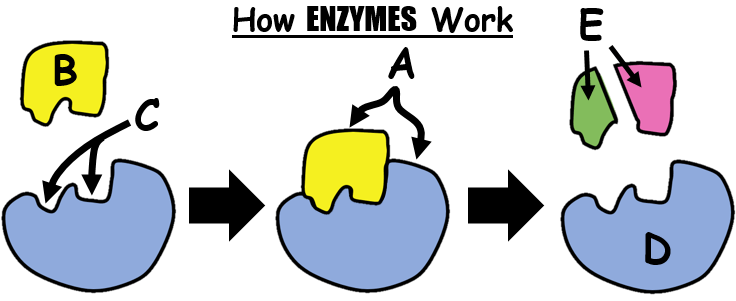
voltage-gated channels
surface receptor
calcium channels
active site
16
Multiple Choice
Substrate
Enzyme
Product
Complex
17
Multiple Choice
Substrate
Enzyme
Substrate
Product
18
Multiple Choice
What happens to an enzyme when it denatures?
The shape of enzyme molecule changes and the attracts different substates.
The activation energy of the reaction stops and the enzyme dies.
It's optimal conditions for temperature of the enzyme are doubled.
The shape of the enzyme molecule is changed and enzyme will become non-functional.
19
Multiple Choice
give permission for the reaction
raise activation energy
speed up reactions
control how many reactions occur
20
Multiple Choice
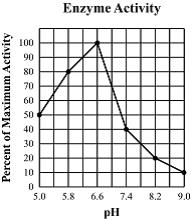
The optimum pH of the enzyme is 6.6.
The optimum pH of the enzyme is 5.8
The enzyme’s activity increases as pH increases 5.0 to 9.0
The enzyme’s activity is greater around pH of 8.0 .
21
Multiple Choice
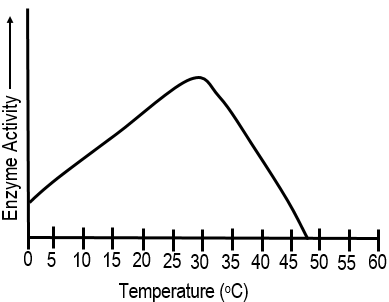
15oC
40oC
30oC
35oC
22
Multiple Choice
active site
enzymes
substrate
products
23
Multiple Choice
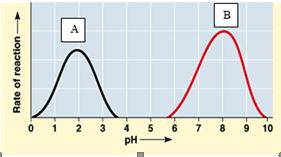
What is the optimal pH of enzyme A?
8
2
5.7-10
10
24
25
26
27
28
29
Multiple Choice
In which phase of Mitosis do the Chromosomes pull Apart
Metaphase
Prophase
Anaphase
Telophase
30
Multiple Choice
Carbohydrate
Lipids
Protein
Nucleic Acid
31
Multiple Choice
Cells of organism must replicate for ?
growth
repair of damaged tissue
replacement of dying cells.
All of the above
32
Multiple Choice
What does DNA Replication mean?
DNA is made.
DNA makes new cells.
DNA copies itself.
DNA starts the cell cycle.
33
Multiple Choice
PMAT helps us remember the correct order of the phases of Mitosis. Which of the following has the phases of Mitosis in the correct Order
Interphase, Mitosis, Cytokinesis
Prophase, Metaphase, Anaphase, Prophase
Anaphase, Telophase, Prophase, Telophase
Prophase, Metaphase, Anaphase, Telophase
34
Multiple Choice
Which stage of the cell cycle do cells spend the most time?
Cytokinesis
Mitosis
Interphase
Prophase
35
Multiple Choice
Which stage of the Life Cycle of the cell is this cell in (look close-the DNA hasn't formed Chromosomes (X) yet)
Interphase
Prophase
Anaphase
Telophase
36
Multiple Choice
During what phase of Mitosis do the chromosomes line up in the Middle
Metaphase
Prophase
Telophase
Anaphase
37
Multiple Choice
What are the "X" shaped things in the drawing.
PMATs
Chromosomes
Ribosomes
Telophase
38
Multiple Select
Which of these are part of the Cell Cycle?
Mitosis
Interphase
Prophase
Metaphase
Cytokines
39
DNA Replication!
- Making copies of DNA so that all your cells can look the same!
40
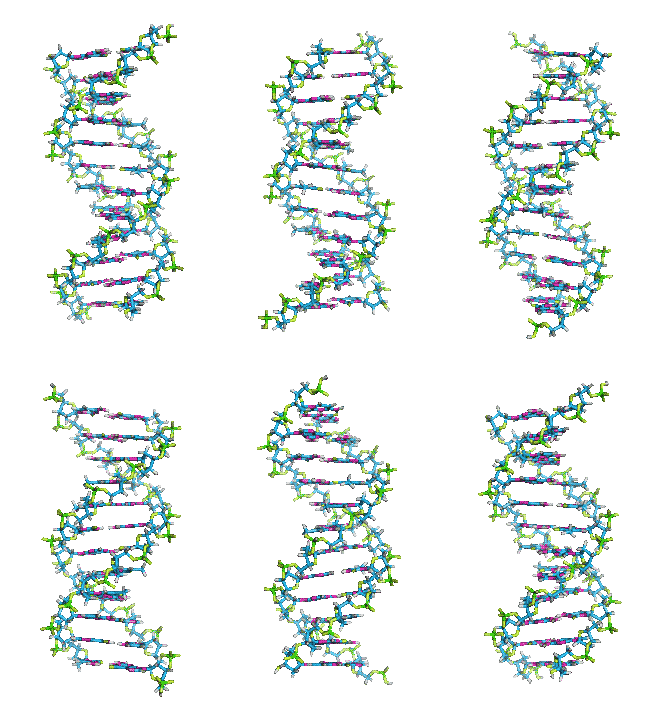
DNA Structure
1. DNA is made of ladders(Nitrogen bases - A, T, G, C)- The ladder is also known us "rungs"
2. DNA base pairing rules: A=T and G=C
3. The backbone of DNA is made of Deoxyribose sugar and a phosphate.
4. A-T have two hydrogen bonds and G-C has three hydrogen bond
5. DNA is antiparallel! They go in opposite directions!
41
DNA Direction!
Antiparallel- They go in opposite directions
Primes- Reading starts at Oxygen (Tip of the pentose sugar) and goes clockwise
42
Stages of DNA replication
1. Helicase unwinds/unzips the DNA
2. Single-stranded binding proteins bind to unzipped strands to keep them separated!
3. DNA Polymerase enzyme adds nitrogen bases (A, T, G, C) to the leading strand
43
Stages of DNA replication
4. Primase enzyme adds primer on the lagging strand of the DNA to make Okazaki fragments
5. DNA polymerase adds the nucleotide bases to Okazaki fragments
6. Ligase- Connects/Glues the Okazaki fragments to complete DNA replication
44
DNA Replication
Ameoba sisters!
45
Multiple Choice
anti-parallel
deoxyribosic
helical
radioactive
46
Multiple Choice
Which sequence of DNA bases would pair with this partial strand
CAT TCA CTG
ATG TGA CAG
TAC ACT GTC
GTA AGT GAC
CAT TCA CTG
47
Multiple Choice
Which is the first step?
DNA Helicase unwinds original DNA strand
RNA Primase lays down RNA primer for new nucleotide bases.
DNA polymerase builds new strands by bring in new nucleotide bases.
Ligase knits together fragments on lagging strand
48
Multiple Choice
What are the 4 nitrogen bases?
adenine, thymine, cytoplasm, and guanine
adenine, thymine cytosine, and guanine
adenine, thymine, cytosine, and gylcerol
adenine, thymine, cytosine, and glucose
49
Multiple Choice
Guanine bonds with ______________.
Adenine
Guanine
Cytosine
Thymine
Biomolecules, Cell Cycle, and DNA
RC 1 Review Part 2
Complete the following review using your ISN as reference. Some slides contain reading material or videos. Your expectation is to read and view these study resources. (Your time spent on each slide is recorded)
Grade Goal is 90% - unlimited tries
grades above 87 will replace a zero or recieve extra credit
Show answer
Auto Play
Slide 1 / 49
SLIDE

Similar Resources on Wayground
45 questions
Physical Characteristics of the Middle East
Presentation
•
9th Grade
46 questions
It's Electrifying! Notes
Presentation
•
8th Grade
47 questions
Cooking methods
Presentation
•
9th Grade
44 questions
Revision - Single Award Biology
Presentation
•
9th Grade
45 questions
Unit 2 Biodiversity Review
Presentation
•
9th Grade
43 questions
Nature of Science Vocabulary
Presentation
•
9th Grade
44 questions
Ecological Relationship
Presentation
•
8th Grade
48 questions
Lesson: Electricity Introduction
Presentation
•
9th Grade
Popular Resources on Wayground
20 questions
Math Review
Quiz
•
3rd Grade
15 questions
Fast food
Quiz
•
7th Grade
20 questions
Context Clues
Quiz
•
6th Grade
20 questions
Inferences
Quiz
•
4th Grade
19 questions
Classifying Quadrilaterals
Quiz
•
3rd Grade
20 questions
Figurative Language Review
Quiz
•
6th Grade
20 questions
Equivalent Fractions
Quiz
•
3rd Grade
10 questions
Identify Fractions, Mixed Numbers & Improper Fractions
Quiz
•
3rd - 4th Grade
Discover more resources for Science
25 questions
Naming Ionic and Covalent Compounds
Quiz
•
9th Grade
40 questions
NCFE Earth and Environmental Science Released Test
Quiz
•
9th - 12th Grade
10 questions
Exploring Weather Influences and Map Reading
Interactive video
•
6th - 10th Grade
20 questions
Human Impact on the Environment Review #2
Quiz
•
9th Grade
20 questions
Balancing Chemical Equations
Quiz
•
9th Grade
61 questions
End of the Year Trivia Fun
Quiz
•
9th Grade
15 questions
Protein synthesis
Quiz
•
9th Grade
30 questions
Environmental Science Final Exam REVIEW
Quiz
•
9th - 12th Grade