

Patricia Hubbell, Richard García, Langston Hughes

Presentation
•
English
•
8th Grade
•
Practice Problem
•
Medium
+19
Standards-aligned

Paula Rein
Used 3+ times
FREE Resource
5 Slides • 14 Questions
1
2
Reading: Reread and Read Ahead to Determine Meanings From Context
Poetry often contains unusual words with which you may not be familiar. Nevertheless, you can often understand these words if you examine the context—the words and phrases surrounding an unfamiliar word. When you find an unfamiliar word, reread and read ahead for context clues that will help you figure out the meaning.
When you think you have come up with a possible meaning, insert the meaning in place of the unfamiliar word, and reread the sentence. If it does not make sense, look for more context clues, or consult a dictionary.
3
Reading: Reread and Read Ahead to Determine Meanings From Context
In “Concrete Mixers” by Patricia Hubbell, for example, the word ponderous may be unfamiliar, but the context provides clues to its meaning.
Tough gray-skinned monsters standing ponderous,
Elephant-bellied....
If you reread the line with ponderous and focus on “monsters standing” and then read ahead to “elephant-bellied,” you can figure out from these clues that ponderous probably means “big and heavy.”
4
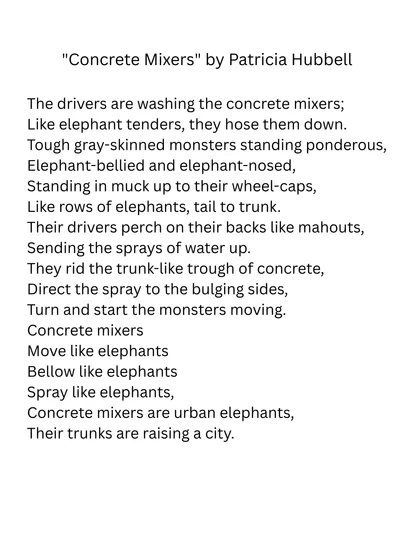
Likely meaning of hose in line 2:
Likely meaning of muck in line 5:
Likely meaning of perch in line 7:
Likely meaning of bellow in line 14:
Likely meaning of urban in line 16:
5
Literary Analysis: Figurative Language
Poets often use imaginative figures of speech, or figurative language, to make their poems more musical and memorable. Figures of speech often compare unlike things. A simile directly states the comparison of two unlike things by using a word such as like or as. A metaphor suggests a comparison between two unlike things by saying that one is the other. Personification compares something nonhuman to a human being by giving it human characteristics.
Similes: Life is like a dance. The ocean is as moody as a child.
Metaphor: Life is a dance.
Personification: The ocean laughs and cries.
6
Multiple Choice
What does “Concrete Mixers” describe?
a rural village in Africa
a zoo in India
a construction site in a modern city
a large corporation
7
Multiple Choice
To what or whom does “Concrete Mixers” compare the operators of the concrete
mixers?
elephants
elephant drivers
firefighters
hoses
8
Multiple Choice
To what or whom does “Concrete Mixers” compare the mixing machines?
elephants
elephant drivers
fire trucks
washing machines
9
Multiple Choice
What does the word perch mean in the context of these lines from “Concrete Mixers”?
Their drivers perch on their backs like mahouts,
Sending the sprays of water up.
water
sneeze
fish
sit
10
Multiple Choice
What is the speaker doing in “Harlem Night Song”?
hoping to join a band
asking someone to join him or her
giving a tour
worrying about the weather
11
Multiple Choice
In “Harlem Night Song,” whom does the speaker seem to be addressing?
a young child
an elderly parent
homeless person
someone he or she loves
12
Multiple Choice
What kind of figure of speech do these lines from “Harlem Night Song” contain?
Stars are great drops
Of golden dew.
simile
metaphor
personification
none
13
Multiple Choice
In the context of these lines from “Harlem Night Song,” which word tells you that dew is probably some kind of moisture?
Moon is shining,
Night sky is blue.
Stars are great drops
Of golden dew.
shining
blue
drops
golden
14
Multiple Choice
What does “The City Is So Big” suggest about the city?
It is boring.
It is actually very small.
It is old and creaky.
It is frightening.
15
Multiple Choice
According to “The City Is So Big,” where do people in the city “disappear”?
in elevators
on bridges
on trains
on moving stairs
16
Multiple Choice
What does the word quake probably mean in the context of this line from “The
City Is So Big”?
Its bridges quake with fear
accident
shake
smile
stretch
17
Multiple Choice
Which lines from “The City Is So Big” contain a simile?
The city is so big / Its bridges quake with fear
The lights sliding from house to house / And trains pass with windows
shining
And trains pass with windows shining / Like a smile full of teeth
I have seen machines eating houses / And stairways walk all by themselves
18
Multiple Choice
Which of these words often signal a simile?
like and as
so and and
for and like
none of the above
19
Multiple Choice
Which word is most nearly opposite in meaning to the word ponderous?
light
strong
awkward
thoughtful
Show answer
Auto Play
Slide 1 / 19
SLIDE
Similar Resources on Wayground

15 questions
Test Taking Strategies
Presentation
•
7th - 8th Grade
15 questions
The Giver (Symbolism)
Presentation
•
8th Grade
15 questions
Conflict
Presentation
•
8th Grade
15 questions
Drawing Conclusions
Presentation
•
8th Grade
13 questions
FIRST CONDITIONAL
Presentation
•
8th Grade
12 questions
Parts of an Informative Essay
Presentation
•
8th Grade
12 questions
Making Connections
Presentation
•
8th Grade
16 questions
Logical Fallacies
Presentation
•
8th Grade
Popular Resources on Wayground
10 questions
How much do you know about our Portrait of an Eagle?

Quiz
•
10th Grade
10 questions
Fast Food Slogans
Quiz
•
6th - 8th Grade
21 questions
Continents and Oceans
Quiz
•
6th Grade
20 questions
Parts of Speech
Quiz
•
5th Grade
16 questions
Subject & Predicate
Quiz
•
5th Grade
25 questions
Multiplication Facts
Quiz
•
5th Grade
12 questions
Map Skills
Quiz
•
3rd Grade
22 questions
Continents and Oceans
Quiz
•
5th Grade
Discover more resources for English
25 questions
Making Inferences
Quiz
•
6th - 8th Grade
20 questions
Figurative Language Review
Quiz
•
8th Grade
30 questions
Central Idea practice Grade 7-8
Quiz
•
6th - 8th Grade
12 questions
Final Figurative Language Review
Presentation
•
6th - 8th Grade
20 questions
Sentences, Fragments, and Run-ons
Quiz
•
8th Grade
20 questions
TEXTUAL EVIDENCE & INFERENCES
Quiz
•
6th - 8th Grade
11 questions
Objective Summary Review
Quiz
•
6th - 8th Grade
17 questions
Plot
Quiz
•
8th Grade