
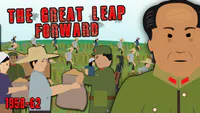
The Great Leap Forward and the Cultural Revolution

Presentation
•
Social Studies
•
9th - 12th Grade
•
Practice Problem
•
Easy

C Y
Used 23+ times
FREE Resource
24 Slides • 9 Questions
1

Great Leap
• The Great Leap Forward would
modernize China’s economy by building
up the coal, steel, and iron industries.
• It also called for increasing farm
productivity.
• The plan revolved around the
Communist idea that citizens don’t work
for personal gain, but rather for the good
of the community and country.
© Brain Wrinkles
2
Multiple Choice
What was Mao's plan called that would increase China's productivity and modernize the country?
The Cultural Revolution
The Hundred Flowers Campaign
The Great Leap Forward
The Long March
3

Communes
• Under the Great Leap Forward, the
government took over all businesses,
factories, and private property.
• The government set up communes
where up to 25,000 people lived and
worked as a group.
• The government was in control of the
people’s work schedules and social
lives.
© Brain Wrinkles
4


© Brain Wrinkles
Women working together during the Great Leap
Forward.
5

Rations
• Workers did not own the land they worked,
nor did they get to keep the goods they
created.
• Goods made in the communes were
collected by the government and then
distributed to citizens.
• A ration system was in place in the
communes and each family was given set
amounts of food, clothing, and other
necessary items.
© Brain Wrinkles
6


© Brain Wrinkles
Collecting Rations
7
Open Ended
How did the government organize the people to increase productivity?
8

Did It Work?
• The Great Leap Forward was a huge
disaster.
• Within a year, the plan failed due to poor
management, environmental issues,
and government corruption.
• Instead of growing stronger, China’s
economy actually shrank during this
time period.
© Brain Wrinkles
9
Multiple Select
Why was the Great Leap Forward a disaster?
poor management
environmental issues
government corruption
not enough workers
10

Problems
• The Communist government did a terrible
job of managing the communes and
industries.
• Droughts and floods damaged the farming
regions, and the farming communes could
not feed the starving country.
• Corrupt government officials kept more
than their share of rationed food and
goods.
© Brain Wrinkles
11

Outcomes
• From 1958-1960, one of the largest
famines in history struck China.
• The Great Leap Forward left the Chinese
people ill-prepared to handle it and about
20 million citizens died during this time.
• Individual rights and freedoms also
suffered during this time, and many people
did not like the government making all of
the decisions for them.
© Brain Wrinkles
12
Multiple Choice
Ultimately, the Chinese felt as though the government should be in control of everything
True
False
13


© Brain Wrinkles
The Great Famine
14

Result
• When the Great Leap Forward failed,
many Chinese lost confidence in Mao’s
leadership.
• They questioned his ability to take care
of and provide for the country.
• More and more people began calling for
government reforms.
© Brain Wrinkles
15

Cultural
Revolution
• Mao realized that he was losing control of
the country.
• In response, he created a new program
called the Cultural Revolution in 1966.
• Mao promised that the revolution would
restore the spirit of Communism and bring
Chinese culture back to the country.
© Brain Wrinkles
16
Multiple Choice
What is the Cultural Revolution?
Mao's plan to convince the world that the Chinese are superior
Mao's new plan to restore the spirit of Communism and bring Chinese culture back
Mao's plan to revise the Great Leap Forward by ending corruption
Mao's plan to get rid of Communism and bring Capitalism into China
17


© Brain Wrinkles
Cultural Revolution
Propaganda
18

Red Guard
• In reality, Mao created the Cultural Revolution
to stop all opposition to his Communist rule.
• He urged students to quit school and wage
war on anyone who opposed communism.
• The students were organized into an army
known as the Red Guards.
• They attacked, imprisoned, and even killed
those suspected of not agreeing with Mao.
© Brain Wrinkles
19
Multiple Choice
What was the purpose of the Red Guards?
To attack, imprison, or even kill anyone that did not agree with Mao
To protect Mao
To spread Mao's teachings and ideology
To promote economic growth and development
20


© Brain Wrinkles
Red Guard
Propaganda
Posters
21

Culture?
• Any artist, writer, professor, or religious leader
who opposed Communism was tortured,
imprisoned, or killed.
• Monuments, statues, and artwork created
before the Cultural Revolution were destroyed.
• Schools and factories shut down, and the
economy grew weaker.
• Fear and distrust of the government created
mass chaos in China.
© Brain Wrinkles
22
Multiple Choice
Fear and distrust of the government created mass chaos in China
True
False
23


© Brain Wrinkles
24

It served
End
• The purpose of the Cultural Revolution was to
restore ancient Chinese culture and traditions;
but in reality, it served as a brutal way to
eliminate opposition to Mao’s Communist rule.
• Mao declared the Cultural Revolution
complete in 1969, although many of the
attacks continued until Mao’s death in 1976.
• As a result of this program, many Chinese
became more fearful and distrustful of the
Communist government.
© Brain Wrinkles
25

It served
New Leader
• After Mao’s death, China’s new leader,
Deng Xiaoping, made many reforms to
Mao’s rules, but the government still
stuck to its communist roots.
• Xiaoping allowed farmers to own their
own land, opened China to foreign
investments, and he allowed some
private businesses to open.
© Brain Wrinkles
26
Multiple Choice
After Mao's death, China's new leader, Deng Xiaoping, made what changes?
He implemented a one-child policy
He continued the Cultural Revolution even though it ended in 1969.
He abolished the death penalty
He allowed farmers to own their own land
27

It served
Control
• Despite the economic reforms, the
Chinese people were still not given
basic human rights like freedom of
speech, freedom of religion, or the right
to a fair trial.
• The government continued to imprison
and torture those who spoke out against
Communism.
© Brain Wrinkles
28

It served
Protests
• In 1989, over 10,000 Chinese students
gathered to protest China’s corrupt
Communist government in Tiananmen
Square in the capital city of Beijing.
• They filled the square for 7 weeks,
peacefully protesting Communism and
calling for a move towards democracy.
• They inspired other protests throughout
China.
© Brain Wrinkles
29

It served
Tiananmen
• On June 4, 1989, the Chinese
government had enough and took
action against the peaceful protestors.
• Soldiers and tanks were sent into the
square and opened fire on the
protestors that refused to leave.
• Hundreds of innocent lives were lost,
and the tragedy became known as the
Tiananmen Square Massacre.
© Brain Wrinkles
30


© Brain Wrinkles
31


© Brain Wrinkles
32

It served
Pressure
• The Tiananmen Square Massacre raised
international attention to China’s poor
treatment of human rights.
• Countries around the world condemned this
violence and began urging China to improve
the human rights of its citizens.
• Finally, the international pressure began to
have some effect and the Chinese
government began making some real
reforms in human rights.
© Brain Wrinkles
33
Open Ended
Explain what happened at the Tiananmen Square Massacre and the changes that occurred after.
Great Leap
• The Great Leap Forward would
modernize China’s economy by building
up the coal, steel, and iron industries.
• It also called for increasing farm
productivity.
• The plan revolved around the
Communist idea that citizens don’t work
for personal gain, but rather for the good
of the community and country.
© Brain Wrinkles
Show answer
Auto Play
Slide 1 / 33
SLIDE
Similar Resources on Wayground

26 questions
Juneteenth
Presentation
•
9th - 12th Grade
25 questions
The Cuban Revolution
Presentation
•
9th - 12th Grade
26 questions
WORD CHOICE
Presentation
•
9th - 12th Grade
26 questions
DNA Structure & Replication
Presentation
•
9th - 12th Grade
26 questions
Limiting Factors and Carrying Capacity EOC Review
Presentation
•
9th - 12th Grade
27 questions
Commas Lesson
Presentation
•
9th - 12th Grade
25 questions
Federalism
Presentation
•
9th - 12th Grade
27 questions
Early Republic section 1
Presentation
•
8th - 12th Grade
Popular Resources on Wayground
10 questions
Safety Day 2026 – Student Review

Quiz
•
9th Grade
21 questions
Continents and Oceans
Quiz
•
6th Grade
20 questions
Parts of Speech
Quiz
•
5th Grade
16 questions
Subject & Predicate
Quiz
•
5th Grade
25 questions
Multiplication Facts
Quiz
•
5th Grade
12 questions
Map Skills
Quiz
•
3rd Grade
22 questions
Continents and Oceans
Quiz
•
5th Grade
15 questions
Rounding Decimals
Quiz
•
5th Grade
Discover more resources for Social Studies
10 questions
Exploring the Age of Exploration: Key Events and Figures

Interactive video
•
6th - 10th Grade
9 questions
Exploring Ancient Mesopotamia and Its Civilizations
Interactive video
•
10th Grade
20 questions
Chapter 8 Test "Types of Business Organizations"
Quiz
•
12th Grade
39 questions
Unit 7 Key Terms
Quiz
•
11th Grade - University
10 questions
Debating the Legacy of Christopher Columbus
Interactive video
•
6th - 10th Grade
38 questions
Unit 6 Key Terms
Quiz
•
11th Grade - University
27 questions
World Geography - Q1 9week Test
Quiz
•
9th Grade
22 questions
U3T2 Vocab FAC: Domestic Policy
Quiz
•
10th Grade