

Energy 2

Presentation
•
Science
•
8th Grade
•
Practice Problem
•
Medium
+12
Standards-aligned

Christina Quattrone
Used 8+ times
FREE Resource
9 Slides • 16 Questions
1

2

Is affected by speed and mass
ex more mass and more speed = greater kinetic energy
Object must have motion
The kinetic energy of an object increases as its velocity increases
Kinetic energy
3
Example: Juan is running on the beach with his dad. Juan has a mass of 40 kg and is running at a velocity of 2 m/s.
How much kinetic energy does he have?
Kinetic Energy Formula

1/2 x mass x velocity2 remember 2 = SQUARED
1/2 x 40 x 22
20 x 4 = 80 JOULES
KINETIC ENERGY IS MEASURED IN JOULES
4
Multiple Choice
A plane with a mass of 6,800 kg is moving at a speed of 55.0 m/s. What is the kinetic energy of the plane? KE =21mv2
20,600,000 J.
10,285,000 J.
374,000 J.
187,000 J.
5
Multiple Choice
What is the kinetic energy of a 0.500 kg toy car moving at a speed of 1.50 m/s? KE =21mv2
1.13 J.
2.25 J.
0.563 J.
0.167 J.
6
Multiple Choice
What is the kinetic energy of a 4.0 kg cart that is moving at a speed of 0.50 m/s? KE =21mv2
0.50 J
4.0 J.
8.0 J.
2.0 J.
7
Multiple Choice
A scientist conducts a test to determine how best to increase the kinetic energy of a moving ball. Which change would add the most energy?
Doubling the speed of the ball.
Tripling the mass of the ball.
Tripling the speed of the ball.
Doubling the mass of the ball.
8
Multiple Choice
Which action will decrease the kinetic energy of a train?
Adding more cars to the train.
Decreasing the temperature of the train.
Adding passengers to the train.
Decreasing the speed of the train.
9
Multiple Choice
Which object has the greatest kinetic energy?
A 2,000 kg plane moving at 30 m/s.
A 40,000 kg boat moving at 0.1 m/s.
A 4,200 kg truck moving at 2.0 m/s.
A 0.01 kg paintball moving at 50 m/s.
10
Multiple Choice
When a book falls from a shelf, its kinetic energy _______ because its velocity _______.
decreases; increases
increases; increases
decreases; decreases
increases; decreases
11
Multiple Choice
The kinetic energy of an object increases as its _______ increases.
potential energy
gravitational energy
height
velocity
12
Multiple Select
Which variables affect the kinetic energy of an object?
speed
acceleration
volume
mass
13

- is the energy held by an object because of its position relative to other objects, stresses within itself, its electric charge, or other factors.
Ex- A spring would have potential energy if it is sitting on a shelf, is compressed, or is stretched
Potential Energy
14
when an object is closer to the ground
Decreases
when an object is higher off the ground
Increases
For example, a rock in a tree has more potential energy than a rock on the ground.
15
For example: A 0.145kg baseball is flying at a height of 2.50 m. How much potential energy does the ball have?
PE = mgh
PE= 0.145 x 9.81 x 2.50
How to find potential energy
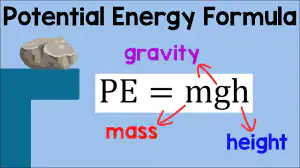
Gravity can be inputted as 9.81
This is the gravitational acceleration on Earth
So, PE = 9.81mh
16
Multiple Select
A metal block is let go from a certain height. What information is needed to calculate the velocity of the metal block just before it hits the ground?
The volume of the block.
The temperature of the block.
The original height of the block.
The gravitational constant.
17
Multiple Choice
What is the approximate potential energy of a rock weighing 10 KG that sits on a hill 300 m high? PE= mgh; where g = 9.81; PE = 9.81mh
3,000 J.
30,000 J.
300 J.
30 J.
18
Multiple Choice
Which spring has more potential energy stored? PE= mgh; where g = 9.81; PE = 9.81mh
A 1.0 N/m constant spring stretched 0.3 m.
A 1.0 N/m constant spring stretched 0.2 m.
A 2.0 N/m constant spring stretched 0.3 m.
A 2.0 N/m constant spring stretched 0.2 m.
19
Maximum velocity is reached at higher points
(Remember velocity is like speed but with directionality)
the rate of change of the object's position with respect to a frame of reference and time. It might sound complicated, but velocity is basically speeding in a specific direction.
20
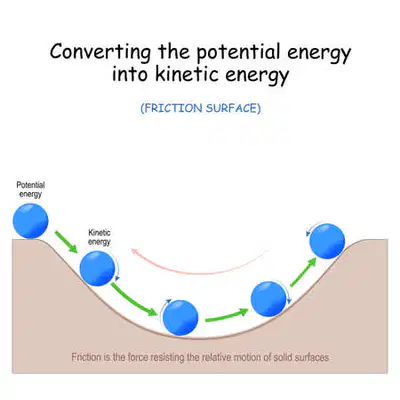
When an object has potential energy, that means that due to its position, it can gain kinetic energy
For example, ball rolls up a hill. As the ball rolls, its kinetic energy DECREASES and its potential energy INCREASES.
Potential and Kinetic Energy
21
V = √2gh gravitational constant is 9.81
V = √2(9.81)h 9.81 x 2 is 19.62
V = √19.62h Since you know velocity, you must get height alone
1. Multiply velocity by itself (V2)- this is the inverse of the square root.
2. Divide the velocity by 19.62
Ex A rocket flies directly upward with an initial velocity of 24.0 m/s. Assuming there is no air friction, what is the maximum height the rocket will reach?
24 = √19.62h 242 = √19.62h 576 = 19.62h 576/19.62 = 29.4 m
Solving for height
V = √2gh gravitational constant is 9.81
V = √2(9.81)h 9.81 x 2 is 19.62
V = √19.62h multiply 19.62 x height then square root
Example- An object is let go from a height of 1.4m, what will its velocity be?
V = √19.62 x 1.4 V = 5.2 m/s
Solving for velocity

22
Multiple Choice
A scientist shoots a rocket straight up into the air. Which action would increase the maximum height that the rocket can reach?
Decreasing the mass of the rocket.
Decreasing the velocity of the rocket.
Increasing the velocity of the rocket.
Increasing the mass of the rocket.
23
Multiple Choice
A roller coaster car starts rolling down a hill from a height of 60 m. The track becomes straight at a height of 30 m. Which statement is true of the roller coaster car at 30 m?
It has potential energy but no kinetic energy.
It has neither kinetic energy nor potential energy.
It has kinetic energy but no potential energy.
It has both kinetic energy and potential energy.
24
Multiple Choice
A ball is thrown straight up with an initial velocity of 4.40 m/s. Assuming there is no air friction, what is the maximum height the ball will reach? V =19.62h
0.449 m.
0.225 m.
1.98 m.
0.988 m.
25
Multiple Choice
A wooden block is let go from a height of 5.80 m. What is the velocity of the block just before it hits the ground? V =19.62h
10.7 m/s.
56.8 m/s.
7.54 m/s.
28.4 m/s.
Show answer
Auto Play
Slide 1 / 25
SLIDE
Similar Resources on Wayground

19 questions
Geologic Time Review
Presentation
•
8th Grade
19 questions
Review- Electromagnetism
Presentation
•
8th Grade
18 questions
Plant Reproduction
Presentation
•
8th Grade
18 questions
Lesson 5.5: The Theory of Plate Tectonics
Presentation
•
8th Grade
21 questions
Earth Layers
Presentation
•
8th Grade
19 questions
Aquatic Ecosystem & Ocean zones
Presentation
•
8th Grade
20 questions
Science Tools
Presentation
•
8th Grade
20 questions
Cluster 4 Day 1-Symbiosis
Presentation
•
8th Grade
Popular Resources on Wayground
21 questions
Continents and Oceans

Quiz
•
6th Grade
20 questions
Parts of Speech
Quiz
•
5th Grade
16 questions
Subject & Predicate
Quiz
•
5th Grade
25 questions
Multiplication Facts
Quiz
•
5th Grade
12 questions
Map Skills
Quiz
•
3rd Grade
22 questions
Continents and Oceans
Quiz
•
5th Grade
15 questions
Rounding Decimals
Quiz
•
5th Grade
20 questions
Brand Labels
Quiz
•
5th - 12th Grade
Discover more resources for Science
20 questions
Newton's Laws of Motion
Quiz
•
8th Grade
20 questions
Scientific Method and Variables
Quiz
•
8th Grade
20 questions
Scientific method and variables
Quiz
•
8th Grade
20 questions
Claim, Evidence and Reasoning (CER)
Quiz
•
6th - 8th Grade
21 questions
Newton's Laws of Motion
Quiz
•
8th Grade
20 questions
Elements, Compounds and Mixtures
Quiz
•
8th Grade
10 questions
Exploring Chemical and Physical Changes

Interactive video
•
6th - 10th Grade
26 questions
Force - Net Force, Balanced and Unbalanced Forces
Quiz
•
8th Grade