

Equatorial & Hot Desert Climates

Presentation
•
Social Studies
•
9th Grade
•
Practice Problem
•
Medium

Joselito Ebro
Used 1+ times
FREE Resource
22 Slides • 8 Questions
1
Equatorial and Hot Desert Climates
2
Lesson Objectives
Describe the main characteristics of equatorial and hot desert climates.
Explain the factors that influence equatorial and desert climates.
3
4
Equatorial Climate Characteristics
Equatorial regions are found on or near the equator
5
Open Ended

Using the map, name a country in the Equatorial region.
6
Main Characteristics: Equatorial

7


Generally above 26 degrees Celsius throughout the year.
Hot Conditions
Often over 2000 mm.
High levels of Rainfall
The temperatures are high throughout the year.
A lack of seasons
8


Known as diurnal range -- higher than the seasonal differences in temperature.
Daytime / Nighttime Temperatures
May fall on as many as 250 days each year.
Convectional Rainfall
May be limited in the morning, by the afternoon, towering cumulonimbus clouds mark the start of the convectional rains.
Variable Cloud Cover
9


The diurnal range is less than in hot desert areas.
Reduced Heat Loss due to Cloud Cover
Moisture in the atmosphere -- relative humidities of 100 % are often reached in the late afternoon.
High Humidity
Reduced wind speeds within the rainforest due to the large numbers of trees present.
Reduced Wind Speeds
10

11
Multiple Choice

What are the warmest months in Manaus, Brazil?
October and November
September and October
January and February
May and September
12
Multiple Choice
What are the coolest months in Manaus, Brazil?
June and November
September and December
April and February
May and September
13
Multiple Choice
Which months is Manaus wet season?
November to May
September to December
April and November
June to December
14
Multiple Choice
Which months is Manaus dry season?
June to October
September to December
February and November
June to December
15
Main Characteristics: Hot Desert

16
The diurnal range is less than in hot desert areas.
Hot days and Cold nights
Moisture in the atmosphere -- relative humidities of 100 % are often reached in the late afternoon.
Low/Irregular Rainfall
Reduced wind speeds within the rainforest due to the large numbers of trees present.
Reduced Wind Speeds
17


caused by the lack of cloud cover
Hot days, Cold nights
lacking any seasonal pattern
Low and Irregular rainfalls
throughout the year
Low Humidity
which sometimes caus sandstorms
Warm, dry winds
18

19
Multiple Choice

What are the warmest months in Cairo, Egypt?
October to November
June and August
January to March
June to October
20
Multiple Choice
What is the coolest month in Cairo, Egypt?
May
January
June
December
21
22
Open Ended
Suggest reasons why Cairo receives more annual sunshine hours (9.5) than Manaus (5.7)
23

Factors:
The angle of the overhead sun
The thickness of the atmosphere
Latitude
24
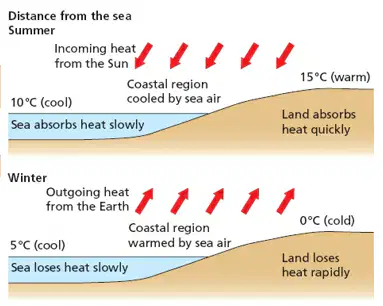
Water properties:
Water absorbs and loses heat slowly, compared with land.
Proximity to Sea
25

Warm currents from the equatorial regions raise the temperature of polar areas.
Ocean Currents
26

Air temperature decreases with increasing altitude, around 10 degrees per kilometer.
Altitude
27

Prevailing or dominant winds from land lower the winter temperatures (opposite in summer). While prevailing winds from the sea lower the summer temperatures and raise them in winter.
Winds
28
29

Decreases the amount of insolation reaching the surface by reflecting some of it.
Cloud Cover
30

In low-pressure systems, the air is rising -- producing rain -- found in equatorial areas.
In high-pressure areas, are is sinking, and rain formation is prevented.
Pressure
Equatorial and Hot Desert Climates
Show answer
Auto Play
Slide 1 / 30
SLIDE
Similar Resources on Wayground

22 questions
FEDERALISTS AND ANTIFEDERALISTS
Presentation
•
8th Grade
23 questions
Solving One-Step, Two Step and Multistep Inequalities
Presentation
•
9th Grade
23 questions
Solving Quadratic Equations
Presentation
•
9th Grade
25 questions
The Reformation
Presentation
•
9th Grade
22 questions
The Scientific Revolution and the Enlightenment
Presentation
•
9th - 10th Grade
21 questions
Types of Gov
Presentation
•
9th Grade
23 questions
Trans-Atlantic Slave Trade
Presentation
•
KG
22 questions
Japanese-American Internment Camps
Presentation
•
8th - 10th Grade
Popular Resources on Wayground
16 questions
Grade 3 Simulation Assessment 2

Quiz
•
3rd Grade
19 questions
HCS Grade 5 Simulation Assessment_1 2526sy
Quiz
•
5th Grade
10 questions
Cinco de Mayo Trivia Questions

Interactive video
•
3rd - 5th Grade
17 questions
HCS Grade 4 Simulation Assessment_2 2526sy
Quiz
•
4th Grade
24 questions
HCS Grade 5 Simulation Assessment_2 2526sy
Quiz
•
5th Grade
13 questions
Cinco de mayo
Interactive video
•
6th - 8th Grade
20 questions
Math Review
Quiz
•
3rd Grade
30 questions
GVMS House Trivia 2026
Quiz
•
6th - 8th Grade
Discover more resources for Social Studies
10 questions
Exploring the Age of Exploration: Key Events and Figures
Interactive video
•
6th - 10th Grade
50 questions
US History EOC Review
Quiz
•
9th - 12th Grade
20 questions
Unit 6a Judicial Branch Quiz
Quiz
•
9th - 12th Grade
12 questions
Articles of Confederation and Constitutional Convention Quiz

Passage
•
9th Grade
42 questions
AP World History Modern: Unit 9
Quiz
•
9th - 12th Grade
42 questions
APUSH Period 3 Review
Quiz
•
9th - 12th Grade
25 questions
El Imperio Inca
Quiz
•
9th Grade
15 questions
1.2 Westward Expansion, Native Americans, and Farmers
Quiz
•
9th - 12th Grade