EES Exam Review Part 4: Geosphere
Presentation
•
Science
•
9th - 12th Grade
•
Medium
+17
Standards-aligned
Pamela Slater
Used 4+ times
FREE Resource
28 Slides • 48 Questions
1
2
3
4
5
6
Earth's Layers
Earth is made of four layers.
We live on the crust, made of cool rocks and oceans.
Next, we have the mantle made of hot liquid rock.
Then we have the inner and outer core. They are extremely hot and made of metal.
Scientists made inferences about the inner layers. We cannot really dig through the Earth because the inner layers are so hot.
7
Explanation Slide...
​
8
Convection Currents happen in the mantle
9
Earth's Plates
The crust is made of solid rock called Plates. There are 12 main plates.
Remember that the plates are solid, but they are floating on the mantle, which is liquid. ​
So, the plates ​move due to changes that happen in the mantle below.
The movement of the plates is called Plate Tectonics.​
10
Click on the link to to Identify the Names and locations of the 15 Plates and some major types of boundaries
​
15 Major Tectonic Plates & Types of Boundaries
11
​Review - Plate Boundaries
Earth's crust is cracked into 12 plates.
The plates can be Oceanic or Continental.
The plates meet at boundaries.
Scientists study plate boundaries because changes in the geosphere happen there.
They classify plate boundaries into:
Convergent
Oceanic-Oceanic
Oceanic- Continental
Continent-Continent
Divergent
Transform
​
12
EXAMPLE: Convergent -Oceanic to Oceanic
13
EXAMPLE: Convergent -Oceanic to Oceanic
14
EXAMPLE: Convergent -Oceanic to Continental
Nazca subducts beneath South American Plate
15
EXAMPLE: Convergent -Oceanic to Continental
Forms the Andes Moutains
16
EXAMPLE: Convergent -Continental to Continental
Forms the Himalyan Moutains
17
18
The Rock Cycle
The Rock Cycle is a group of changes. Igneous rock can change into sedimentary rock or into metamorphic rock. Sedimentary rock can change into metamorphic rock or into igneous rock. Metamorphic rock can change into igneous or sedimentary rock.
19
Igneous Rocks
Magma is formed by the melting of rocks
Igneous rocks are formed by the cooling of magma
Volcanic glass, like obsidian, formed from a lava that cooled so quickly crystals did not form; glassy texture
20
Igneous Rocks
Volcanic or extrusive rock, like basalt, formed from a lava that cooled on Earth's surface, allowing small crystals to form; fine-grained texture
Plutonic or intrusive rock, like granite, formed from a magma that cooled below Earth's surface, allowing large crystals to form; coarse-grained texture
21
Sedimentary Rocks
Sediments are formed by the weathering and erosion of rocks
Clastic Sedimentary rocks, like sandstone, are formed by the compaction and cementation of sediments ranging in size, from smallest to largest: clay, silt, sand, pebbles, cobbles, and boulders
22
Sedimentary Rocks
Chemical sedimentary rocks, like rock salt, are made when water evaporates or when the mineral falls out of a water solution
Organic sedimentary rocks, like coal, are made from the remains of plants and animals.
23
Metamorphic Rocks
Metamorphic rocks are created when any rock experiences high heat and pressure
Foliated metamorphic rocks, like gneiss, have visible layering or bands of minerals
Nonfoliated metamorphic rocks, like quartzite, have NO visible layering or bands of minerals and instead are more crystalline
24
25
26
27
28
29
Match
Match the layer to its composition.
Crust
Mantle
Outer Core
Inner Core
Solid Rock
Liquid Rock
Liquid Metal
Solid Metal
Solid Rock
Liquid Rock
Liquid Metal
Solid Metal
30
Multiple Choice
The area around the pacific plate where boundaries form and there are lots of volcanoes is called...
31
Multiple Choice
When scientists map the location of earthquakes, where do they find that most earthquakes happen?
middle of tectonic plates
in the core of the earth
only near mountains
at plate boundaries
32
Multiple Choice
Coal is formed from...
The remains of ancient plants from swamps
The remains of ancient ocean life
The remains of dead dinosaurs
Erupting volcanoes
33
Multiple Choice
There are large reserves of oil Canada, Saudi Arabia and Russia, because of this we know that these areas were once
under ancient shallow seas
part of ancient swamps
filled with ancient volcanoes
hot a dry climates
34
Multiple Choice
Where are metals and minerals most often found?
In mountains
Near tectonic plate boundaries and volcanoes
Deep in the oceans
At the North and South Pole
35
Multiple Choice
36
Multiple Choice
The area around the pacific plate where boundaries form is called...
death ring
fire zone
ring of fire
zone of fire
37
Multiple Choice
38
Multiple Choice
39
Multiple Choice
Which cross section correctly shows the inferred movement of material in the asthenosphere beneath the Mid-Atlantic Ridge? X = North American Plate Y = African plate
1
2
3
4
40
Multiple Choice
Which cross section shows the inferred movement of material in the asthenosphere beneath the Juan de Fuca Plate and the North American Plate?
A
B
C
D
41
Multiple Choice
Obsidian is a dark, glassy rock formed by the cooling of lava.
extrusive igneous
sedimentary
metamorphic
intrusive igneous
42
Multiple Choice
Why are resources not evenly distributed across Earth's surface?
Geological processes
Humans bring them to other places.
High tides
Tornadoes
43
Multiple Choice
it gets cooler
it gets hotter
it stays the same
the core is frozen
44
Labelling
Label the layers of the Earth in the image.
45
Drag and Drop
46
Multiple Choice
Earth's surface is made up of seven major landmasses
the continents DO NOT move
Earth is slowly cooling and shrinking
the continents were once joined together in a single landmass
47
Multiple Choice
What evidence supports the idea that all the continents were once joined together?
Similar rocks found on different continents.
Mountains created by colliding continents.
Evidence of glaciers in unexpected places.
All of the above
48
Multiple Choice
Earthquake
Volcano Eruption
Tornado
Mountain Building
49
Multiple Choice
Plate
Divergent
Convergent
Transform
50
Multiple Choice
What is the name of this tectonic plate?
African
Antarctic
Indian
Arabian
51
Multiple Choice
What leads to the creation of island arcs?
Collision of two oceanic plates.
Collision of oceanic and continental plates
seafloor spreading
collision of two continental plates
52
Multiple Choice
What is NOT likely to happen at a divergent boundary?
mountain formation
rift valley
seafloor spreading
formation of a volcano
53
Multiple Choice
This animation depicts which of the following?
How the Himalayan mountains formed
How the Andes formed
How the Hawaiian Islands formed
How the East African Rift Valley formed.
54
Multiple Choice
What is the name of this tectonic plate?
Cocos
Nazca
Scotia
South American
55
Multiple Choice
What is happening at the subduction zone of the Juan de Fuca and North American Plates?
Plates are sliding past each other
Plates are spreading apart
One plate is being pulled under another.
there is a hot spot creating volcanic islands
56
Multiple Choice
Mid-ocean ridges are places where tectonic plates are doing what?
colliding
sliding past each other
spreading apart
none of these
57
Match
Match each diagram with the correct boundary type.
Convergent Bountary
Transform Boundary
Divergent Boundary
Subduction
Convergent Bountary
Transform Boundary
Divergent Boundary
Subduction
58
Multiple Choice
At which plate boundary is new crust formed?
divergent
convergent
continental
transform
59
Multiple Choice
Volcano
Mountain
Rift
Island Arc
60
Multiple Choice
What natural event can cause a Tsunami?
Earthquakes
Volcanic Eruptions
Landslides
Glacier breaking off into the ocean
All of the above
61
Multiple Choice
A prime example of an area over a hot spot is :
Japan
the Andes Mountains
the East African Rift
the Hawaiian Islands
62
Multiple Choice
Which of the volcanic islands is the oldest?
Ni'ihua
Kaua'i
O'ahu
Moloka'i
Maui
63
Multiple Choice
Sedimentary
Igneous
Metamorphic
64
Multiple Choice
Sedimentary
Igneous
Metamorphic
65
Multiple Choice
igneous rocks
metamorphic rocks
sedimentary rocks
66
Multiple Choice
heat and pressure
erosion and deposition
melting and cooling
67
Multiple Choice
heat and pressure
melting and cooling
weathering and erosion
68
Multiple Choice
Coal
igneous
metamorphic
sedimentary
69
Multiple Choice
Coal is formed from layered plant and animal material and is used as fuel.
igneous
sedimentary
metamorphic
70
Multiple Choice
Basalt is a fine-grained rock
igneous
sedimentary
metamorphic
71
Multiple Choice
Granite is a coarse grained, rock formed underground.
intrusive igneous
sedimentary
metamorphic
extrusive igneous
72
Multiple Choice
Pumice is a lightweight rock with holes formed from gas bubbles.
igneous
sedimentary
metamorphic
73
Multiple Choice
Which igneous rock cooled the fastest?
74
Multiple Choice
Which type of rocks contain fossils?
Igneous
Sedimentary
Metamorphic
Fossils are not real
75
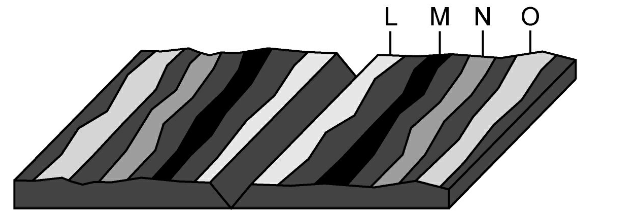
Multiple Choice
L
M
N
O
76
Multiple Choice
How does heat from the core cause molten rock in these convection currents to move?
Sinks when hot, and rises when cool
Rises when hot, and sinks when cool
Heat from inside the Earth does not cause rocks to move.
Show answer
Auto Play
Slide 1 / 76
SLIDE

Similar Resources on Wayground
70 questions
TSIA2 Boot Camp - Unlocking Word Meaning
Lesson
•
9th - 12th Grade
69 questions
5.1.5 Life Science Practice
Lesson
•
9th - 12th Grade
69 questions
Physical and Chemical Properties
Lesson
•
9th - 12th Grade
69 questions
Properties of a Substance and Chemical Reaction
Lesson
•
9th - 12th Grade
69 questions
Chemistry Reactions
Lesson
•
9th - 12th Grade
69 questions
Earth's Layers and Seasons
Lesson
•
9th - 12th Grade
70 questions
Phylum Mollusca Notes
Lesson
•
10th - 12th Grade
72 questions
Senderos 2 Lección 4 - El Cuerpo
Lesson
•
10th - 12th Grade
Popular Resources on Wayground
15 questions
Fractions on a Number Line
Quiz
•
3rd Grade
14 questions
Boundaries & Healthy Relationships
Lesson
•
6th - 8th Grade
13 questions
SMS Cafeteria Expectations Quiz
Quiz
•
6th - 8th Grade
20 questions
Equivalent Fractions
Quiz
•
3rd Grade
25 questions
Multiplication Facts
Quiz
•
5th Grade
12 questions
SMS Restroom Expectations Quiz
Quiz
•
6th - 8th Grade
20 questions
Main Idea and Details
Quiz
•
5th Grade
10 questions
Pi Day Trivia!
Quiz
•
6th - 9th Grade
Discover more resources for Science
10 questions
Exploring the Layers of the Earth
Interactive video
•
6th - 10th Grade
25 questions
Naming Ionic and Covalent Compounds
Quiz
•
9th Grade
35 questions
DNA Structure and Replication
Quiz
•
10th Grade
33 questions
Unit 5 Chemical Reactions Review
Quiz
•
9th - 12th Grade
24 questions
U8 Respiratory System Review
Quiz
•
12th Grade
20 questions
The Cell Cycle and Mitosis
Quiz
•
9th Grade
9 questions
Explore Homeostasis and Feedback Mechanisms
Quiz
•
9th - 12th Grade
10 questions
Exploring the Human Respiratory System
Interactive video
•
6th - 10th Grade