
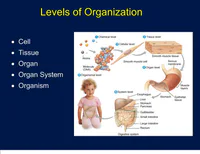
Levels of Organization and Homeostasis

Presentation
•
Biology
•
9th - 12th Grade
•
Practice Problem
•
Hard
+2
Standards-aligned

Victoria Colbert
Used 2+ times
FREE Resource
20 Slides • 16 Questions
1

Levels of
Organization
2

Levels of Organization
Non-living
Living
Simple
Complex
Biomolecule
Life begins! →
INCREASING COMPLEXITY
DECREASING COMPLEXITY
3

ATOM
A basic unit of matter consisting of protons, neutrons, and
electrons.
Example: Carbon, Hydrogen, Oxygen, Nitrogen, Phosphorus, Sulfur
4


BIOMOLECULES
These are molecules composed of protons neutrons and electrons
that are made for living organism.Organisms are made up of organic
and inorganic molecules.
Examples:
Organic molecules: Carbohydrates, Proteins, Lipids, and Nucleic Acid
Inorganic molecules: Carbon dioxide and water
CARBOHYDRATES
PROTEINS
LIPIDS
NUCLEIC ACIDS
5


ORGANELLES
Any number of organized structures within a living cell.
Ex. mitochondria, chloroplast and nucleus
6


The basic unit of life.
CELL
7


TISSUE
Specialized cells working together to perform a specific function.
Animal Tissue
Plant Tissue
8


ORGAN
A group of tissues working together to perform a specific
function.
PLANT ORGANS
9


A group of organs working together to perform a specific
function.
ORGAN SYSTEM
10


ORGANISM
An individual animal, plant, or single-celled life form.
11

POPULATION
A group of plants, animals, or living organisms of the
same species.
12

COMMUNITY
A group of plants or animals living in the same place.
13


A biological community of interacting organisms which
include the biotic and abiotic factors.
ECOSYSTEM
14


BIOME
An ecosystem of plants and animals that have common
characteristics for the environment they live in.
15

The life supporting stratum extending from the atmosphere to
the deep sea vents of the oceans.
BIOSPHERE

16
Multiple Choice
Which of the following correctly displays the levels of organization from smallest to largest?
Atom, Molecule, Organ, Organelle, Organ System
Organ, Organ System, Population, Organism, Community
Cell, Tissue, Organelle, Organ, Organ System
Organism, Population, Community, Ecosystem, Biome
17
Multiple Choice

Which level of biological organization is shown in this image?
Ecosystem
Organism
Cells
Organelles
18
Homeostasis is maintained by negative feedback (stay by target) loops and positive feedback (go beyond target) loops
Receptors: Detect stimulus
Effector: Change

19
Regulation of a stable internal environment in our bodies.
Positive Feedback: Blood clotting, childbirth, digestion, nerve signals (End products of an action cause) (away from the target)
Negative Feedback: (sugar in blood) triggers insulin to be release to remove glucose from blood) (inhibit action from continuing) (stay by the target)

20
21
Thermoregulation is a process that allows your body to maintain its core internal temperature
Heat can be exchanged between an animal and its environment through four mechanisms: radiation, evaporation, convection, and conduction

22
23
Multiple Choice
24
Multiple Choice
25
Multiple Choice
26
Multiple Choice
27
Multiple Choice
28
Multiple Choice
29
Multiple Choice

According to the feedback loop, what does high blood sugar promote?
Insulin Release
Glucagon Release
Insulin Uptake
Glycogen Uptake
30
Multiple Choice
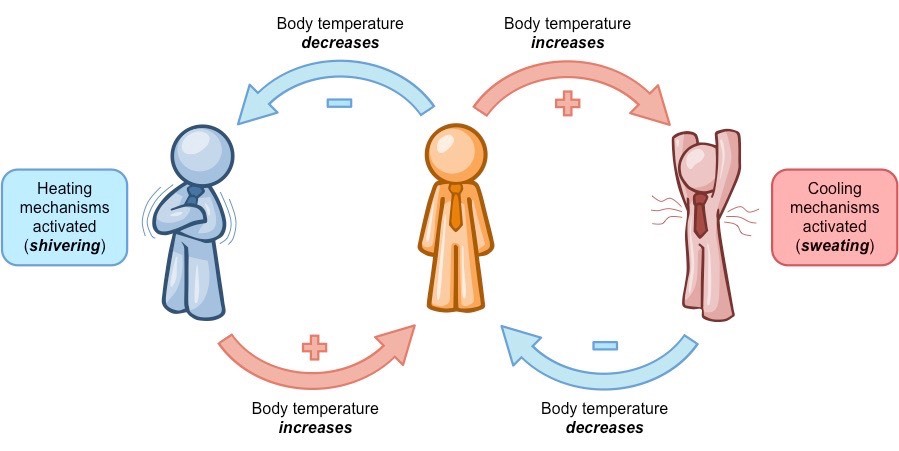
In this body temperature feedback loop, predict what would happen if cooling mechanisms were NOT activated?
The body would not warm up.
The body would not cool down.
Your body would get colder and colder.
Your body would release lots of heat.
31
Multiple Choice
A feedback loop best fits which characteristic of life?
Cells
Organization
Homeostasis
Adaptation
32
Multiple Choice

33
Multiple Choice
Homeostasis
allows for a wildly fluctuating internal environment
is impossible in vertebrates
is the maintenance of a relatively stable internal environment and often incorporates a form of feedback regulation
34
Multiple Choice
35
Multiple Choice
36
Multiple Choice
Which body system controls the body to maintain homeostasis?
excretory
nervous
circulatory
skeletal
Levels of
Organization
Show answer
Auto Play
Slide 1 / 36
SLIDE
Similar Resources on Wayground

32 questions
Quadratic Equations by Graphing
Presentation
•
9th - 12th Grade
28 questions
Evidence of Evolution
Presentation
•
9th - 12th Grade
34 questions
Biology EOC Reporting Category 1 Review
Presentation
•
9th - 12th Grade
29 questions
Pedigree Lesson 2022
Presentation
•
7th - 10th Grade
30 questions
Cycling of Energy
Presentation
•
9th - 12th Grade
31 questions
Intro Simple Harmonic Motion
Presentation
•
9th - 12th Grade
30 questions
Quinceañera
Presentation
•
9th - 12th Grade
Popular Resources on Wayground
10 questions
How much do you know about our Portrait of an Eagle?

Quiz
•
10th Grade
10 questions
Fast Food Slogans
Quiz
•
6th - 8th Grade
21 questions
Continents and Oceans
Quiz
•
6th Grade
20 questions
Parts of Speech
Quiz
•
5th Grade
16 questions
Subject & Predicate
Quiz
•
5th Grade
25 questions
Multiplication Facts
Quiz
•
5th Grade
12 questions
Map Skills
Quiz
•
3rd Grade
22 questions
Continents and Oceans
Quiz
•
5th Grade
Discover more resources for Biology
20 questions
Characteristics of Life
Quiz
•
9th - 10th Grade
10 questions
Exploring the 4 Major Macromolecules and Their Functions

Interactive video
•
9th - 12th Grade
20 questions
Cell organelles and functions
Quiz
•
10th Grade
20 questions
Cell Transport
Quiz
•
9th - 12th Grade
25 questions
photosynthesis and cellular respiration
Quiz
•
9th Grade
20 questions
Macromolecules
Quiz
•
10th Grade
16 questions
Population Ecology
Quiz
•
9th - 12th Grade
20 questions
Cell Organelles
Quiz
•
9th Grade