

Nature of Science, Scientific Laws vs. Theories

Presentation
•
Biology
•
12th Grade
•
Practice Problem
•
Medium
+7
Standards-aligned

Alicia Archer
Used 20+ times
FREE Resource
25 Slides • 15 Questions
1
Open Ended

Define "science" in your own words.
2
You can play the videos on your computer if you need to see better. Please mute your sound so there is not 30 videos playing in this room at once! Click the "CC" button in the corner if you need captions to appear on the screen.

3
Closed Caption Button

4
The Nature of Science
Science (from the Latin "scientia", meaning "knowledge") can be defined as knowledge about the natural world. The scientific method is a method of research with defined steps that include experiments and careful observation. One of the most important aspects of this method is the testing of hypotheses. A hypothesis is a suggested explanation for an event, which can be tested. Hypotheses, or tentative explanations, are generally produced within the context of a scientific theory.
5
6
Multiple Choice
Is the scientific method linear? (Does it have to go in steps?)
Yes
No
7
Scientific Method
Even if you were taught the scientific method in the past, it is not always the same steps in the same order!

8
9
Multiple Choice
What does "science" mean in Latin?
knowledge
biology
tree of life
10
11
Multiple Choice
What are you doing if you make an observation?
making a hypothesis
making an informed guess
gathering data
12
13
Multiple Choice
True or False? An "inference" can be used to make logical conclusions about observations.
True
False
14
Examples of an Inference
You try to open the door to my classroom. It does not budge.
You may infer that...
-the door is locked
You make an observation that there isn't anyone inside, you may infer...
-I am not in the room
You might even make a hypothesis that...
-I am running late
15
16
Multiple Choice
The control group...
does NOT receive the treatment
receives the treatment
17
18
Multiple Choice
The experimental group...
does NOT receive the treatment
receives the treatment
19
20
Multiple Choice
Controlled variables we try to keep the same in an experiment are called...
sameness
standard practice
constants
21
22
Open Ended
Are we done with science? Why?
23
What did we learn?
Nature of Science
Science means knowledge
The scientific method is NOT the same steps every time!
Observations are data you gather
An inference can be used to make logical conclusions about observations. I can infer what is happening based on what I know.
We are NOT done with science! We are still learning, discovering, and creating in the field of science.
We don't know everything there is to know in science!
24
What did we learn?
Nature of Science
A hypothesis is an educated guess about what will happen in your experiment that can be tested.
Observations are data you gather.
Controlled variables we try to keep the same in an experiment are called constants.
An inference can be used to make logical conclusions about observations.
Control group does NOT get the treatment, the experimental group does!
25
Scientific Theory vs. Law
A generally accepted scientific theory is thoroughly tested and confirmed explanation for a set of observations or phenomena. Scientific theory is the foundation of scientific knowledge. In addition, in many scientific disciplines (less so in biology) there are scientific laws, often expressed in mathematical formulas, which describe how elements of nature will behave under certain specific conditions.
26
Scientific Theory vs. Law
A scientific theory explains WHY something happens. A scientific law describes WHAT happens. For example: The theory of evolution explains why so many different animal species exist. The law of gravity describes what happens when you drop an object.
27
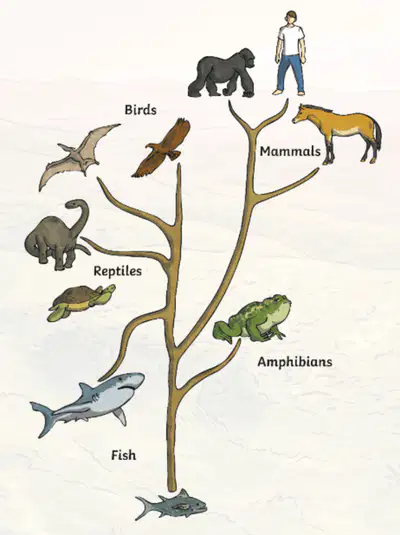
Why did so many species of animals evolve? The theory of evolution explains why!
28

What is happening? A person is falling due to the law of gravity. Laws can often be shown mathematically!
29
30
Open Ended
What is a hypothesis?
31
32
Open Ended
How do everyday people use the word "theory"? (what is its casual use)
33
34
Multiple Choice
What does a scientific theory have that other theories don't?
Enough people believe in them
Facts/Evidence
The theories have names
35
36
Multiple Choice
Can a scientific theory become a scientific law?
yes, with enough evidence and peer review
yes, but it doesn't happen often
no, they are different concepts
37
38
Multiple Choice
A scientific law can...
Describe WHY something happens
Describe WHAT is happening
39
Multiple Choice
A scientific theory can...
Describe WHY something happens
Describe WHAT is happening
40
What did we learn?
Scientific Laws vs. Scientific Theories
A scientific theory explains WHY something happens.
A scientific law describes WHAT happens. This is often described mathematically.
Example: Force = Mass x Acceleration
A hypothesis is an educated guess about what will happen in your experiment that can be tested.
Define "science" in your own words.
Show answer
Auto Play
Slide 1 / 40
OPEN ENDED
Similar Resources on Wayground

34 questions
The Federal Reserve
Presentation
•
12th Grade
37 questions
Tragedy Notes
Presentation
•
12th Grade
34 questions
Organization of Ecosystems
Presentation
•
12th Grade
36 questions
Unit 3 - Appendages of the Skin
Presentation
•
11th - 12th Grade
38 questions
Green house gas
Presentation
•
12th Grade
33 questions
Chapter 6 Integumentary System
Presentation
•
11th - 12th Grade
37 questions
PMA 1 Review Day
Presentation
•
12th Grade
Popular Resources on Wayground
10 questions
Factors 4th grade

Quiz
•
4th Grade
10 questions
Cinco de Mayo Trivia Questions

Interactive video
•
3rd - 5th Grade
13 questions
Cinco de mayo
Interactive video
•
6th - 8th Grade
20 questions
Math Review
Quiz
•
3rd Grade
20 questions
Main Idea and Details
Quiz
•
5th Grade
20 questions
Context Clues
Quiz
•
6th Grade
20 questions
Inferences
Quiz
•
4th Grade
19 questions
Classifying Quadrilaterals
Quiz
•
3rd Grade
Discover more resources for Biology
20 questions
Food Chains and Food Webs
Quiz
•
7th - 12th Grade
18 questions
Population Dynamics
Quiz
•
7th - 12th Grade
50 questions
NC EOC Biology Review part 1
Quiz
•
9th - 12th Grade
10 questions
Ameoba Sisters: Introduction to cells
Interactive video
•
9th - 12th Grade
15 questions
Evidence of Evolution
Quiz
•
8th - 12th Grade
50 questions
Biology Keystone Mixed Review
Quiz
•
9th - 12th Grade
20 questions
NC EOC Biology Review part 1
Quiz
•
9th - 12th Grade
100 questions
Virginia Biology SOL Review
Quiz
•
9th - 12th Grade