
11.2.5 STANDARD NOTES

Presentation
•
History
•
12th Grade
•
Easy

Andrew Lara
Used 12+ times
FREE Resource
12 Slides • 10 Questions
1

Trusts and Monopolies
2
In the late 19th century, the growth of corporate mergers led to monopolies in which one company controlled an entire industry.
The purpose of a trust was to eliminate competition and create a monopoly.
This was usually accomplished when a corporation bought out the stock of another corporation.
Monopoly

3
Trusts
In trust agreements, companies transfered their stock to a group of trustees, who ran the companies as one large organization.
The separate companies were entitled to large profits and dividends that the trusts earned
company
Trust
4
Multiple Choice
What was the purpose of a trust?
To allow companies to directly manage themselves.
To create force companies to pay taxes.
The purpose of a trust is to eliminate business competition
5
Multiple Choice
How do trusts function?
When companies transfer their stock to a trustee.
By having all companies in a trust compete
6

Owner of Standard Oil. (Oil Industry)
Standard Oil entered into trust agreements with competing oil companies.
He became wealthy by paying low wages to employees and driving competition out of business.
He did so by lowering his prices below the production price and raising the price again after the competition collapsed.
John D. Rockefeller
7
Horizontal Intergation
Horizontal integration is the business practice of buying out competing companies.
Drive a business competitor to the point of bankruptcy (going broke) and force them to sell their company to you.
Used by John D. Rockefeller.
8
Multiple Choice
Which industry helped John D. Rockefeller become rich?
Steel industry
9
Multiple Choice
What is the practice of Horizontal Integration?
The practice of diversifying into different industries.
The process of outsourcing production to other companies.
It involves merging or eliminating companies in the same industry.
10

He was the owner of Carnegie Steel. (Steel Industry)
Found new ways to make better steel more cheaply.
Used the business practice of vertical integration to gain control of materials and distribution.
Through vertical integration, Carnegie controlled the resources, manufacturing, and distribution of steel.
Carnegie was the largest steel manufacturer in the country.
Andrew Carnegie
11
Vertical Integration
Vertical integration is the business strategy of buying out suppliers and distributors.
Carnegie bought out all the suppliers of the materials required to make his steel.
He controlled the coal fields and iron mines.
He also bought the transportation system. This meant he didn’t have to pay for his steel to be transported

12
Multiple Choice
What is the business practice of Vertical Integration?
A practice where a company controls multiple stages of production or distribution within its industry.
13
Multiple Choice
Why industry helped Andrew Carnegie gain his massive wealth?
14
Gospel of Wealth
Wrote the Gospel of Wealth in which he stated that the rich should act as stewards of the poor. (help the poor)
Before his death, Carnegie donated much of his wealth. Nearly 350 million dollars to charity.

15
Titles
Powerful industrialists like Carnegie and Rockefeller were either praised or criticized for their business practices.
Those who criticized industrialists referred to them as Robber Barons.
Those who supported industrialists called them Captains of Industry.

16
Multiple Choice
The Gospel of Wealth says that the rich should help the poor.
El Evangelio de la Riqueza dice que los ricos deben ayudar a los pobres.
True
Verdadero
False
Falso
17
Laissez Faire Capitalism
Industrial leaders did not like government regulation of their industries.
To argue against the government regulation of business, industrialists used the theory of laissez-faire capitalism.
Laissez-faire essentially is the economic idea that the less government is involved in business the better. Business will grow and by extension so would society.
18
Sherman Anti-Trust Act
As corporate mergers and monopolies were threatening business competition, Congress passed the Sherman Anti-trust Act in 1890.
The Sherman Anti-Trust Act made it illegal for companies to create trusts that interfered with free trade between states and with other countries.
The goal of the Sherman Anti-Trust Act was to promote fair industrial competition in the United States.
19
Multiple Choice
What was the intended goal of the Sherman Anti-Trust Act?
To eliminate all forms of business competition.
20
Failure of the Sherman Act
The act was difficult to enforce and was ineffective in breaking up big businesses.
Business leaders used it against labor union activities, which they claimed interfered with free trade.

21
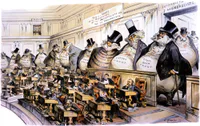
Labeling
Label the Images in the political cartoon with the term that it represents.
Etiquete las imágenes en la caricatura política con lo que se supone que representan.
Rockefeller
Competition
Government
22
Open Ended

What message is the artist of this cartoon trying to convey about Rockefeller? Explain?
¿Qué mensaje está tratando de transmitir el artista de esta caricatura sobre Rockefeller? ¿Explicar?
Trusts and Monopolies
Show answer
Auto Play
Slide 1 / 22
SLIDE
Similar Resources on Wayground

16 questions
Gênero Conto
Presentation
•
12th Grade
18 questions
JANJANG
Presentation
•
12th Grade
19 questions
ECONOMICS TOPIC 1 LESSON 2
Presentation
•
12th Grade
14 questions
Kolonialisme Barat di Indonesia
Presentation
•
11th Grade
16 questions
Review Text Bahasa Inggris Peminatan
Presentation
•
12th Grade
18 questions
Lesson 7.5 - Roosevelt's New Deal
Presentation
•
8th - 9th Grade
15 questions
VSC 3.1--Articles of Confederation: Strengths and Weaknesses
Presentation
•
11th Grade
17 questions
Food Chain/Food Web Recap
Presentation
•
12th Grade
Popular Resources on Wayground
10 questions
Safety Day 2026 – Student Review

Quiz
•
9th Grade
21 questions
Continents and Oceans
Quiz
•
6th Grade
20 questions
Parts of Speech
Quiz
•
5th Grade
16 questions
Subject & Predicate
Quiz
•
5th Grade
25 questions
Multiplication Facts
Quiz
•
5th Grade
12 questions
Map Skills
Quiz
•
3rd Grade
22 questions
Continents and Oceans
Quiz
•
5th Grade
15 questions
Rounding Decimals
Quiz
•
5th Grade