
Mexico Becomes Independent III

Presentation
•
Social Studies
•
7th Grade
•
Practice Problem
•
Easy

CARLOS TRINIDAD
Used 7+ times
FREE Resource
9 Slides • 14 Questions
1
Lesson 3: The End of Spanish Rule
2
Open Ended
Who called for rebellion against Spain, and why?
3
In this lesson, you will...
learn why Mexican independence was important for Texas, and the lasting effects of Spanish rule on the region.
4
McGraw Hill Texas History
For this lesson, you will be reading:
Chapter 7: Mexico Becomes Independent
Lesson 3: The End of Spanish Rule
Remember to use your AVID notes for this lesson.
5

In 1820 a rebellion began in Spain.
Military leaders tried to force the country’s ruler, King Ferdinand, to accept a constitution.
This constitution would have limited royal powers. A civil war broke out between the king’s supporters and his opponents.
Because of this conflict, Spain paid little attention to the needs of the Mexican people.
6

Countless people from across Mexico, such as church officials, joined the revolution.
In 1820 Agustín de Iturbide took command of the revolutionary army.
In February 1821, Iturbide issued his plan to establish a Mexican empire.
Iturbide’s Plan de Iguala offered people of Mexico three guarantees, or promises, and a plan for government.
7
Plan de Iguala
Guarantees:
The Mexican people would be independent from Spain.
The Mexican people would unite, with equal rights for mestizos and
criollos.
Mexico would be a Catholic nation.
Plan of Government:
Government would be a constitutional monarchy with an elected congress of representatives.
8
Open Ended
Who was Agustín de Iturbide and what did he do ?
9
In the summer of 1821, the Spanish viceroy was replaced. His successor was Juan O’Donojú.
O’Donojú arrived in July and quickly realized that the Spanish could not defeat the Mexican revolutionaries.
O’Donojú agreed to a treaty with Iturbide. The two leaders signed the Treaty of Córdoba on August 24, 1821.
This treaty created the independent nation of Mexico, and ended colonial rule in Texas. The former Spanish province of Texas became a territory of a free Mexico.
10
Open Ended
Why did the Spanish viceroy agree to a treaty with Iturbide?
11

Spain’s influence is deeply rooted in Texas culture, traditions, and people.
The first European language to be used in North America, beginning 500 years ago, was Spanish.
Nearly 40 percent of Texas’s population is Hispanic. Family names such as Garcia, Hernandez, Martinez, and Gonzalez are some of the most common names in the country now.
Nearly 6 million Texans today have Spanish names.
12

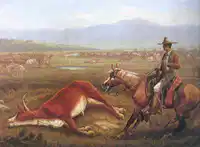
Cattle ranches in Texas adopted Spanish ranching methods and equipment, such as chaps and lariats.
Chaps are leather leggings that offer protection from spiny plants.
Mexican vaqueros, or cowboys, made the first long cattle drives.
In Texas, settlers were quick to adopt Spanish customs. They created a distinct Tejano culture that continues in the state today.
13
Open Ended
What was the first European language to be used in North America?
14
Multiple Choice
The road the Spanish called El Camino Real stretched from _____.
Dallas to Houston
Austin to Amarillo
Nacogchoches to Laredo
Brownsville to El Paso
15
Multiple Choice
What characteristic defined someone as a criollo?
being Mexican of Spanish descent
being of mixed Spanish and Native American heritage
coming originally from the United States
supporting the Mexican independence movement
16
Multiple Choice
One example of Spanish influence on Texas is the state's _____.
Native Americans
place names
office of governor
cotton industry
17
Multiple Choice
The _____ ended Spanish rule Mexico.
New Mexico Treaty
Treaty of New Orleans
Treaty of Córdoba
Adams-Onís Treaty
18
Multiple Choice
People of mixed Spanish and Native American heritage were known as _____.
mestizos
Tejanos
criollos
Texians
19
Multiple Choice
Mexico won its independence from Spain on August 24 of what year?
1836
1821
1811
1845
20
Multiple Choice
At the end of Spain's rule, _____ was the largest settlement in Texas.
Goliad
Houston
Nacogdoches
San Antonio
21
Multiple Choice
A long, light rope with a noose on the end used for catching cattle is called a _____.
lariat
vaquero
cuerda
snare
22
Multiple Choice
_____ is a Spanish term for cowboy.
lariat
vaquero
cuerda
snare
23
Multiple Choice
Agustín de Iturbide's Plan de Iguala confirmed the Mexican people's devotion to the _____ Church.
Spanish
Catholic
Protestant
Orthodox
Lesson 3: The End of Spanish Rule
Show answer
Auto Play
Slide 1 / 23
SLIDE
Similar Resources on Wayground

16 questions
Influences on Japan
Presentation
•
7th Grade
18 questions
Black History - Significant African Americans
Presentation
•
7th Grade
18 questions
Sam Houston’s Presidency
Presentation
•
7th Grade
17 questions
Age of Jackson
Presentation
•
7th Grade
19 questions
Civil War and Reconstruction
Presentation
•
7th Grade
20 questions
US Conflicts in SW Asia Crash Course
Presentation
•
7th Grade
19 questions
War of 1812
Presentation
•
7th - 8th Grade
15 questions
The History of Voting Rights in America
Presentation
•
7th Grade
Popular Resources on Wayground
10 questions
Safety Day 2026 – Student Review

Quiz
•
9th Grade
21 questions
Continents and Oceans
Quiz
•
6th Grade
20 questions
Parts of Speech
Quiz
•
5th Grade
16 questions
Subject & Predicate
Quiz
•
5th Grade
25 questions
Multiplication Facts
Quiz
•
5th Grade
12 questions
Map Skills
Quiz
•
3rd Grade
22 questions
Continents and Oceans
Quiz
•
5th Grade
15 questions
Rounding Decimals
Quiz
•
5th Grade
Discover more resources for Social Studies
19 questions
Foundations of America
Quiz
•
6th - 8th Grade
10 questions
Exploring the Age of Exploration: Key Events and Figures

Interactive video
•
6th - 10th Grade
15 questions
Middle Ages of the Middle East Vocab List (CFA #2)
Quiz
•
6th - 8th Grade
10 questions
13 Colonies: Comparing Regions
Quiz
•
7th Grade
26 questions
SW Asia History
Quiz
•
7th Grade
16 questions
Causes of the Texas Revolution
Quiz
•
7th Grade
14 questions
Types of Government Overview (SW Asia)
Presentation
•
7th Grade
8 questions
DLT 1: Citizen Participations
Quiz
•
7th Grade