
Smooth as Silk: Mastering Sandpaper and Finishing Wood

Presentation
•
Specialty
•
6th - 8th Grade
•
Practice Problem
•
Medium

Laura Allinder
Used 1+ times
FREE Resource
10 Slides • 9 Questions
1
Mastering Sandpaper and Finishing Wood
2
3
Introduction to Sandpaper
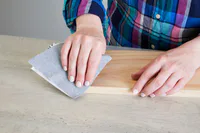
Sandpaper is an essential tool for finishing wood.
It consists of abrasive particles (like sand) bonded to a paper or cloth backing.
***Abrasive means something is capable of rubbing or grinding a hard surface.***
***Bonded means glued together.***
4
Multiple Choice
Abrasive means something is capable of:
waxing a surface
removing dust
sawing through wood
rubbing or grinding a surface
5
Fill in the Blanks
6
Choose the right grit for your project
lower, coarser, grits for rough sanding (40-100)
higher, finer grits for fine finishing. (120-440)
***Grit is a rating system for the size of the abrasive particles.***
Always sand with the grain of the wood to avoid scratches.
Remember to move from lower to higher grits for a smoother finish.
7
Dropdown
8
Multiple Choice
What is the purpose of using higher grits when sanding wood?
To avoid scratches
To achieve a smoother finish
To remove rough imperfections
To bond abrasive particles
9
Smooth Finish
Trivia: Using higher grits when sanding wood helps achieve a smoother finish. It removes rough imperfections and avoids scratches. Higher grits also bond abrasive particles better. So, next time you sand wood, remember to start with a lower grit and gradually work your way up for that perfect smoothness!
10
Drag and Drop
11
Types of Sandpaper Grits
12
Categorize
40
60
80
100
120
220
340
440
13
Multiple Choice
What is the purpose of using coarse grit sandpaper?
To achieve a polished surface
To smooth rough surfaces
To provide a smooth finish
To remove material quickly
14
Coarse Grit Sandpaper:
15
Mastering Sandpaper and Finishing Wood
Start with a coarse grit: Remove imperfections and shape the wood.
Progress to finer grits: Smooth the surface and remove scratches.
Use a sanding block: Maintain even pressure and prevent uneven sanding.
Sand in the direction of the grain: Avoid cross-grain scratches.
Finish with a fine grit: Achieve a smooth, polished surface.
Remove dust: Clean the surface thoroughly before applying finish to ensure a flawless result.
16
Multiple Choice
What is the purpose of using a sanding block?
To remove imperfections and shape the wood
To smooth the surface and remove scratches
To maintain even pressure and prevent uneven sanding
To achieve a smooth, polished surface
17
Do it yourself (DYI)
Pro tip: You can make your own sanding block by wrapping a piece of sandpaper around a small scrap piece of wood.
18
Maintaining Even Pressure
Trivia: Using a sanding block helps maintain even pressure and prevents uneven sanding. This ensures a smooth and polished surface. It also helps in removing imperfections, shaping the wood, and smoothing the surface to remove scratches. Remember to use a sanding block for a professional finish!
19
Fill in the Blanks
You should always sand
Mastering Sandpaper and Finishing Wood
Show answer
Auto Play
Slide 1 / 19
SLIDE
Similar Resources on Wayground

16 questions
Run-Ons, Fragments, and Complete Sentences
Presentation
•
5th - 8th Grade
14 questions
Amping up your Thesis with Adjectives
Presentation
•
7th Grade
17 questions
Reasons for the 13 Colonies
Presentation
•
7th Grade
15 questions
Egyptian Rulers of the New Kingdom
Presentation
•
6th - 8th Grade
16 questions
Patterns of Thermal Energy
Presentation
•
6th - 8th Grade
12 questions
Setting
Presentation
•
6th Grade
17 questions
Reading Inventory Practice
Presentation
•
6th - 8th Grade
Popular Resources on Wayground
10 questions
Safety Day 2026 – Student Review

Quiz
•
9th Grade
21 questions
Continents and Oceans
Quiz
•
6th Grade
20 questions
Parts of Speech
Quiz
•
5th Grade
16 questions
Subject & Predicate
Quiz
•
5th Grade
25 questions
Multiplication Facts
Quiz
•
5th Grade
12 questions
Map Skills
Quiz
•
3rd Grade
22 questions
Continents and Oceans
Quiz
•
5th Grade
15 questions
Rounding Decimals
Quiz
•
5th Grade