

Meterology notes

Presentation
•
Science
•
12th Grade
•
Practice Problem
•
Medium
+8
Standards-aligned

Alice Mccall
Used 6+ times
FREE Resource
38 Slides • 10 Questions
1

Meteorology
The study of atmospheric
phenomena
2

Weather vs. Climate
• Weather: the current state of the
atmosphere
• Climate: long-term variations in
weather for a particular area
3

Weather terms
• Humidity: a measure of the amount of water
the air is holding at a certain temperature
• Dew Point: the temperature at which dew or
rain will fall from the air.
• Barometric pressure: a measure of how hard
the air is pressing down. (low pressure is
rainy/storm and high pressure is clear.)
4

• Meteorology
is the study of
weather on
the surface as
well as in the
atmosphere.
5

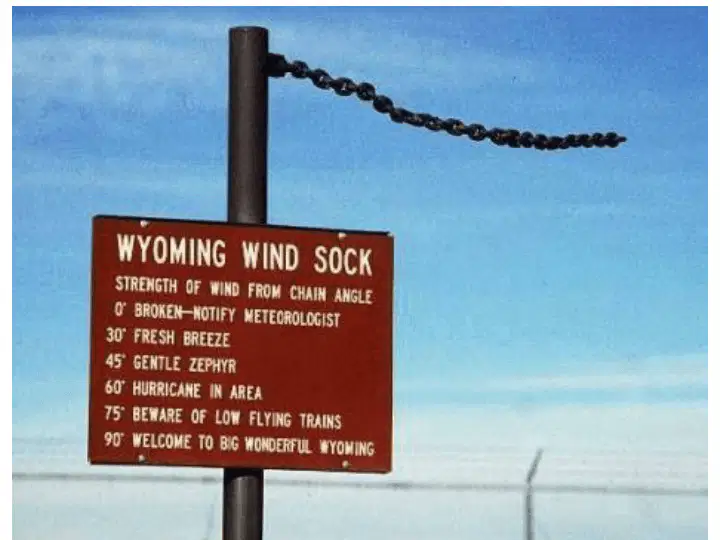
Wind Systems cause weather
• A wind system is caused by air flowing from
areas of HIGH pressure to areas of LOW
pressure.
• Wind systems are named based on the
direction they come from. Ex: A northeast
wind comes from the NORTHEAST- and flows
toward the SOUTHWEST.
6
7
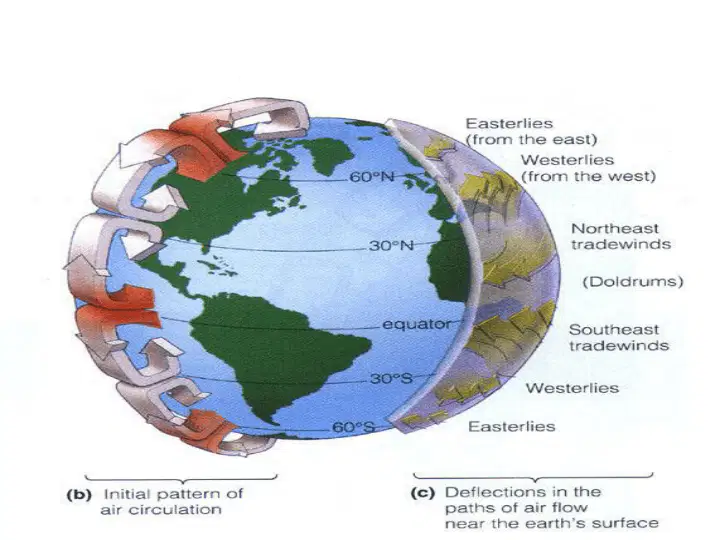
What are the wind systems of Earth
8
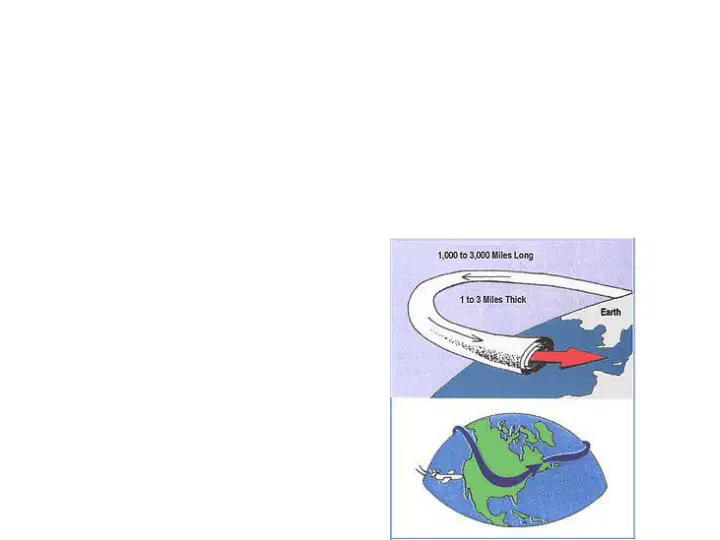
What is the Jet Stream
The Jet stream is a high altitude, narrow
westerly wind, band that occurs above
large temperature contrasts and can flow
as fast as 185 km/h
9

Surface data
• Different tools are used to measure different
data on the surface:
• Thermometers measure temperature.
• Barometers measure air pressure.
• Anemometers measure wind speed.
• Hygrometers measure relative humidity.
10

How is weather measured in the
Atmosphere?
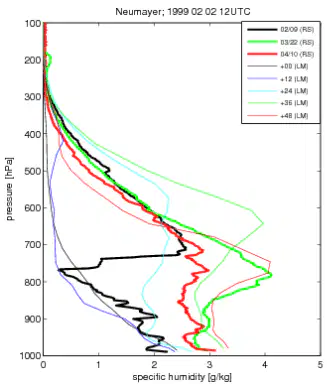
A radiosonde is a small package of sensors
used in weather balloons to measure pressure,
altitude, wind speed, and humidity.
• Data is transmitted back to ground stations
by radio signals and plotted on a chart.
• These charts are used in forecasting and
predicting changes in surface weather.
11


12

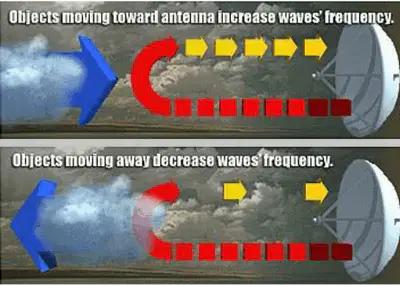
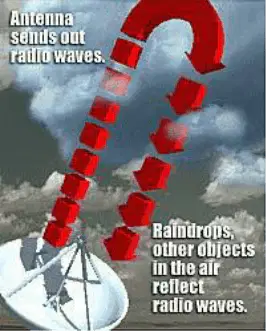
How does Doppler Radar work
13

How to read a weather radar | Understanding the colors | wcnc.com
You can open this webpage in a new tab.
14
Multiple Choice
Long term averages in the weather are considered
climate
weather
15
Multiple Choice
Winds are named based on where they:
go to
come from
16

Air masses
• A large body of air that takes on the
characteristics of the area over which it forms.
17

Air Masses
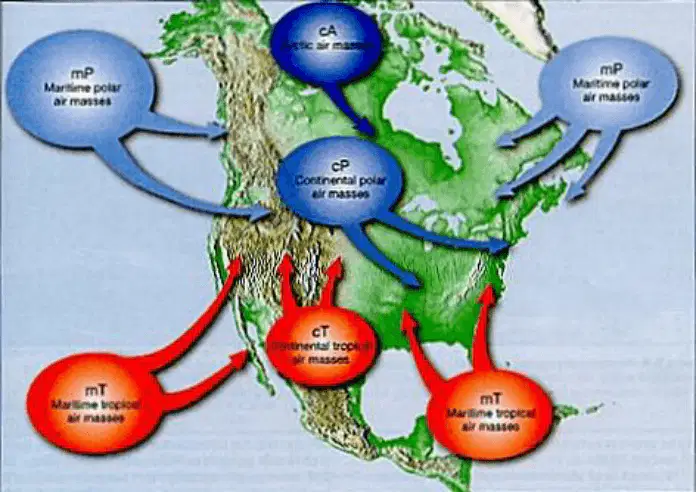
• Air masses are classified according to their
source regions. The main types of air
masses, are
• warm and dry continental tropical,
• warm and humid maritime tropical,
• cold and dry continental polar,
• cold and humid maritime polar,
• and arctic.
All five main types of air masses
can be found in North America.
18

19
Multiple Choice
A warm humid air mass is classified as:
maritime tropical
maritime polar
continental tropical
continental polar
20
Multiple Choice
A cold dry air mass is classified as:
maritime tropical
maritime polar
continental tropical
continental polar
21

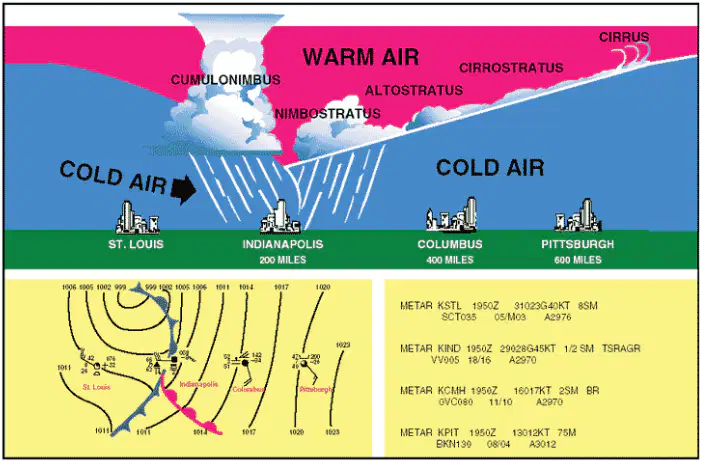
• Air masses do not stay in one place. When the air masses move, it changes the weather.
What is a weather front?
A front is a boundary between two different
air masses, resulting in stormy weather. A
front usually is a line of separation between
warm and cold air masses.
22

• How do you identify a front on a surface
weather map or by your own weather
observations?
Look for: changes in
• Temperature
• Pressure
• Humidity
• Wind
23

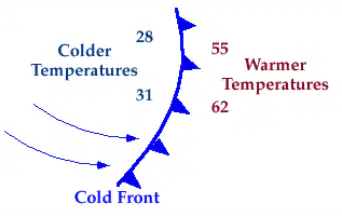
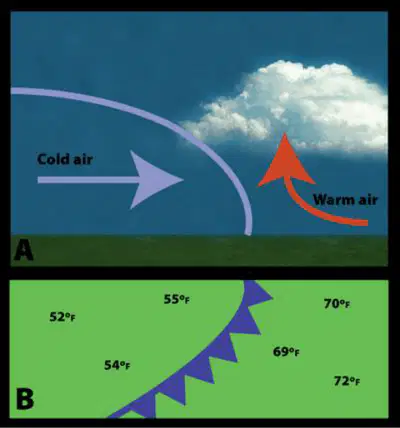
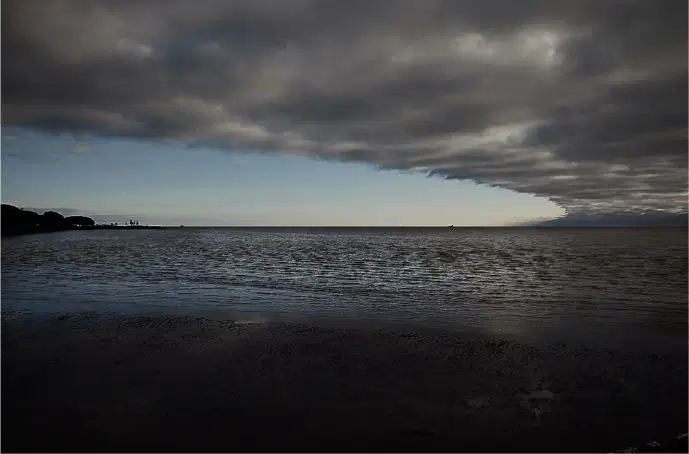
• What is a cold front?
A cold front is a
boundary between two
air masses, one cold
and the other warm,
moving so that the
colder air replaces the
warmer air. These usually move through quickly.
Weather? Rain,
thunderstorms
24

25

26

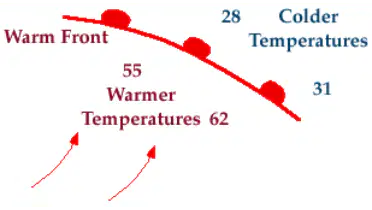
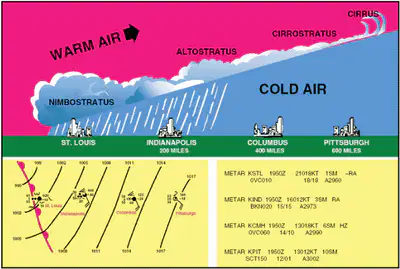
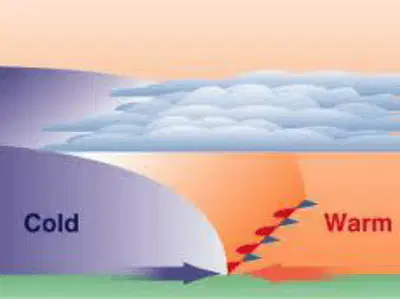
• What is a warm front?
A warm front is a
boundary between two
air masses, one cool
and the other warm,
moving so that the
warmer air replaces the
cooler air.
• Weather? Usually rain
over a longer period of
time. Less violent.
27

28

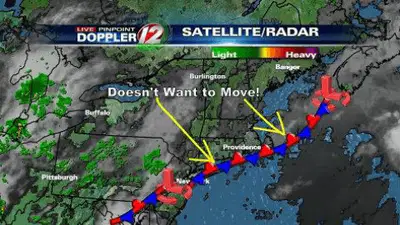
• What is a stationary front?
A stationary front is a boundary between two
air masses that more or less doesn’t move,
Rainy
for
days
29

30

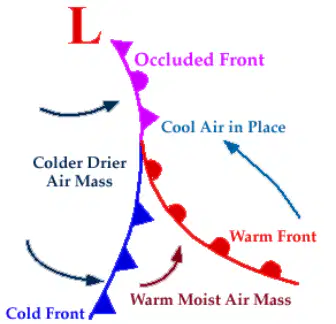
• What is an occluded
front?
An occluded front is a
combination of two
fronts that form when a
cold front catches up
and overtakes a warm
front. A counterclockwise circulation results.
• Weather? Rainy, stormy,
bomb cyclone
31

32
33
Multiple Choice
When cold air moves into warmer air, warmer air
rises over the cold forming clouds
sinks under the cold forming clear skies
rises over the cold forming clear skies
sinks under the cold forming clouds
34
Multiple Choice
A bomb cyclone, a severe storm with pressure that drops quickly often forms due to a(an)
cold front
warm front
occluded front
stationary front
35
Multiple Choice
Which type of front typically moves through faster than the others?
cold front
warm front
occluded front
stationary front
36

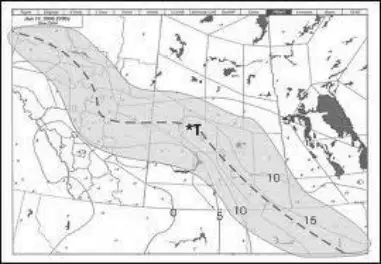
• What is a trough?
A trough on a
weather map is an
elongated area of
relatively low
pressure.
• Weather? cloudy
and rainy.
37
Not this
38

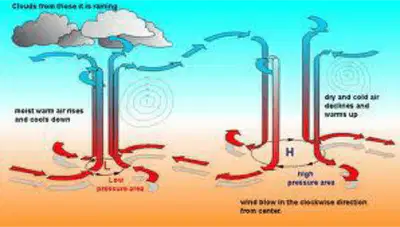
High versus low pressures
39
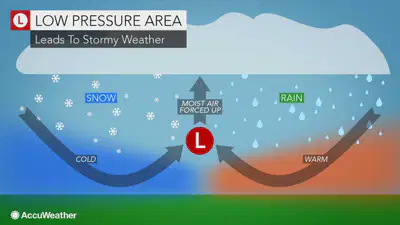
High pressure means the air is falling, thus the air is clear.
Low pressure means the air is rising into the atmosphere, thus we get rain and storms. The lower the pressure, the worse the storm
40

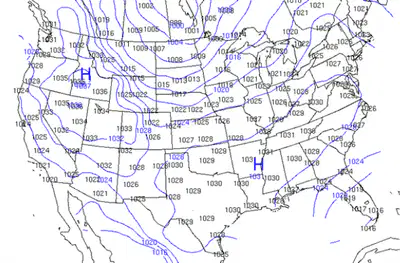
isobars
• Lines that connect areas of equal pressure
41

42

What do close together isobars mean?
• Isobars are kind of like contour lines on a map.
If they are closer together the gradient is
“steeper.”
• The winds are blowing from the high to the
low pressure→high winds when lines are
close together.
43
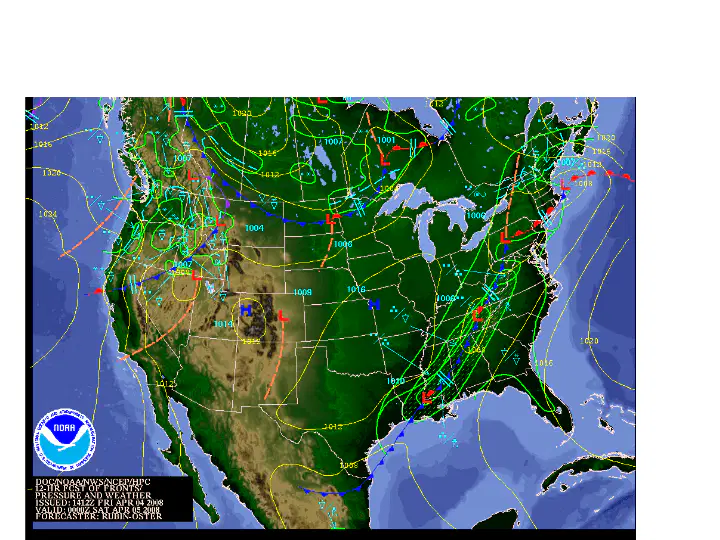
Where is it windy?
44

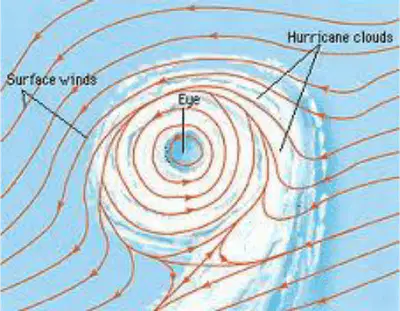
Isobars during a hurricane
45

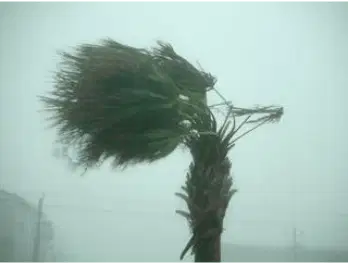
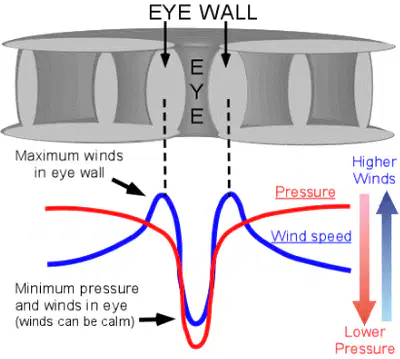
Air pressure in a hurricane eye can be as
low as 899 millibars (26.5 inches Hg)!
46
Multiple Choice
When isobars are close together, the wind will be
fast wind
light wind
47
Multiple Choice
Wind moves from
high pressure to low
low pressure to high
high pressure to high
low pressure to low
48
Poll
When I grow up, I would LOVE to be
a meteorolgist
a TV weather reporter
an Earth Science teacher who can teach about weather
all of the above
Meteorology
The study of atmospheric
phenomena
Show answer
Auto Play
Slide 1 / 48
SLIDE
Similar Resources on Wayground

45 questions
Solutions 2024 Lesson
Presentation
•
12th Grade
45 questions
Planets
Presentation
•
KG
46 questions
Atoms, Tek 8.5B, and 8.5C
Presentation
•
KG - University
46 questions
Science Olympiad Prep Group Review
Presentation
•
KG - 12th Grade
44 questions
Bio 12.1 and 12.2 LESSON
Presentation
•
12th Grade - University
46 questions
ESS 1.1
Presentation
•
12th Grade
41 questions
Photosynthesis
Presentation
•
11th Grade
45 questions
Ecology
Presentation
•
12th Grade
Popular Resources on Wayground
19 questions
Naming Polygons

Quiz
•
3rd Grade
10 questions
Prime Factorization
Quiz
•
6th Grade
20 questions
Math Review
Quiz
•
3rd Grade
15 questions
Fast food
Quiz
•
7th Grade
20 questions
Main Idea and Details
Quiz
•
5th Grade
20 questions
Context Clues
Quiz
•
6th Grade
20 questions
Inferences
Quiz
•
4th Grade
19 questions
Classifying Quadrilaterals
Quiz
•
3rd Grade
Discover more resources for Science
100 questions
Biology EOC Review
Quiz
•
9th - 12th Grade
25 questions
Biology EOC review Quiz
Quiz
•
9th - 12th Grade
21 questions
Biology EOC Review (ecology)
Quiz
•
9th - 12th Grade
30 questions
Environmental Science Final Exam REVIEW
Quiz
•
9th - 12th Grade
49 questions
AP Environmental Science Final Exam Review
Quiz
•
10th Grade - University
16 questions
Taxonomy and Classification
Quiz
•
6th - 12th Grade
50 questions
Biology EOC Review
Quiz
•
9th - 12th Grade
28 questions
Greenhouse effect
Quiz
•
9th - 12th Grade