
The Amazing World of Mitosis

Presentation
•
Biology
•
9th - 12th Grade
•
Practice Problem
•
Hard
Standards-aligned

Michelle Price
Used 1+ times
FREE Resource
12 Slides • 5 Questions
1
The World of Mitosis
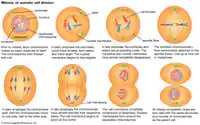
Explore the fascinating process of cell division and its importance in growth, development, and repair. Discover the key stages and mechanisms involved in mitosis, a fundamental process in all living organisms.
2
3
Interphase: The Preparation Phase
4
Multiple Choice
Which phase of the cell cycle is the longest?
prophase
metaphase
interphase
telophase
5
G2 Phase
G2 phase is the longest phase of the cell cycle. It is the time when the cell prepares for division by growing and replicating its DNA. During this phase, the cell checks for any errors in DNA replication and repairs them. Once the cell completes G2 phase, it enters the M phase where it divides into two daughter cells.
6
Prophase: Getting Ready
Nucleolus disappears.
7
Multiple Choice
What is the first stage of mitosis?
Anaphase
Prophase
Telophase
Metaphase
8
First Stage of Mitosis: Prophase
Trivia: During prophase, the genetic material condenses into visible chromosomes. The nuclear membrane dissolves, and the spindle fibers start to form. This stage prepares the cell for division. Prophase is derived from the Greek words 'pro' meaning 'before' and 'phasis' meaning 'appearance'.
9
Mitosis: Metaphase
During metaphase, chromosomes align along the equatorial plane of the cell. This alignment is crucial for the accurate distribution of genetic material to the daughter cells. The spindle fibers attach to the centromeres of each chromosome, ensuring proper alignment and tension.
10
Multiple Choice
What is the role of spindle fibers during metaphase in mitosis?
To ensure proper alignment and tension of chromosomes
To initiate the process of cell division
To break down the nuclear envelope
To form the equatorial plane of the cell
11
Spindle Fibers:
12
Anaphase: Chromosome Separation
During anaphase, the sister chromatids separate and move towards opposite poles of the cell. This process is facilitated by the spindle fibers, which attach to the centromeres and pull the chromosomes apart. Once separated, each chromatid becomes an individual chromosome.
13
Multiple Choice
What is the role of spindle fibers during anaphase?
To separate the sister chromatids
To attach to the centromeres
To move towards opposite poles of the cell
To ensure each daughter cell receives a complete set of chromosomes
14
Spindle Fibers:
To ensure each daughter cell receives a complete set of chromosomes. During anaphase, spindle fibers attach to the centromeres and separate the sister chromatids, allowing them to move towards opposite poles of the cell. This process ensures that each daughter cell receives a complete set of chromosomes for proper cell division.
15
Telophase: Cell Division
16
Multiple Choice
What is the final stage of mitosis?
Prophase
Metaphase
Anaphase
Telophase
17
Telophase
Telophase is the final stage of mitosis. During this stage, the chromosomes have reached opposite poles of the cell and begin to decondense. The nuclear envelope reforms around each set of chromosomes, and the cell undergoes cytokinesis, resulting in two separate daughter cells. Telophase marks the completion of cell division.
The World of Mitosis
Explore the fascinating process of cell division and its importance in growth, development, and repair. Discover the key stages and mechanisms involved in mitosis, a fundamental process in all living organisms.
Show answer
Auto Play
Slide 1 / 17
SLIDE
Similar Resources on Wayground

13 questions
Protein Synthesis and Mutations Review
Presentation
•
9th - 12th Grade
12 questions
Word Choice,: Figurative, Connotative, and Impact
Presentation
•
9th - 12th Grade
11 questions
Teenager 5 Session 22: Pronunciation & Speaking
Presentation
•
KG
13 questions
Congruent Triangles
Presentation
•
9th - 12th Grade
14 questions
Carbon and Nitrogen Cycle
Presentation
•
9th - 12th Grade
15 questions
Endocrine System
Presentation
•
9th - 12th Grade
14 questions
2 Lesson: BIO.A.2.3 Enzymes
Presentation
•
9th - 12th Grade
16 questions
Observations and Inferences
Presentation
•
9th - 12th Grade
Popular Resources on Wayground
6 questions
PRIDE Always and Everywhere
Presentation
•
12th Grade
20 questions
Lab Safety Quiz

Quiz
•
6th Grade
26 questions
KOR Review Kahoot Questions
Quiz
•
8th Grade
21 questions
Continents and Oceans
Quiz
•
6th Grade
12 questions
Unit Zero lesson 2 cafeteria
Presentation
•
9th - 12th Grade
20 questions
Parts of Speech
Quiz
•
5th Grade
10 questions
Riddles Riddles fun Riddles
Quiz
•
6th - 12th Grade
16 questions
Subject & Predicate
Quiz
•
5th Grade
Discover more resources for Biology
20 questions
Characteristics of Life
Quiz
•
9th - 10th Grade
20 questions
Scientific Method & Variables
Quiz
•
9th - 12th Grade
10 questions
Exploring the 4 Major Macromolecules and Their Functions

Interactive video
•
9th - 12th Grade
20 questions
Cell Transport
Quiz
•
9th - 12th Grade
20 questions
Biomolecules
Quiz
•
9th Grade
25 questions
photosynthesis and cellular respiration
Quiz
•
9th Grade
20 questions
Characteristics of Life
Quiz
•
7th - 10th Grade
26 questions
Quiz Week 2 REVIEW (9/4/26)
Quiz
•
9th - 12th Grade