

untitled

Presentation
•
Science, Geography
•
•
Practice Problem
•
Easy

Benevolence Yangsi
Used 1+ times
FREE Resource
16 Slides • 22 Questions
1
Fronts

2
Fronts
Front: boundaries of air masses Differ by temperature, density, and humidity
- The weather we experience depends on which front is dominant
- Fronts bring precipitation

3
Cold Front
- A Cold air masses pushes a warm air mass upward
- The air & weather becomes cooler
- Heavy precipitation and storms follow
- Tall cumulonimbus clouds form because the wind is pushing air & water vapor upward

4
Multiple Choice
During a cold front you are likely to experience...
Thunderstorm
Light drizzle
Sunny Weather
5
Warm Front
- A warm air mass overtakes a cold air mass
- The temperature warms as cold air is pushed back
- Water vapor causes high humidity
- Precipitation is milder (ex. drizzles)

6
Multiple Choice
A warm front...
replaces warm air with cool air
replaces cool air with warm air
7
Stationary Front
- A warm and cold air mass meet trying to move in opposite directions
- Neither is moved
- Heavy storms & precipitation can last for days

8
Multiple Choice
True or False: Stationary fronts try to move in the opposite direction, while occluded fronts move in the same direction
True
False
9
Occluded Front
- A warm air mass is caught between 2 cold air masses
- Cold air masses rise over the warmer
- Strong winds and heavy precipitation result

10
Multiple Choice
All fronts are associated with which pressure system?
High
Low
11
Multiple Select
Which front causes precipitation? (Check all that apply)
Cold
Warm
Stationary
Occluded
12
Multiple Choice
Which front has the densest air?
Occluded
Stationary
Cold
Warm
13
Air Masses:
Air masses are formed by the HEATING and COOLING of land and water.
Air masses are large bodies of air that have the same TEMPERATURE and MOISTURE level throughout.
There are FOUR (4) types of air masses:
- CONTINENTAL POLAR (cP)
- CONTINENTAL TROPICAL (cT)
- MARITIME POLAR (mP)
- MARITIME TROPICAL (mT)
The INTERACTION between air masses can impact WEATHER, CONVECTION CURRENTS and WIND.
14
Multiple Choice
Air masses are formed by the ________ and ________ of land and water.
Heating and cooling
Increasing volume and temperature
cooling and increasing pressure
Heating and increasing the density
15
Multiple Choice
The INTERACTION between air masses can impact,
WEATHER,
CONVECTION CURRENTS
WINDS.
All of the above
16
Multiple Choice
High pressure will usually bring what kind of weather?
Clear skies
Cloudy
High humidity
17
Multiple Choice

What type of front is shown?
Warm Front
Cold Front
18
Cold Fronts
Cold air pushes underneath warm air. Clouds collect and make heavy thunderstorms and precipitation.

19
Multiple Choice
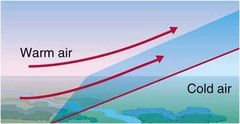
This is a Warm front. Do you expect the weather to be more intense or less intense?
More
Less
20
Warm Fronts
CLoud cover moves over the cold front. Clouds spread out
Weather lasts longer but is more intense.

21
Weather and Climate
Explain the geographic factors that influence the movement of groups of people in the world.
I can compare and contrast weather and climate accurately and list factors that affect climate.
Determine the meaning of words and phrases in oral presentations and literary and informational text.
I can define Weather and Climate accurately.

22
Weather
Weather is the short-term changes in the air for a given place and time. For example: if it is raining outside your window right now, that is the weather.

23
Open Ended
Look outside your window.
What is the weather like right now?
24
Climate
Climate is a region's average weather conditions over a long period of time. For example: if summers are usually hot and muggy, it tells you something about climate.

25
Open Ended
We live in Yakima, Washington.
What are some words you might use to describe our climate during the summertime.
26
Multiple Choice
"It snowed last night."
Is this talking about Weather or Climate.
Weather
Climate
27
Multiple Choice
"It is usually freezing cold in the winter and very hot in the summer in Yakima, Washington."
Is this talking about Weather or Climate?
Weather
Climate
28
Open Ended
Explain one or more differences between weather and climate. USE COMPLETE SENTENCES.
29
Factors that effect Climate
Sun
Location
Wind
Water
Mountains
30
Sun and Location
Because of Earth's tilt, movement and shape different places on Earth receive different amounts of sunlight.

31
Multiple Choice
What is it called when the Earth spins on its axis?
Revolution
Rotation
32
Multiple Choice
What is it called when the Earth revolves around the Sun?
Rotation
Revolution
33
Multiple Choice
Does warm air rise or sink?
Rise
Sink
34
Mountains
Even in warm places, mountains will have snow on them because it is colder at a higher elevation. They also create wet and dry areas by forcing the air pushing against it to rise. As the air rises, it cools and causes the moisture in the air to fall. This side of the mountain is often green and lush. Once the air gets to the other side of the mountain it sinks and has little moisture left creating a dry side.

35
Open Ended
List at least three of the five factors that affect climate.
36
Multiple Choice
What is the major cause of ocean waves?
wind
ocean salinity
Earth’s rotation
the Moon’s gravity
37

38
Multiple Choice
Which statement best describes how a meteorologist predicts the weather for an area?
The meteorologist searches the internet for information about the weather.
The meteorologist speaks with other meteorologists and asks their opinions.
The meteorologist makes a prediction using a variety of weather sources and date.
The meteorologist watches the way animals behave for clues about the weather.
Fronts
Show answer
Auto Play
Slide 1 / 38
SLIDE
Similar Resources on Wayground

32 questions
TCi Adaptation Lesson 3
Presentation
•
6th - 8th Grade
33 questions
Energy Transfer in Ecosystems
Presentation
•
6th - 10th Grade
33 questions
Organs & Organ Systems
Presentation
•
7th Grade
33 questions
life cycle of stars
Presentation
•
8th - 12th Grade
33 questions
Specific Heat & Local Winds
Presentation
•
6th - 8th Grade
33 questions
Weather Instruments
Presentation
•
3rd - 5th Grade
32 questions
Forces and Motion
Presentation
•
5th Grade
32 questions
Genetic Engineering
Presentation
•
8th Grade
Popular Resources on Wayground
28 questions
US History Regents Review

Quiz
•
11th Grade
36 questions
Biology Regents Review
Quiz
•
9th - 10th Grade
20 questions
Math Review
Quiz
•
3rd Grade
38 questions
Regents Life Science General Review
Quiz
•
9th Grade
20 questions
Math Review
Quiz
•
6th Grade
21 questions
EOY Grade 6 Benchmark Assessment - Content Skills
Quiz
•
6th Grade
20 questions
Inferences
Quiz
•
4th Grade
20 questions
Figurative Language Review
Quiz
•
6th Grade
Discover more resources for Science
59 questions
SS Final Exam Review
Quiz
•
KG - University
19 questions
Disney Movies
Quiz
•
KG - 8th Grade
23 questions
super heros
Quiz
•
KG - Professional Dev...
15 questions
Music 2016
Quiz
•
KG - 12th Grade
63 questions
Sight Words
Quiz
•
KG
41 questions
End of the YEAR Trivia FUN!
Quiz
•
KG - 3rd Grade
20 questions
Place Value
Quiz
•
KG - 3rd Grade