7th-T2 L1: States of Matter
Presentation
•
Science
•
6th - 8th Grade
•
Practice Problem
•
Easy
+8
Standards-aligned
Angeles Pedroza
Used 2+ times
FREE Resource
21 Slides • 30 Questions
1
2
3
4
5
Draw
How many solids, liquids, and gases can you find in this picture? Label the solids with an S, liquids with an L, and gases with a G.
6
7
Drag and Drop
8
Labelling
What are the three different states of matter?
solid
gas
liquid
energy
9
10
11
Dropdown
12
Drag and Drop
13
Drag and Drop
14
Multiple Choice
The particles in a solid are closely locked in position so that they ________move around one another on their own.
cannot
can
15
Multiple Choice
The particles in a solid can only ________ in place, meaning they move back and forth slightly.
16
17
18
Multiple Choice
True or false: All solids are the same.
true
false
19
Multiple Select
Not all solids are the same. Some are.....? (hint: 3 answers)
hard/flexible
smooth/sharp
heavy/light
liquid/gas
20
Word Cloud
People at a packed concert don’t move very far, but if they’re having fun, they’re not standing still, either! These people dancing in place are a lot like particles vibrating in a solid.
Think about the motion of the particles in a solid and come up with your own way of describing them.
21
Open Ended
Write down the differences that you notice in shape, structure, and texture between the quartz and the eraser.
22
23
24
Draw
A pat of butter is an amorphous solid. The particles that make up the butter are not arranged in a regular pattern. The sapphire gem stones are crystalline solids. Draw what you think the particles look like in a crystalline solid.
25
Drag and Drop
26
Multiple Select
________, ________, and ________ are examples of crystalline solids.
salt
sugar
snow
liquids
27
Multiple Choice
What do crystalline and amorphous solid shave in common?
They have a definite shape and a
definite volume
28
29
30
Drag and Drop
31
Drag and Drop
32
Drag and Drop
33
Drag and Drop
34
Multiple Choice
When the water spilled, what changed: its shape or its volume?
shape
volume
35
36
Multiple Choice
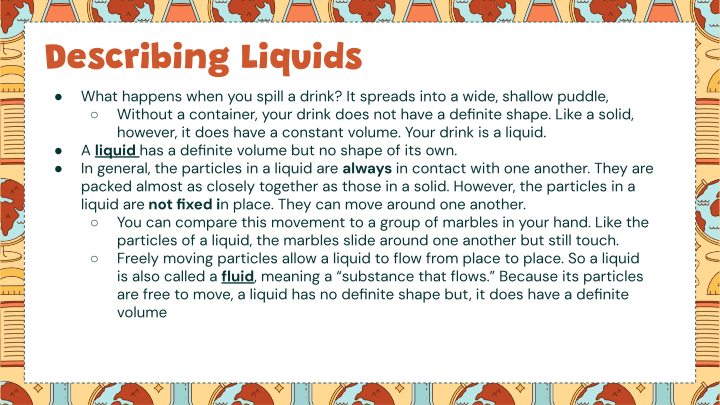
What is a liquid?
A liquid has both a definite volume and shape.
A liquid has no volume or shape.
Liquids have definite vol-ume but no shape of its own
37
Multiple Choice
How are particles in liquids different from particles in solids?
Particles in liquids cannot move around like particles in solids.
Particles in liquids can move around one another; in solids, they are in a fixed
place
Particles in liquids and solids have the same amount of movement.
38
39
40
41
42
Multiple Select
What are the two major characteristic properties of liquids? (hint: 2 answers)
surface tension
viscosity
fluid
43
Drag and Drop
44
Drag and Drop
45
Multiple Choice
Honey flows slowly compared to many other liquids. Does it have more or less viscosity than water?
more
less
46
Match
Match the following
Means liquids can flow easily
Means liquids cannot flow easily
Means liquids can break apart more easily
Means liquids cannot be broken apart easily
Low Viscosity
High Viscosity
Low Surface Tension
High Surface Tensions
Low Viscosity
High Viscosity
Low Surface Tension
High Surface Tensions
47
48
49
Drag and Drop
50
Multiple Choice
Particles in a gas _________ remain in contact with one another.
do not
do
51
Show answer
Auto Play
Slide 1 / 51
SLIDE

Similar Resources on Wayground
46 questions
Phase Changes and Heat Energy Cornell Doodle Notes
Presentation
•
6th - 8th Grade
42 questions
7th Grade Science Benchmark 3 Review
Presentation
•
6th - 8th Grade
47 questions
Tools to Measure Matter
Presentation
•
6th - 8th Grade
47 questions
Metric Measuring Matter Lesson
Presentation
•
6th - 8th Grade
46 questions
Mixtures and separation
Presentation
•
6th - 7th Grade
46 questions
Cells
Presentation
•
6th - 8th Grade
45 questions
cell organelles
Presentation
•
6th - 8th Grade
47 questions
Weather and Water
Presentation
•
6th - 8th Grade
Popular Resources on Wayground
20 questions
"What is the question asking??" Grades 3-5
Quiz
•
1st - 5th Grade
20 questions
“What is the question asking??” Grades 6-8
Quiz
•
6th - 8th Grade
10 questions
Fire Safety Quiz
Quiz
•
12th Grade
20 questions
Equivalent Fractions
Quiz
•
3rd Grade
34 questions
STAAR Review 6th - 8th grade Reading Part 1
Quiz
•
6th - 8th Grade
20 questions
“What is the question asking??” English I-II
Quiz
•
9th - 12th Grade
20 questions
Main Idea and Details
Quiz
•
5th Grade
47 questions
8th Grade Reading STAAR Ultimate Review!
Quiz
•
8th Grade
Discover more resources for Science
20 questions
8th Grade Science STAAR Review
Quiz
•
8th Grade
8 questions
Amoeba Sister Asexual vs Sexual Reproduction
Interactive video
•
8th Grade
19 questions
Introduction to Properties of Waves
Presentation
•
6th - 8th Grade
16 questions
Interactions within Ecosystems
Presentation
•
6th - 8th Grade
20 questions
Rocks and The Rock Cycle
Quiz
•
6th Grade
20 questions
genetics, punnett squares, heredity
Quiz
•
7th Grade
16 questions
Photosynthesis and Cellular Respiration Review
Quiz
•
7th Grade
10 questions
Ecosystem levels of organization
Quiz
•
6th Grade