
- Resource Library
- Social Studies
- History
- ...
- From Pearl Harbor To The Atomic Bomb: A Turning Point In History

From Pearl Harbor to the Atomic Bomb: A Turning Point in History

Presentation
•
Social Studies
•
9th - 12th Grade
•
Practice Problem
•
Medium

Linda Cox
Used 1+ times
FREE Resource
10 Slides • 5 Questions
1
From Pearl Harbor to the Atomic Bomb: A pivotal moment that shaped the world.
2
Pearl Harbor:
3
Multiple Choice
What event led to the United States' entry into World War II and the use of atomic bombs on Hiroshima and Nagasaki?
Attack on Pearl Harbor
D-Day invasion
Battle of Stalingrad
Bombing of London
4
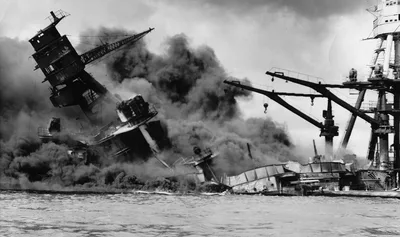
5
Turning Point in History
Infamous Speech: President Roosevelt's address to Congress on December 8, 1941, asking for a declaration of war against Japan.
This lead to the development of the atomic bomb.

6
Multiple Choice
Which event marked the development and use of atomic bombs by the US on Hiroshima and Nagasaki in August 1945?
Pearl Harbor attack
Infamous Speech
D-Day invasion
Atomic Bomb
7
Atomic Bomb
Trivia: The development and use of atomic bombs by the US on Hiroshima and Nagasaki in August 1945 marked a turning point in history. The bombings resulted in the immediate deaths of around 200,000 people and had long-lasting effects on the survivors. The bombings also led to Japan's surrender, effectively ending World War II.
8
Turning Point in History
Pearl Harbor: Japanese attack on US naval base in 1941
Atomic Bomb: US drops atomic bombs on Hiroshima and Nagasaki in 1945
9
Multiple Choice
Which event was a plan for peace after World War I?
Pearl Harbor
Atomic Bomb
Fourteen Points
Hiroshima and Nagasaki
10
The Manhattan Project
11
Multiple Choice
Who were the key figures in the development of atomic weapons?
Albert Einstein
Marie Curie
Robert Oppenheimer
Enrico Fermi
12
Key Figures in Atomic Weapons
Trivia: Robert Oppenheimer was the scientific director of the Manhattan Project, which developed the first atomic bomb. Albert Einstein, although not directly involved in the project, wrote a letter to President Roosevelt urging the development of atomic weapons. Marie Curie made significant contributions to the field of radioactivity, but was not involved in atomic weapons. Enrico Fermi played a crucial role in the development of the first controlled nuclear chain reaction.
13
Turning Point in History
14
Multiple Choice
What event marked the beginning of the nuclear age?
Japanese attack on US naval base
First atomic bomb dropped
Second atomic bomb dropped
End of World War II
15
The Nuclear Age
Trivia: The beginning of the nuclear age was marked by the first atomic bomb dropped. This event occurred during World War II and forever changed the course of history. The immense power and destructive capabilities of nuclear weapons have since shaped global politics and warfare strategies.
From Pearl Harbor to the Atomic Bomb: A pivotal moment that shaped the world.
Show answer
Auto Play
Slide 1 / 15
SLIDE
Similar Resources on Wayground

10 questions
The Renaissance 2 lesson
Presentation
•
9th - 12th Grade
11 questions
Civil Rights/Civil Liberties
Presentation
•
9th - 12th Grade
11 questions
Statistical Evaluation
Presentation
•
9th - 12th Grade
10 questions
Writing an equation from a graph
Presentation
•
9th - 12th Grade
10 questions
Domain 2 Lesson 3
Presentation
•
9th - 12th Grade
11 questions
Teenager 5 Session 24: Pronunciation & Speaking
Presentation
•
KG
11 questions
Spanish 1 Los #s 20-100
Presentation
•
9th - 12th Grade
11 questions
PASSIVE VOICE
Presentation
•
9th - 12th Grade
Popular Resources on Wayground
10 questions
How much do you know about our Portrait of an Eagle?

Quiz
•
10th Grade
10 questions
Fast Food Slogans
Quiz
•
6th - 8th Grade
21 questions
Continents and Oceans
Quiz
•
6th Grade
20 questions
Parts of Speech
Quiz
•
5th Grade
16 questions
Subject & Predicate
Quiz
•
5th Grade
25 questions
Multiplication Facts
Quiz
•
5th Grade
12 questions
Map Skills
Quiz
•
3rd Grade
22 questions
Continents and Oceans
Quiz
•
5th Grade
Discover more resources for Social Studies
10 questions
Exploring the Age of Exploration: Key Events and Figures

Interactive video
•
6th - 10th Grade
17 questions
1.3 Review
Presentation
•
11th Grade
10 questions
Exploring the 13 Colonies Regions
Interactive video
•
6th - 10th Grade
8 questions
Smith Unit 5 Quick Check #1 Big Business, Monopolies &Technology
Quiz
•
11th Grade
46 questions
Unit 1 Test REVIEW Ancient Greece and Rome
Quiz
•
9th - 12th Grade
10 questions
Exploring Ancient Mesopotamia Through Song
Interactive video
•
6th - 10th Grade
27 questions
Supply & Demand Test Review
Quiz
•
12th Grade
36 questions
Unit 5 Key Terms
Quiz
•
11th Grade - University