Search Header Logo
Phy Sci Sem 1 Exam Review

Phy Sci Sem 1 Exam Review

Assessment

Presentation

Science

10th Grade

Medium

Created by

John Oglesby

Used 1+ times

FREE Resource

50 Slides • 89 Questions

1

Physical Science
Semester 1 Exam Review - 2023-24

2

Topic Questions Pts/each Total
Metric System 2 2 4
Properties & Change 5 2 10
Per. Table Organization 8 2 16
Ionic Bonding 10 2 20
Covalent Bonding 8 2 16
Acids 4 2 8
Essay Questions 2 5 10

total 47 100

3

Metric System
Units of Measure

4

Base Units

  • Volume = Liters = L

  • Mass = Grams = g

  • Length = meters = m

media

5

The Metric System

media

6

Prefixes

  • The Metric system is based on multiples of tens.

media

7

Remember

  • “King Henry Doesn’t (Usually) Drink Chocolate Milk”

media

8

Multiple Select

Which units below are NOT part of the metric system? Check all that apply.

1

Inches

2

Feet

3

Meters

4

Grams

9

Multiple Select

Which units are the BASE units in the metric system? Check all that apply.

1

Meters

2

Liters

3

Grams

4

Inches

5

Miles

10

Multiple Choice

The metric unit of measurement for length is ____________________. 
1
Liter
2
Meter
3
gram
4
inch

11

Multiple Choice

The metric unit of measurement for weight or mass is ________________.
1
Gram
2
Liter
3
Pound
4
Meter

12

Multiple Choice

The metric unit of measurement for capacity or volume is ________________.
1
Gram
2
Meter
3
Liter
4
Ounce

13

Converting Units

  • Changing a Metric Units to another Metric Unit

  • Moving BIG unit to small Multiply

  • Moving small to BIG Divide

media

14

Multiple Choice

42 L = ? mL

1

4,200

2

.0042

3

4.20

4

42,000

15

Multiple Choice

400 cg = ? g
1
4
2
40
3
50
4
400

16

Multiple Choice

Convert:

3 kg = ? g

1

3

2

30

3

300

4

3,000

17

Physical Properties of an Element

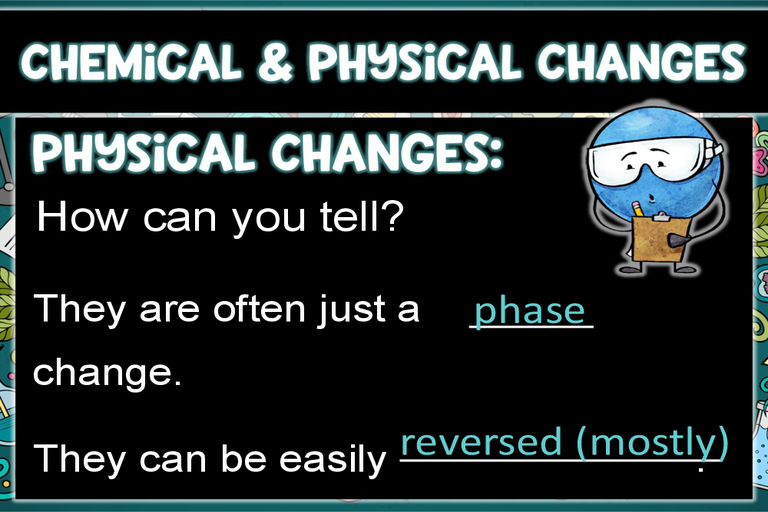
Physical Property: Characteristics that can be observed or measured without changing the composition (identity) of a substance


You don't have to change what an apple is made of to see that it is red and being able to hold it in your hand


media

18

Multiple Select

Density is a physical property that describes the relationshipep between the ________ of its _________.

1

matter, volume

2

mass, volume

3

volume, matter

4

none of the above

19


Physical Propeties

Density is a property that describes the relationship between the mass of a material and its volume. It does not change the substance.


Substances that have a higher density contain more matter (stuff) in a given volume.


The density of a substance will stay constant/the same.


media

20

Multiple Choice

The physical property melting point is the

1

temperature at which a liquid changes to a solid

2

temperature at which a liquid boils

3

temperature at which a solid can change to a liquid

21

Multiple Choice

The tranisition metal copper has luster. This means

1

is is very dull

2

it is very shiny

3

it is very thin

4

it is very dirty

22

Physical Property-Boiling Point

  • The temperature at which liquid boils.

  • A substance can change from a liquid to a gas.

  • Boiling temperature is unchanging under constant conditions for a given substance.


media

23

Open Ended

Explain malleable and ductile metals. What can be done to them?

24

Physical Properties of Metals

  • Good conductor of heat and electricity.

  • Conductivity- does it heat up or allow electricity to pass through it.

  • Is it ductile- can it be stretched out into a wire.

  • Can it be hammered into sheets or pounded into shapes- Malleable.

  • Do they have luster- are they Shiny?

  • They are solid at room temperature. Except for Mercury (Hg).

media

25

Multiple Choice

Which is a Physical property?

1

A metal can react with water to become a metal oxide (rust)

2

A metal can be hammered into a shape (malleable)

26

Multiple Choice

Which is a Chemical property

1

A metal can react with water to form a metal oxide (rust)

2

A metal can be hammered into a shape (malleable)

27

Chemical Properties

  • Flammability- the ability of a chemical to burn or ignite.

  • Combustibility-how easily a substance can burst into flames, through fire or combustion.

  • Toxicity-an elements ability to become toxic or poisonous

  • pH- how acidic or basicity something is. Acidic can have a sour taste, smell that burns, and a sticky texture. Basicity can be bitter like baking soda, no smell, and slippery.

media

​Describes the ability of a substance to react with another substance to become something else

​Magnesium can react with oxygen (burn) to become magnesium oxide (let me demonstrate)

28

Chemical Properties Continued

  • Reactivity- the ability of matter to react chemically with other substances.

  • Oxidize- ability to react with oxgyen

  • Ability of substances to react with acids or water but not all substances do this.

29

media
media

Anther physical property is

MAGNETISM

• Whether or not an

object is attracted
to a magnet

30

media

More EXAMPLES -

Physical

• size, shape, freezing point, boiling

point, melting point, magnetism,
viscosity, density, luster and many
more.
– Viscosity - The resistance of a liquid to

flowing.

– Examples:
– Low viscosity-water, rubbing alcohol
– High viscosity-honey

31

media
media
media

Chemical Properties

• When a substance interacts with

another substance to change its
chemical make-up.

32

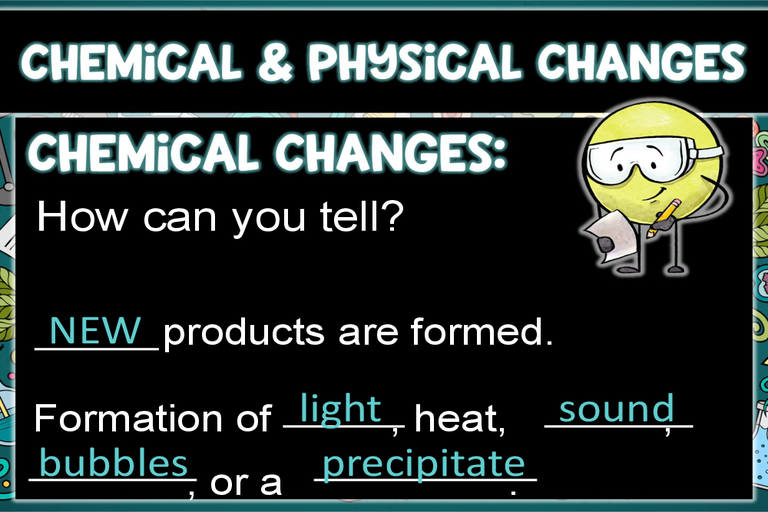
media

Chemical properties include:

• Flammability
• Rusting
• Reactive to water
• pH
• odor
• Produces gas bubbles
• New product is created

33

media
media

Flammability

the ability to catch on fire

34

Multiple Choice

Which is an example of a chemical change?

1

ripping paper

2

chopping wood

3

baking a cake

4

stretching a rubber band

35

Multiple Choice

If I take a piece of paper and rip it up into pieces, is that a physical or chemical change?

1

Chemical

2

Physical

36

media

37

Multiple Choice

A Log chopped into firewood is an example of a _________ change

1

Physical

2

Chemical

38

media

39

Multiple Choice

Burning firewood in the fireplace is an example of a ________ change

1

Physical

2

Chemical

40

Atomic Structure

media

41

Atomic Structure

media

42

Electron

media

43

Multiple Choice

What is the charge of a proton?

1

Negative

2

Positive

3

Neutral

44

media

45

media

46

Multiple Choice

What is the charge of a neutron?

1

Negative

2

Positive

3

Neutral

47

media

48

Open Ended

What are the particles circulating around the Nucleus

49

media

50

media

51

Multiple Choice

A charged atom is called a(n)...

1

electron.

2

ion.

3

proton.

4

acid.

52

Atoms & their parts

The center of the atom is called the nucleus. The nucleus of most atoms is made up of two kinds of particles, protons & neutrons. Protons carry a positive (+) charge. Charge is an electrical property that can by either positive or negative.

Neutrons have no charge. The masses of protons and neutrons are measured in the atomic mass units (amu). Each proton or neutron has a mass of about 1 amu.

Electrons are subatomic particles that exist in an area outside the nucleus called the electron cloud. Electrons have a negative (-) charge. The mass of electrons is insignificant compared to the mass of protons & neutrons.

media

53

Multiple Choice

Which of the following parts of an atom are positively charged?

1

neutron

2

proton

3

electron

4

nucleus

54

Multiple Choice

Question image

What is the charge on an electron?

1

+1

2

0

3

-1

4

-2

55

Multiple Choice

Question image

What is the centre of an atom called?

1

Nucleus

2

Electron

3

Proton

4

Neutron

56

Multiple Choice

  1. 1) What is the charge of the nucleus of an atom?

1

negative

2

positive

3

neutral

4

none

57

Multiple Choice

Question image

What word describes two atoms of the same element but a different number of neutrons.

1

Isomer

2

Isolate

3

Isotope

4

Isopale

58

Multiple Choice

Question image

This is a neutrally-charged lithium ion. It has 3 protons and 3 neutrons. How many electrons does it have?

1

9

2

0

3

6

4

3

59

Multiple Choice

What are subatomic particles? 
1
the nucleus 
2
electron cloud
3
positive charge
4
electrons, protons, and neutrons

60

Multiple Choice

Question image

If the atomic number is 7 and the mass number 17 how many protons does the atom have?

1

17

2

7

3

10

4

0

61

Multiple Choice

Subatomic particle with a charge of 0
1
neutron
2
proton
3
electron
4
quark

62

Multiple Choice

Which of the following determines the identity of an element?

1

number of protons

2

atomic mass

3

number of neutrons

4

number of shells

63

Multiple Choice

Valence electrons are the...

1

Innermost electrons

2

Middle electrons

3

Outermost electrons

4

Any electrons

64

media

65

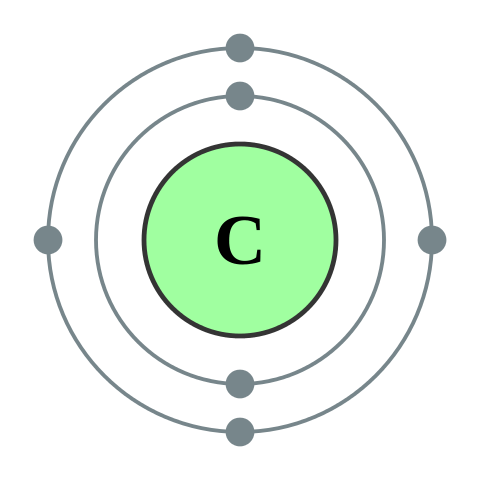
Multiple Choice

Question image

How many valence electrons does carbon have?

1

4

2

5

3

6

4

7

66

media

67

Multiple Choice

Question image

1

2

2

8

3

3

4

13

68

media

69

media

70

Multiple Choice

Which element is similar to Li?

1

Be

2

K

71

Multiple Choice

Question image

How many valence electrons does an atom of Fluorine have?

1

11

2

2

3

9

4

7

72

Multiple Choice

Which element is similar to Mg?

1

Ca

2

B

73

Groups & Periods

  • Groups: Columns; up & down, similar properties. ⬆️ ⬇️

  • Periods: Rows; left to right; increasing atomic ➡️ ⬅️

media

74

Multiple Choice

Students in Mrs. Clark's science class are investigating a substance that has the following properties

-shiny

-bends easily

-hard, not easily broken


Based on these properties how would you classify the substance?

1

metal

2

nonmetal

3

metalloid

75

Multiple Choice

The majority of the periodic table is made up of

1

Metals

2

Nonmetals

3

Metalloids

4

Noble gases

76

Multiple Choice

Which element is similar to F?

1

Ne

2

Cl

77

Multiple Choice

Question image
Look at the periodic table that is provided. Where would nonmetals be located? 
1
to the left of the table 
2
to the right of the table 
3
in the zigzag line 

78

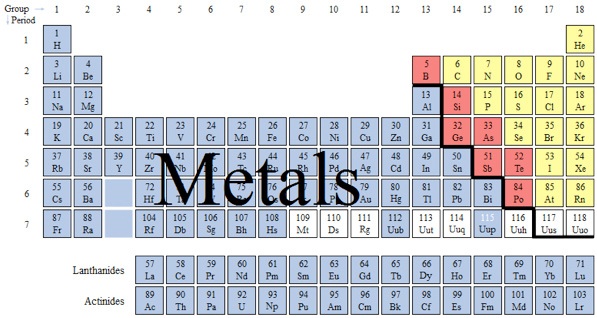
Metals, Nonmetals, Metalloids

  • Metals: ductile, malleable, luster, solids

  • Metalloids: properties of metals & nonmetals

  • Nonmetals: brittle & dull

media

79

Multiple Choice

Question image
Look at the periodic table that is provided. Where would metals be located? 
1
to the left of the table 
2
to the right of the table 
3
in the zigzag line 

80

Multiple Choice

Question image

Which color identifies as the group non-metals?

1

neither color

2

blue

3

red

4

yellow

81

media

82

media

83

Multiple Choice

Question image

The vertical (up and down) columns in the Periodic Table are called

1

groups

2

towers

3

periods

4

atomic numbers

84

media

85

Multiple Choice

Question image

How many valence electrons are found in atoms of group 1?

1

7

2

6

3

4

4

1

86

Multiple Choice

Question image

USE THE PERIODIC TABLE

How many valence electrons does Phosphorus have?

1

31

2

5

3

15

4

4

87

Multiple Choice

Question image

How many valence electrons does carbon have?

1

4

2

5

3

6

4

7

88

Multiple Choice

If we combine Zn2+ with O2- , what will be the chemical formula and name of the compound?

1

Zn2O2 -zinc dioxide

2

ZnO - zinc oxygen

3

ZnO2 - zinc (II) oxide

4

ZnO - zinc oxide

89

Naming ionic compounds is pretty simple.

  • Cation + Anion = ionic compound

media

90

Multiple Choice

Co+2  combines with NO2-  to form
1
Co2(NO2)
2
Co(NO2)2
3
NO(Co)2
4
Co(NO)3

91

Multiple Choice

Lithium Chloride

1

LiCl

2

Li3Cl

3

LiClO3

4

LiClO4

92

Multiple Choice

AlPO4

1

Aluminum Phosphide

2

Aluminum Phosphoxide

3

Aluminum Phosphorus Oxide

4

Aluminum Phosphate

93

Aluminum + Chlorine

  • Aluminum ion has a 3+ charge after giving its valence electrons to Chlorine

  • Chlorine has 7 valence electrons on each atom, only having room for 1 more

  • This electron transfer forms Chloride ions

  • It takes 3 Chlorine atoms to absorb the electrons from Aluminum

  • Aluminum Chloride is formed

  • AlCl3

media

94

Multiple Choice

copper(II) chloride
1
CuCl2
2
CuCl
3
Cu2Cl
4
Cu2Cl2

95

media

96

Multiple Choice

Cobalt (II) Oxide

1

Co2O

2

CoO2

3

CoO

4

Co2O2

97

Fill in the Blanks

media image

98

Match

Match each compound with the correct name

Fe(NO3)3

Fe(NO3)2

Fe(NO2)3

Fe(NO2)2

iron(III) nitrate

iron(II) nitrate

iron(III) nitrite

iron(II) nitrite

99

Multiple Choice

Which of the following is the correct ionic formula for a Barium and Phosphate compound?

1

Ba(PO4)

2

Ba3(PO4)

3

Ba3(PO4)2

4

Ba2(PO4)3

100

Match

Match the following compounds with the correct name

Au3N

AuN

AuNO3

AuNO2

Au(NO3)3

gold(I) nitride

gold(III) nitride

gold(I) nitrate

gold(I) nitrite

gold(III) nitrate

101

Naming compounds with Transition Metals

  • Use a roman numeral after the cation to show the charge of the transition metal

  • Fe3+ is named Iron (III)

  • Fe2+ is named Iron (II)

  • Everything else stays the same

media

102

Examples: Chromium and Oxygen

  • Chromium 2+ becomes Chromium (II)

  • Cr2+ + O2- --> CrO

  • Chromium (II) oxide

  • Chromium 3+ becomes Chromium (III)

  • Cr3+ + O2- --> Cr2O3

  • Chromium (III) oxide

103

Multiple Choice

FeCl3

1

Iron (III) Chloride

2

Iron (III) Chlorate

3

Iron (II) Chloride

4

Iron (II) Chromate

104

Mixed Practice

Binary Ionic

Ionic with Polyatomics

Ionic with Transition Metals

Iionic with Transition metals and Polyatomics

105

Multiple Choice

Name the following ionic compound: MgSO4

1

magnesium (II) sulfide

2

magnesium sulfide

3

magnesium sulfate

4

magnesium (II) sulfate

106

Multiple Choice

Name the following ionic compound: BeCl2
1
beryllium chlorine
2
beryllium II chloride
3
beryllium chloride
4
beryllium dichloride

107

Multiple Choice

Name the following compound: FeCl3

1

iron chloride

2

iron III chloride

3

iron II chloride

4

iron III chlorate

108

Multiple Choice

The formula for Magnesium phosphide is:

1

Mg3(PO4)2

2

MgP

3

MgPO4

4

Mg3P2

109

Multiple Choice

What is the formula for manganese(III) oxide?

1

MnO

2

MnO3

3

Mn3O

4

Mn2O3

110

Multiple Choice

WHAT IS THE FORMULA FOR COPPER(II) SULFATE?

1

CuS

2

Cu(SO4)4

3

CuSO4

4

CuSO

111

Multiple Choice

WHAT IS THE FORMULA FOR LITHIUM OXIDE?

1

LiO2

2

Li2O

3

Li2O3

4

LiO

112

Multiple Choice

WHAT IS THE NAME FOR Ti(ClO3)2

1

TITANIUM CHLORATE

2

TITANIUM CHLORIDE

3

TITANIUM(II) CHLORATE

4

TITANIUM(II) CHLORIDE

113

Multiple Choice

phosphorus trichloride
1
KCl3
2
PCl3
3
K3Cl
4
P3Cl

114

Multiple Choice

WHAT IS THE NAME FOR Cr(NO3)2?

1

CHROMIUM NITRATE

2

CHROMIUM(II) NITRATE

3

CHROMIUM DINITRATE

4

CHROMIUM(II) NITRIDE

115

Multiple Choice

silicon dioxide
1
SO2
2
NaO2
3
SiO2
4
SiO

116

G10 Review on Covalent Bonding

Unit 3 Session 2

media

117

Multiple Choice

diphosphorus pentoxide
1
P2O5
2
PO5
3
P5O2
4
P2O6

118

Covalent Compounds

A covalent compound is usually composed of two or more nonmetal elements.

119

Multiple Choice

SiCl4
1
silicon tetrachloride
2
silicon quadchloride
3
monosilicon tetrachloride
4
silicon chloride

120

media

121

Multiple Choice

The chemical formula of sulfur hexabromide is
1
SBr₆
2
S₆Br
3
S(VI)Br
4
S6Br

122

Multiple Choice

What is the correct chemical formula for sulfur hexafluoride?

1

SF6

2

S6F6

3

S6F

4

SF

123

Multiple Choice

Name the molecular compound CO

1

carbon monoxide

2

monocarbon monoxide

3

carbide

4

oxygen carbide

124

Fill in the Blanks

125

Multiple Choice

Name the following compound:

CO2

1

monocarbon dioxide

2

carbon oxide

3

carbon dioxide

4

oxygen carbonide

126

Multiple Choice

Covalent Bonds are between...

1

a metal and a metal

2

a metal and a non-metal

3

a nonmetal and a nonmetal

127

Multiple Choice

What is the name of NF3?
1
mononitrogen trifluoride
2
nitrogen trifluoride
3
nitrogen flouride
4
nitrogen fluorine 

128

Multiple Choice

What is the name for SiCl4?

1

silicon tetrachloride

2

silicon quadchloride

3

monosilicon tetrachloride

4

silicon chloride

129

Naming Binary Acids

  • Contains just two elements

  • One of those elements is hydrogen

  • Use prefix "hydro" and suffix "ic"

  • HCl = hydrochloric acid

  • HF = Hydrofluoric acid

130

Multiple Choice

What is the formula for hydrobromic acid acid?

1

HBr

2

HB

3

HBrO3

4

HBO3

131

Multiple Choice

What is the formula for hydroiodic acid acid?

1

HIO2

2

HIo

3

HI

4

IO2

132

Multiple Choice

Carbon and Oxygen will make a ___________ bond.

1

ionic

2

covalent

3

metallic

133

Acid with Polyatomic Ions

  • NO "HYDRO" IN NAME

  • Use polyatomic ion list to identify anion

  • Change "ate" to "ic"

  • Change "ite" to "ous"

134

Multiple Choice

Beryllium and sulfur will form a ______ bond

1

ionic

2

covalent

3

metalloid

135

Multiple Choice

Name the acid: HC2H3O2

1

Acetic Acid

2

Acetous Acid

3

Hydroacetic acid

4

Acetate Acid

136

Multiple Choice

What is the correct name of HClO3?

1

hydrochloric acid

2

chloric acid

3

chlorous acid

4

hydrochlorous acid

137

Multiple Choice

Name the following: CO

1

Carbon Oxide

2

Carbon Monoxide

3

Carbon(II) Oxide

138

Multiple Choice

What is the formula for nitrous acid?

1

HNO2

2

H3NO2

3

H2NO2

4

HNO3

139

Multiple Choice

carbonic acid

1

H2CO3

2

H2CrO4

3

H2C2O4

4

HCO3

Physical Science
Semester 1 Exam Review - 2023-24

Show answer

Auto Play

Slide 1 / 139

SLIDE