Search Header Logo
  1. Resource Library
  2. Science
  3. Biology
  4. Dichotomous Key
  5. Dichotomous Keys
Dichotomous Keys

Dichotomous Keys

Assessment

Presentation

Science

8th Grade

Easy

NGSS
MS-ESS1-1, MS-LS4-2, MS-ESS1-2

+6

Standards-aligned

Created by

Rebecca Smith

Used 6+ times

FREE Resource

7 Slides • 29 Questions

1

media

2

3

media

4

media

5

media

6

media

7

media

8

Multiple Choice

Question image

What is a dichotomous key used for in science?

1

To organize biomes

2

Classify organisms

3

Identify bacteria only

4

None of these

9

Multiple Choice

When using a dichotomous key to identify organisms, what do we look at?
1
physical features
2
weather patterns
3
environment
4
diet

10

Multiple Choice

What is the purpose of a dichotomous key?
1
to find a common ancestor
2
to show the evolution of organisms
3
to show relationships between organisms
4
to identify organisms

11

Multiple Choice

The science of describing, classifying, and naming living things is called:
1
Geology
2
Biology
3
Taxonomy
4
Chemistry

12

Multiple Choice

Question image
An illustration and a dichotomous key are given. What is the correct classification for this organism?
1
Class Insecta
2
Order Amblygygi
3
Order Araneae
4
Order Scorpiones

13

Multiple Choice

The scientific name for an organism is made from the:
1
class and family name
2
genus and species name
3
domain and kingdom name
4
kingdom and phylum name

14

Multiple Choice

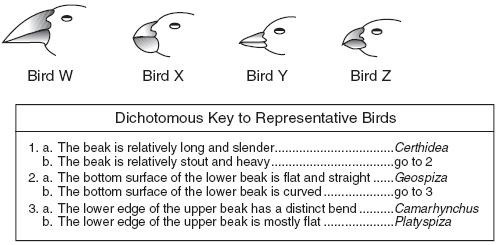
Question image

What is the name of bird W?

1

Certhidea

2

Geospiza

3

Camarhynchus

4

Platyspiza

15

Multiple Choice

Question image
A dichotomous key for trees is provided. Hikers found a tree that has large brown cones and single sharp needles. What species of tree have the hikers found?
1
Juniper
2
Pine
3
Spruce
4
Fir

16

Multiple Choice

Question image
A dichotomous key for trees is provided. Hikers found a tree that has large brown cones and single sharp needles. What species of tree have the hikers found?
1
Juniper
2
Pine
3
Spruce
4
Fir

17

Multiple Choice

Which of the following characteristics will most likely be helpful in identifying a butterfly using a dichotomous key?
1
Migrates north every spring
2
hangs on branches
3
flutters wings fast on hot days
4
Wings have long extensions

18

Multiple Choice

Question image
A dichotomous key for insects is given. To what order does an insect with two pairs of scaly wings belong?
1
Coleoptera
2
Heteroptera
3
Diptera
4
Lepidoptera

19

Multiple Choice

Question image
A dichotomous key for insects is given. To what order does an insect with two pairs of scaly wings belong?
1
Coleoptera
2
Heteroptera
3
Diptera
4
Lepidoptera

20

Multiple Choice

Question image
A student discovers an arachnid with a segmented abdomen, long legs, and a tail with no stinger. The student uses the dichotomous key below to identify it. Which arachnid has the student found?
1
Whip Scorpion
2
Wind Scorpion
3
Daddy long legs
4
Scorpion

21

Multiple Choice

Question image
A labeled diagram of a fiddler crab is provided. Which of the following is an accurate observation of the structures of a fiddler crab? Fiddler crabs have -
1
five pairs of walking legs on each side.
2
an enlarged propodus on both front legs.
3
a pair of eyes on stalks at the top of the body.
4
two pairs or chelipeds for a total of four.

22

Multiple Choice

Question image
A table of arachnid and insect characteristics is shown. Which characteristic could be used to distinguish between
arachnids and insects?
1
Jointed legs
2
Body segments
3
Presence of eyes
4
Presence of antennae

23

Multiple Choice

What step do we always start with when using dichotomous keys?
1
1
2
2
3
3
4
4

24

Multiple Choice

Question image
Using this dichotomous key, identify the name of the circled Fish, J.
1
peacock flounder
2
band-tail puffer
3
trumpet fish
4
spotted goat fish

25

Multiple Choice

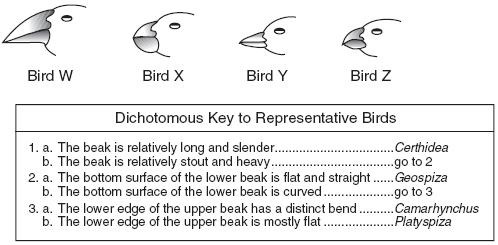
Question image

What is the name of bird Z?

1

Certhidea

2

Geospiza

3

Camarhynchus

4

Platyspiza

26

Multiple Choice

Question image

Using this dichotomous key, identity the name of the circled fish.

1

band-tail puffer

2

spotted goat fish

3

peacock flounder

4

trumpet fish

27

Multiple Choice

Question image

What is monster # 1 ?

1

Alienus quadlegicus

2

Alienus haircus

3

Alienus Tritoothicus

4

Alienus Blobicus

28

Multiple Choice

Question image

What is monster # 3 ?

1

Alienus Fuzzicus

2

Alienus Stripicus

3

Alienus Tritoothicus

4

Alienus Blobicus

29

Multiple Choice

Question image

What is monster # 4 ?

1

Alienus Fuzzicus

2

Alienus Stripicus

3

Alienus Quadlegicus

4

Alienus Blobicus

30

Multiple Choice

Question image

What is monster # 2 ?

1

Alienus Fuzzicus

2

Alienus Stripicus

3

Alienus Tritoothicus

4

Alienus Blobicus

31

Multiple Choice

Question image

What is monster # 5 ?

1

Alienus Fuzzicus

2

Alienus Tritoothicus

3

Alienus Hairicus

4

Alienus Blobicus

32

Multiple Choice

Question image

What is monster # 6 ?

1

Alienus Stripicus

2

Alienus Tritoothicus

3

Alienus Hairicus

4

Alienus Quadlegicus

33

Multiple Select

Question image

Which of the following best describes insect no#.8

1

3 pairs of legs, body has 3 parts

2

4 pairs of legs, body has 2 parts

3

5–8 pairs of legs, with other

smaller limbs

4

Many pairs of legs, long thin body

34

Multiple Choice

Question image

According to key above, which animal has wings covered by an exoskeleton and a round body?

1

Ladybug

2

Grasshopper

3

Dragonfly

4

Housefly

35

Multiple Choice

Question image

Which of the following is a centipede?

1
2
3
4

36

Multiple Choice

Question image

A student discovers an arachnid with a segmented abdomen, long legs, and a tail with no stinger. The student uses the dichotomous key below to identify it. Which arachnid has the student found?

1

Whip Scorpion

2

Wind Scorpion

3

Daddy long legs

4

Scorpion

media

Show answer

Auto Play

Slide 1 / 36

SLIDE