

Kwanzaa

Presentation
•
Social Studies
•
12th Grade
•
Practice Problem
•
Medium

Yolanda Meade
Used 6+ times
FREE Resource
18 Slides • 10 Questions
1

KWANZAA
December 26- January 1
2


3

4

KWANZAA is an African American and pan-African holiday which celebrates
family, community and culture. It is based on African first harvest celebrations
organized around five fundamental kinds of activities: ingathering of the people;
special reverence for the creator and creation; commemoration of the past;
recommitment to the highest cultural values; and celebration of the Good.
Building on this ancient tradition, Dr. Maulana Karenga, professor and chair,
Department of Africana Studies, CSULB, created Kwanzaa in 1966 as an act of
cultural recovery and reconstruction. A seven-day holiday, Kwanzaa is celebrated
from December 26 to January 1 and is structured around seven core
communitarian African values, the Nguzo Saba (The Seven Principles) which are
directed toward reinforcing family, community and culture.
5


Dr. Maulana Karenga
6
Fill in the Blanks

7
Fill in the Blanks

8


The Symbols of Kwanzaa
Kwanzaa has seven basic symbols and two supplemental
ones. Each represents values and concepts reflective of
African culture and contributive to community building and
reinforcement.
9


Primary Symbols of Kwanzaa
Mazao (The Crops)
These are symbolic of African harvest celebrations and of the rewards of productive
and collective labor.
Mkeka (The Mat)
This is symbolic of our tradition and history and therefore, the foundation on which
we build.
10


Kinara (The Candle Holder)
This is symbolic of our roots, our parent people -- continental Africans.
Muhindi (The Corn)
This is symbolic of our children and our future which they embody.
Kikombe cha Umoja (The Unity Cup)
This is symbolic of the foundational principle and practice of unity which makes all else
possible.
11


Mishumaa Saba (The Seven Candles)
These are symbolic of the Nguzo Saba, the Seven Principles, the matrix and minimum
set of values which African people are urged to live by in order to rescue and
reconstruct their lives in their own image and according to their own needs.
Zawadi (The Gifts)
These are symbolic of the labor and love of parents and the commitments made and
kept by the children.
12


Bendera (The Flag)
The colors of the Kwanzaa flag are colors of the Organization Us, black, red and
green - black for the people, red for their struggle, and green for the future that
comes from their struggle. The Bendera is based on the national flag given to us by
the Hon. Marcus Garvey, with slight adjustments in order and interpretation of the
colors made in the 1960s along with many African countries.
We put Black because, in fact, the people come first, then Red for the struggle which
is waged on by and for the people, and finally, Green, which is for the people's future
which comes out of their struggle. The stress and focus here then is on the people.
They are the priority and thus are placed first.
13
Fill in the Blanks

14
Multiple Choice
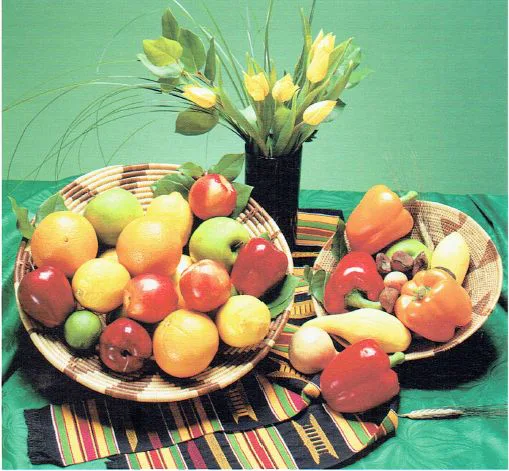
These are symbolic of African harvest celebrations and of the rewards of productive and collective labor.
Mazao
Muhindi
15
Multiple Choice

This is symbolic of our children and our future which they embody.
Mazao
Muhindi
16


Nguzo Saba Poster
The Nguzo Saba poster or some form of the written Nguzo Saba should always be a
part of the Kwanzaa set. For it is these Seven Principles which give Kwanzaa its core
and seven days of cultural focus.
17


Nguzo Saba- Seven Principals
18
Multiple Choice
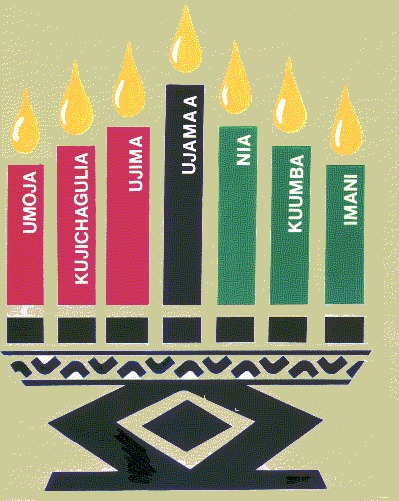
Nguzo Saba means seven principles.
True
False
19


Umoja (Unity)
To strive for and maintain unity in the
family, community, nation, and race.
Dagi knot - a Pan African symbol of unity
found in several African cultures, i.e.,
Yoruba, Hausa, Bushongo, etc.
Kujichagulia
(Self-Determination)
To define ourselves, name ourselves,
create for ourselves and speak for
ourselves.
Ahenwa - The Akan throne, symbol of
national identity, cultural groundedness
and rightful governance
20


Ujima (Collective Work
and Responsibility)
To build and maintain our community
together and make our brother's and
sister's problems our problems and to
solve them together.
Akoma ntoaso - the Adinkra symbol of shared
effort and obligation
Ujamaa (Cooperative
Economics)
To build and maintain our own stores,
shops and other businesses and to
profit from them together.
Two interlocking half circles - the Nsibidi
symbol of togetherness and family
21


Nia (Purpose)
To make our collective vocation the
building and developing of our
community in order to restore our
people to their traditional greatness.
The heiroglyph Nefer - Ancient Egyptian
symbol of beauty and good
Kuumba (Creativity)
To do always as much as we can, in the
way we can, in order to leave our
community more beautiful and
beneficial than we inherited it.
The seven vibrations of divine creation - the
Dogon symbol of creativity
22


Imani (Faith)
To believe with all our heart in our
people, our parents, our teachers, our
leaders and the righteousness and
victory of our struggle.
The ancient Egyptian double symbol of the
ankh (life) and djed pillar (stability,
endurance) serves here as a symbol of
steadifastness in commitment to the Good,
the Right, and the Beautiful in life
23

Additional Terms and Meanings
The greetings during Kwanzaa are in Swahili. Swahili is a
Pan-African language and is chosen to reflect African Americans'
commitment to the whole of Africa and African culture rather
than to a specific ethnic or national group or culture. The
greetings are to reinforce awareness of and commitment to
the Seven Principles. It is: "Habari gani?" and the answer is
each of the principles for each of the days of Kwanzaa, i.e.,
"Umoja", on the first day, "Kujichagulia", on the second day
and so on.
24


Additional Terms and Meanings
Habari gani?= What’s the news?
Heri za Kwanzaa!= Happy Kwanzaa
Karamu= Celebration
25
Fill in the Blanks

26
Multiple Choice

December 26- Umoja means unity in this principle our focus it to...
To define ourselves, name ourselves, create for ourselves and speak for ourselves.
To do always as much as we can, in the way we can, in order to leave our community more beautiful and beneficial than we inherited it.
To strive for and maintain unity in the family, community, nation, and race.
27
Multiple Select
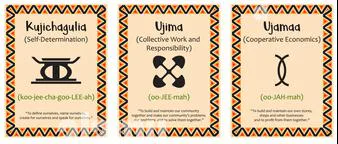
December 27, 28, 29- Kujichagulia (Self Determination); Ujima (Collective Work and Responsibility); and Ujamaa (Cooperative Economics. Check the three boxes that define the principles.
To do always as much as we can, in the way we can, in order to leave our community more beautiful and beneficial than we inherited it.
To define ourselves, name ourselves, create for ourselves and speak for ourselves.
To build and maintain our community together and make our brother's and sister's problems our problems and to solve them together.
To build and maintain our own stores, shops and other businesses and to profit from them together.
28
Multiple Select

December 30, 31 and January 1
Nia (Purpose), Kuumba (Creativity), and Imani (Faith).
Check the three boxes that define the principles.
To do always as much as we can, in the way we can, in order to leave our community more beautiful and beneficial than we inherited it.
To believe with all our heart in our people, our parents, our teachers, our leaders and the righteousness and victory of our struggle.
To strive for and maintain unity in the family, community, nation, and race.
To make our collective vocation the building and developing of our community in order to restore our people to their traditional greatness.
KWANZAA
December 26- January 1
Show answer
Auto Play
Slide 1 / 28
SLIDE
Similar Resources on Wayground

20 questions
Boycotts and Sit-in
Presentation
•
12th Grade
22 questions
Government Spending-Fiscal Policy
Presentation
•
12th Grade
20 questions
Early Cold War
Presentation
•
11th Grade
20 questions
PRESENTASI MATERI AKUNTANSI
Presentation
•
12th Grade
21 questions
Addition and Subtraction
Presentation
•
KG
21 questions
5/5 Fiscal Policy Options
Presentation
•
12th Grade
21 questions
Unit 6 Vocabulary
Presentation
•
12th Grade
Popular Resources on Wayground
24 questions
PBIS-HGMS Day 10

Quiz
•
6th - 8th Grade
10 questions
HCS SCI 03 Summer School Review 3
Quiz
•
3rd Grade
11 questions
Home Scope
Quiz
•
7th - 8th Grade
15 questions
HCS SCI 05 Summer School Assessment 3 Review
Quiz
•
5th Grade
35 questions
Lufkin Road Middle School Student Handbook & Policies Assessment
Quiz
•
7th Grade
18 questions
Geo 11.3 Area of Circles and Sectors
Quiz
•
9th - 11th Grade