Search Header Logo
  1. Resource Library
  2. Science
  3. Physics
  4. Newton's Third Law Of Motion
  5. Newton's 3rd Law Lesson
Newton's 3rd Law Lesson

Newton's 3rd Law Lesson

Assessment

Presentation

Science

6th - 8th Grade

Practice Problem

Easy

NGSS
MS-PS2-1, MS-ESS1-2, MS-PS2-4

+13

Standards-aligned

Created by

KELLY FLORA

Used 12+ times

FREE Resource

25 Slides • 32 Questions

1

Newton's Third Law

media

2

Objectives:

- I can describe Newton's 3rd Law of motion.

- I can name the force pairs acting on an object.

- I understand how inertia is important in collisions.

3

The first 2 laws of motion apply to individual objects.

1st Law - an object at rest will stay at rest, an object in motion will stay in motion unless there's an outside force.


2nd Law - an object's acceleration is directly proportional to the force, and inversely proportional to the mass.

4

The third law of motion deals with pairs of objects.

This is because all forces come in pairs.


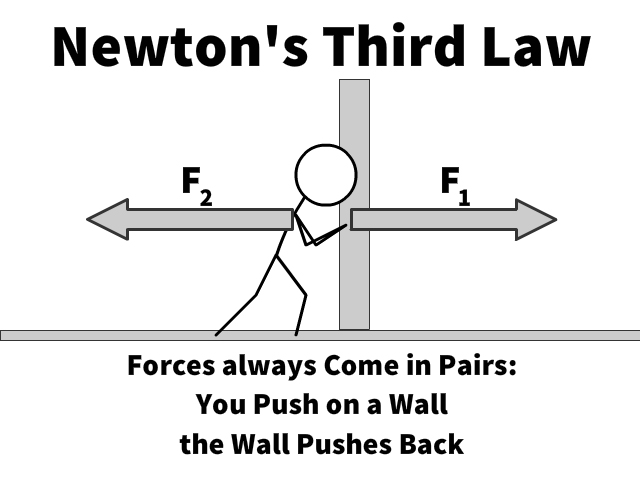
Newton's 3rd Law of Motion - for every action force, there is a force that is 1equal in strength and 2opposite in direction.

5

1Equal in Strength

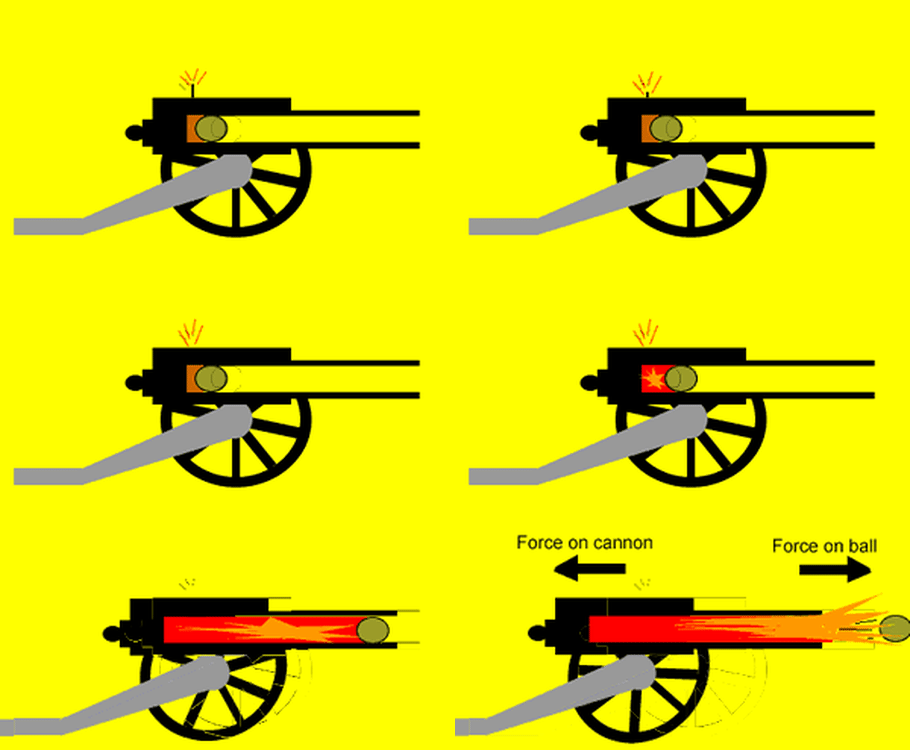
This image shows the force pairs between the force on the cannon and the force on the ball. Newton's 3rd Law says that they must be equal, which is why the canon is pushed backwards.

media

6

1Equal in Strength

Draw this in your Notebook in the white space beside where you wrote the 3rd law page 35

media

7

2Opposite in direction

This image shows the force pairs between the force on the chair and the force on the fire extinguisher. The resulting action is for them to travel in a direction opposite of the extinguisher force.

media

8

2Opposite in direction

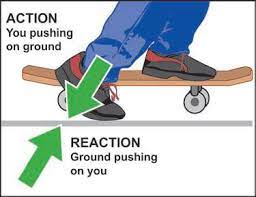
This image shows the force pairs between the force on the ground from your foot, and the force on you from the ground.


The forces that combine to propel you forward are equal and opposite.

media

9

Collisions

Newton's 3rd Law says that any time 2 objects hit each other, they exert equal and opposite forces on each other. However, the effect of the force is not always the same.

10

Collisions

The two people in this example may have exerted the same force on one another, but the result was not the same. Why?

media

11

Open Ended

Why do you think the result of the force pairs in the previous example was different between the boy and the girl?

12

THE ANSWER IS INERTIA!

  • The person with more mass has more inertia, so more force is needed to change his motion.

  • So even though the forces are equal and opposite, there are two very different results based on Newton's 1st Law of Motion, inertia.

13

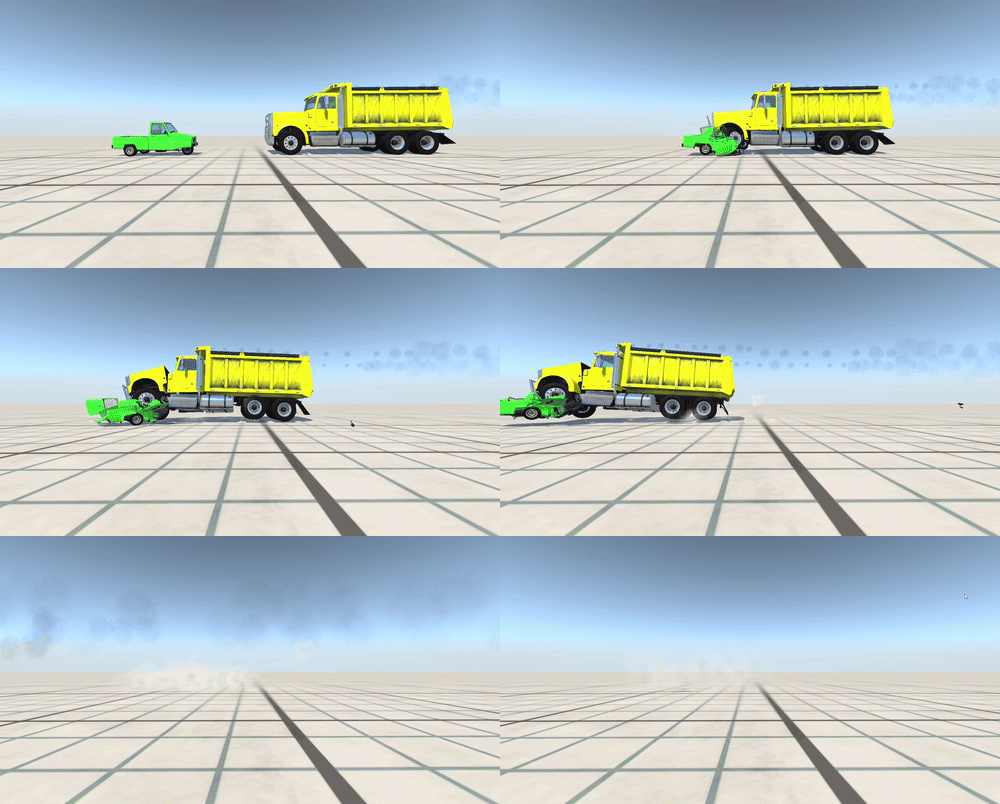
Which truck would you rather be riding in?

The forces that act on each truck may be the exact same, but due to the yellow trucks greater mass and therefore inertia, the results are very different.

media

14

Open Ended

Question image

Explain what force pairs are acting in this example of Newton's 3rd Law.

15

Open Ended

Question image

Explain what force pairs are acting in this example of Newton's 3rd Law.

16

Open Ended

Question image

Explain what force pairs are acting in this example of Newton's 3rd Law.

17

Open Ended

Question image

Explain what force pairs are acting in this example of Newton's 3rd Law.

18

Open Ended

Question image

Explain what force pairs are acting in this example of Newton's 3rd Law.

19

media

20

Multiple Choice

Newton's Third Law States...
1

Objects in motion stay in motion and objects at rest stay at rest

2

Force is equal to mass times acceleration

3

For each action there is an equal and opposite reaction

21

Multiple Choice

Whenever an object exerts a force on another object, the second object exerts a force of the same magnitude, but in the opposite direction to that of the first object.

1

Always true

2

Sometimes true

3

Never true

22

media

23

Multiple Choice

Question image

Force always come in________

1

waves

2

triplets

3

pairs

24

Multiple Choice

True or False: The size of the forces on the first object will only be equal to the size of the force on the second object if they are the same mass.

1

True

2

False

25

media

26

Multiple Choice

When you push on a wall, the wall pushes on you.

1

True

2

False

27

Multiple Choice

When one object collides with another object, no force is exerted back by the second object.

1

True

2

False

28

Multiple Choice

If you push on a wall with a force of 30 N, the force acting on you from the wall is which of the following?

1

0 N

2

10 N

3

20 N

4

30 N

29

media

30

Multiple Choice

If you sit on a chair, the only force acting on you is the force of gravity.

1

True

2

False

31

media

32

media

33

media

34

​Watch this video

35

Dropdown

Newton's ​
Law of Motion states that every action has an ​
and ​
reaction.

36

Multiple Select

What was used in the video to test out Newton's Third Law?

1

toy car

2

string

3

tape

4

straw

5

balloon

37

Match

Based on the video, match the following:

action force

reaction force

for every action there is...

air pushes out of ballon

ballon moves in opposite direction

an equal and opposite reaction

38

media

39

Multiple Choice

When a bowling ball strikes a pin, which imparts a greater force on the other?

1

the bowling ball

2

the pins

3

both exert the same amount of force on each other

40

Multiple Choice

When a bowling ball strikes a pin, which experiences a greater acceleration?

1

the bowling ball because it is more massive

2

the pin because it is less massive

3

the both experience the same amount of acceleration

41

media

42

media

43

Multiple Choice

While driving down the road, a firefly strikes the windshield of a bus and makes a quite obvious mess in front of the face of the driver. The firefly hit the bus and the bus hits the firefly.

Which of the two forces is greater: the force on the firefly or the force on the bus?

1

the force of the firefly

2

the force on the bus

3

the both exert the same amount of force on each other

44

media

45

Watch This Video

46

Multiple Choice

Where is the video being filmed?

1

the Moon

2

International Space Station

3

A secret government base

4

An Extraterrestrial Spacecraft

47

Multiple Choice

In the video, why did the ball move but astronaut Mark Vande Hei not?

1

although they both experience the same force, the astronaut was more massive than the ball

2

although they both experience the same force, the ball was more massive than then the astronaut

3

the amount of force being applied to the ball was greater than the force the ball pushed back with

4

the amount of force being applied to the astronaut was greater than the force astronaut pushed back with

48

Multiple Choice

In the video, why did both of the astronauts move?

1

they both experience the same force and have about the same mass

2

they both experience are under the influence of gravity

3

they both and under the influence of weightlessness

49

Multiple Choice

What is an opposing force?

1

A force in the same direction with same strength.

2

A force in an opposite direction with same strength.

50

Multiple Choice

An archer shoots an arrow. The action force is the bowstring against the arrow, the reaction force is...
1

Air resistance against the bow

2

the arrow's push against the bowstring

3

the grip of the archer's hand on the bow

51

Multiple Choice

A baseball player bats a ball with a force of 1,000 N. The ball exerts a reaction force (without any additional forces action on it) against the bat of...
1

Less than 1, 000 N

2

1,000 N

3

More than 1,000 N

52

Multiple Choice

Question image

When a heavy football player and a light one run into each other, who exerts more force? (pushes harder)

1

The light one

2

They exert the same force on each other

3

The heavy one

53

Multiple Choice

You can't exert a force on anything unless it also exert a force on you.

1

False

2

True

54

Multiple Choice

When you jump up, you push the earth downwards. Why can't you tell that the earth has moved?

1

The force of you jumping up doesn't actually push the earth down.

2

The earth has much more mass so it doesn't move at all

3

The earth is firmly rooted

4

The earth has much more mass so you can't tell that it moved

55

Multiple Choice

Which law explains how rockets are launched into space?
1

Newton's First Law of Motion

2

Newton's Second Law of Motion

3

Newton's Third Law of Motion

4

Newton's Fourth Law of Motion

56

Multiple Choice

Question image
Which best explains why we are able to accelerate forward when starting to run?
1

As one leg moves backward, it provides an equal and opposite force for the other foot to move forward.

2

No acceleration takes place. Runners are always at a fixed velocity.

3

The striking foot pushes backward against the ground. The friction with the ground provides an equal and opposite force forward.

4

The runner's upper body quickly leans forward, causing the entire body to begin accelerating forward

57

Multiple Choice

When you jump up, you push the earth downwards. Why can't you tell that the earth has moved?

1

The force of you jumping up doesn't actually push the earth down.

2

The earth is firmly rooted

3

The earth has much more mass so you can't tell that it moved

Newton's Third Law

media

Show answer

Auto Play

Slide 1 / 57

SLIDE