Search Header Logo
STAAR Boot Camp - Day 8

STAAR Boot Camp - Day 8

Assessment

Presentation

Science

8th Grade

Practice Problem

Easy

NGSS
MS-ESS1-1, MS-PS1-2, MS-PS1-1

+8

Standards-aligned

Created by

Sarah Self

Used 2+ times

FREE Resource

11 Slides • 11 Questions

1

Properties of Matter Quizizz Lesson

STAAR Boot Camp Day 8
April 19, 2024

2

media

Everything is made of matter.
Matter can be measured, classified, and observed using its properties.

Properties of Matter

3

4

Categorize

Options (10)

Shiny

Conductors

Ductile

Malleable

Dull

Insulators

Brittle

Semiconductors

Can be shiny or dull

Can be malleable/ductile or brittle

Organize these properties into the correct classification.

Metals
Nonmetals
Metalloids

5

media
media
media

Shiny (luster), conduct thermal energy and electricity very well (conductors), bend when hit with a hammer (malleable) and can be stretched into wires (ductile).

Metals are...

​Not shiny (dull), cannot or are poor conductors of electricity and heat (insulators), shatter when hit with a hammer (brittle), and cannot be stretched into wires (brittle).

​​Nonmetals are...

​Sometimes shiny or dull, can conduct thermal energy and electricity, but not very well (semiconductors), and can either be malleable/ductile or brittle.

Metalloids are...

6

Multiple Choice

Question image

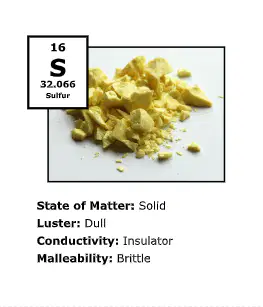
Classify this element as either a metal, nonmetal, or metalloid.

1
Gas
2
Metal
3
Metalloid
4
Nonmetal

7

Multiple Choice

Question image

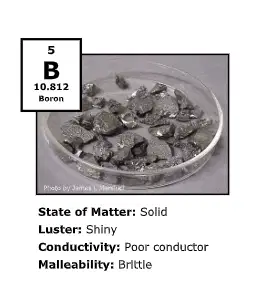
Classify this element as either a metal, nonmetal, or metalloid.

1
Liquid
2
Metal
3

Metalloid

4
Nonmetal

8

Multiple Select

Question image

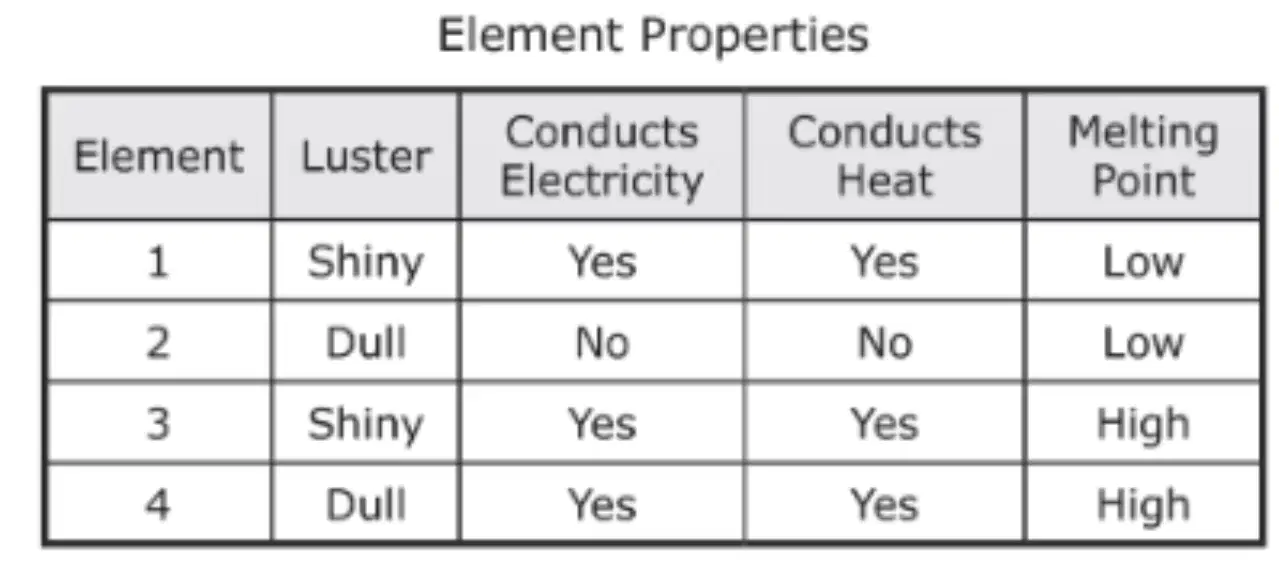
Based on the properties in the table, which TWO elements are most likely metals? (TWO Answers)

1

Element 1

2

Element 2

3

Element 3

4

Element 4

9

10

Dropdown

To solve for density, the formula is...​


To solve for mass, the formula is... ​


To solve for volume, the formula is... ​

11

media

Density is the measurement of how much mass an object has per unit volume.

Mass is measured in grams (g).
Volume is measured in centimeters cubed (cm3) or milliliters (mL).
Density is measured in g/cm3 or g/mL

Density

12

Multiple Choice

Jack has a rock. The rock has a mass of 14 g and a volume of 2 mL. What is the density of the rock?

1

0.7 g/mL

2

1.2 g/mL

3

3.5 g/mL

4

11.4 g/mL

13

Multiple Choice

Question image

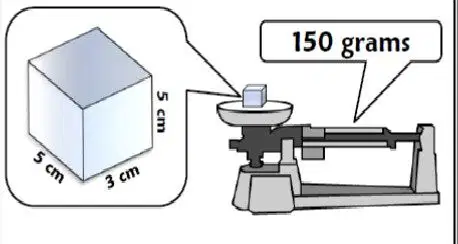
The image shows the an object on a triple beam balance. Its length, width, and height is provided. Based on these measurements, what would be the density of this object?

1

2 g/cm3

2

4 g/cm3

3

6 g/cm3

4

8 g/cm3

14

media
media

​Physical changes happen when matter changes form but not chemical identity.

Physical Changes

​Chemical changes happen when a chemical reaction forms new products.

Chemical Changes

15

Categorize

Options (6)
Question image

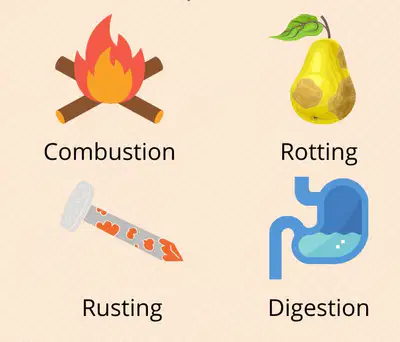
Iron rusting

Question image

Cooking an egg

Question image

Rotting Banana

Question image

Ice cube melting

Question image

Boiling water

Question image

Dissolving sugar in tea

Organize these changes in matter as either a chemical or physical change.

Chemical Change
Physical Change

16

17

Match

Match the following images with what signs of a chemical change are presented.

Baking soda and vinegar react and fizz

A clear liquid changes to purple

A thick, solid substance is formed

A glow stick is cracked and glows

Warm steam is produced

Gas Production

Color Change

Precipitate

Light Production

Temperature Change

18

media

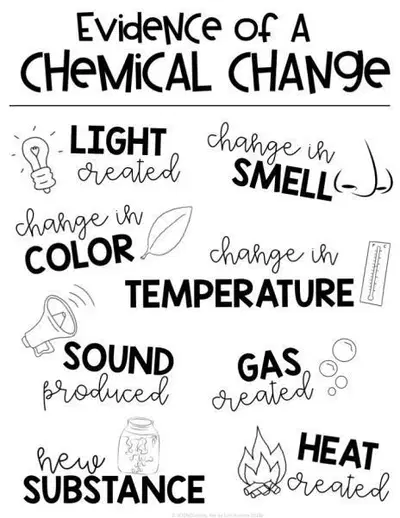
Chemical reactions produce new substances.
Evidence a new substance is being produced are
(1) Color Change
(2) Gas
(3) Light
(4) Temperature Change
(5) Precipitate (solid)
(6) Odor
This can be remembered with City Girls Love Their Phones On!

Chemical Reactions

19

Multiple Select

Which TWO statements describe an action that most likely resulted in a chemical reaction? (TWO answers)

1

A pan of water was heated on a stove, and steam formed.

2

A liquid was mixed with another liquid, and a precipitate formed.

3

Leaves use carbon dioxide and water to make sugar.

4

A cup of saltwater evaporates, leaving behind salt crystals.

20

Multiple Choice

Question image

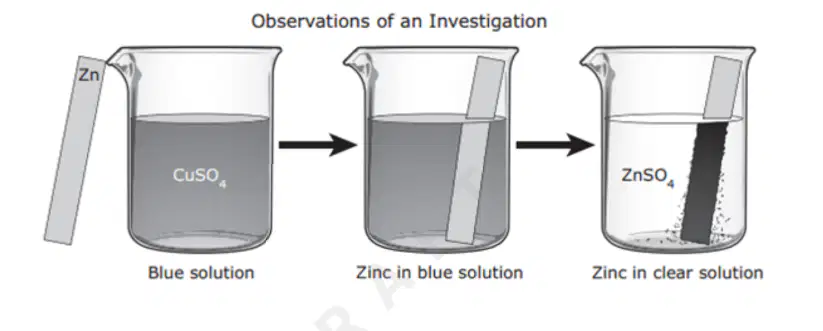
For an investigation a student poured a blue solution of CuSO4 into a beaker. The student placed a shiny, silver-colored strip of zinc metal in the solution and observed the changes.

The student inferred that a chemical reaction occurred. What evidence supports this inference?

1

A dark solid formed on the zinc metal.

2

The zinc metal remained silver-colored and shiny.

3

The CuSO4 solution turned blue when the zinc metal was added.

4

None of these

21

STAAR Question Practice Time!

Go to Canvas and complete Day 8 Questions.

22

Properties of Matter Quizizz Lesson

STAAR Boot Camp Day 8
April 19, 2024

Show answer

Auto Play

Slide 1 / 22

SLIDE