
Search Header Logo
Life Part 2

Life Part 2

Assessment

Presentation

Science

6th - 8th Grade

Medium

NGSS
MS-ESS1-1, MS-LS2-3, MS-LS2-4

+21

Standards-aligned

Created by

Felicia Powers

Used 6+ times

FREE Resource

19 Slides • 29 Questions

1

media

2

Multiple Choice

Plants and animals are both living organisms composed of cells. They share similar structures. There are, however, many differences between plants and animals. Which of the following is the major difference between green plants and animals?

1

plants don’t need oxygen

2

plants are autotropic

3

plants do not respond to stimuli

4

plants are heterotopic

3

Multiple Choice

Heterotrophs

1

make their own food

2

Protist

3

Eubacteria

4

Consume their food

4

Multiple Choice

The Eukarya Domain has which organisms?

1

Bacteria that causes diseases

2

Bacteria found in volcanoes

3

plants, animals., fungi and protists

4

none of the above

5

media
media

6

Multiple Choice

What is Natural Selection?

1

The process by which humans breed a species for certain traits

2

The process in which inherited traits of a population change over many generations

3

The process by which Charles Darwin noted the differences in finches while visiting the Galápagos Islands

4

The process by which individuals that are better adapted to their environment are more likely to survive and reproduce

7

Multiple Choice

Question image

Based on the data for 1850 to 1900, what inference can you make about  the white peppered moth and the mutant black peppered moth?

1

White moths were easier for predators to see

2

Black moths were unable to find sources of food

3

White moths were unable to absorb heat from sunlight

4

Black moths were less likely to migrate to other places

8

Multiple Choice

Question image

What would cause the change in the shapes of the feet of these animal to occur?

1

Genes from both parents lead to genetically different offspring

2

Extinction of animal A led to this change

3

The environment caused selection of this trait over others

4

Adaptation creates diverse animals like animals A and D

9

Multiple Choice

How do you "win" at natural selection?

1

survive

2

go extinct

3

survive & reproduce

10

media

11

media

​What percent is green and yellow?

12

media

​50% Green peas


50% yellow peas

13

media

​Try it on your own.

14

Multiple Choice

Question image

The gene for curled ears (C) is dominant over the gene for straight ears (c). The picture below shows a cat with curled ears (Cc) and a cat with straight ears (cc). What percent of the offspring are expected to have curled ears as a result of a cross between the cats shown.

1

100%

2

75%

3

50%

4

25

15

Multiple Choice

In pea plants, red flower color is dominant to white flower color. If a homozygous red flowered plant is crossed with a white flowered plant, what percentage of their offspring will have red flowers?

1

0%

2

25%

3

75%

4

100%

16

media

17

Multiple Choice

Question image
How many people in the pedigree are carriers for the disorder? 
1
2
8
3
2
4
9

18

Multiple Choice

Question image

In the diagram, individual III-3 indicates

1

a female with no freckles

2

a male with no freckles

3

a male with freckles

4

a female with freckles

19

Multiple Choice

Question image

Use the information provided in the pedigree to determine which of the following genotypes is correct.

1

Arek is heterozygous for ACHOO

2

Hugo is homozygous for ACHOO

3

Luiza is heterozygous for not having ACHOO

4

Milan is homozygous for ACHOO

20

Meiosis

Purpose: Create gametes (Sexual reproduction)

2 divisions


4 cells
23 chromosomes in each cell.

media

21

Mitosis

Purpose: Growth and Repair. (Asexual reproduction)


1 division

2 cells

46 chromosomes in each cell.

media

22

media

23

Multiple Choice

Question image

What process does the spider plant use to transmit its DNA to the plantlets?

1

asexual reproduction, which requires meiosis

2

asexual reproduction, which does not require meiosis

3

sexual reproduction, which requires meiosis

4

sexual reproduction, which does not require meiosis

24

Multiple Choice

Question image

What best describes the plantlet when compared to the plant it was attached to?

1

It is genetically identical to the plant

2

It shares half of its genes with the plant

3

It is genetically different from the plant

4

It shares none of its genes with the plant

25

Multiple Choice

Question image

Based on the image, which best describes the process this organism’s cells undergo during reproduction?

1

mitosis

2

haploid

3

meiosis

4

diploid

26

media

27

media

28

media

29

Multiple Choice

Question image

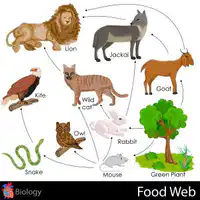
What type of organisms provide the base for this food web?

1

Secondary Consumers

2

Primary Consumers

3

Producers

4

Top Predators

30

Multiple Choice

One relationship between organisms is that of predator-prey. Which of the following is the best description of a predator?

1

An organism that eats another organism

2

An organism that participates in symbiosis

3

An organism that is eaten by another organism

4

An organism that benefits at the expense of another organism

31

Multiple Choice

Sharks are the apex (top) predator of the marine ecosystem. They maintain the balance of the marine environment by eating many of the smaller fish and other marine animals. If shark populations decrease, many of these animals will reproduce at such a rate that it would cause a great strain on marine resources. Which of the following relationships is most similar to the relationship of the shark to the marine ecosystem?

1

A frog eats flies and lizards in a swamp ecosystem

2

A grasshopper eats leaves in a grassland ecosystem

3

A wolf eats small mammals an in a forest ecosystem

4

A scorpion eats insects and arthropods in a desert ecosystem

32

Match

Match the following

Commensalism

Parasitism

Predation

Mutualism

Competition

1 benefits the other is unaffected

1 benefits the other is harmed

1 benefits the other is killed

A win-win relationship

Organisms fighting for resources

33

media

34

media

35

media

36

Multiple Choice

Question image

Which of the following would NOT be an example of a density independent factor?

1

predation

2

tornado

3

hurricane

4

fire

37

Multiple Choice

What is a limiting factor?

1

Factors that always increase a population

2

Factors that always decrease a population

3

Resources that are unlimited

4

Factors/resources that limit how many organisms can live in an area at the same time

38

Multiple Choice

Question image

Soil or dirt

1

Biotic factor

2

Abiotic factor

39

Multiple Choice

Question image

A zebra skeleton

1

Biotic factor

2

Abiotic factor

40

media

41

media

42

media

43

Multiple Choice

Which plant organelle transforms light into glucose to use as food?

1

Mitochondria

2

Vacuoles

3

Chloroplasts

4

Nucleus

44

Multiple Choice

Question image

How do the carbon compounds enter the soil?

1

decomposition

2

photosynthesis

3

respiration

4

predation

45

Multiple Choice

Question image

What could be added to the diagram to show the tree’s contribution to the carbon cycle?

1

arrows to show carbon dioxide entering the tree during photosynthesis

2

arrows to show carbon dioxide leaving the tree during sedimentation

3

decomposers breaking down the dead matter to release carbon

4

an arrow from the chipmunk to the acorn to show the sharing of carbon

46

Multiple Choice

Question image

Which is NOT something that occurs during cellular respiration?

1

the breakdown of food

2

the transformation of energy

3

the release of carbon dioxide

4

the release of oxygen

47

Multiple Choice

Question image

Why is sunlight so important to the process of photosynthesis?

1

It transforms the carbon dioxide into oxygen that is released through the leaves

2

It provides the needed temperatures to change glucose into water

3

It provides the energy needed to combine the atoms in glucose

4

It raises the levels of gases in the air so that water can change into oxygen

48

Multiple Choice

Question image

How does this action relate to cellular respiration?

1

The food the person eats will be broken down to release its energy

2

The oxygen the person breathes in while eating is changed into glucose

3

The carbon dioxide in the food is converted into oxygen that is used as energy

4

The energy in the food is turned into oxygen, which is how the person breathes

media

Show answer

Auto Play

Slide 1 / 48

SLIDE
