Unit 4: Evolution & Natural Selection
Presentation
•
Science
•
9th - 12th Grade
•
Medium
+24
Standards-aligned
Amanda Duncan
Used 4+ times
FREE Resource
7 Slides • 93 Questions
1
LS4-1 Evidence of Evolution
LS4-2 Steps of Natural Selection
LS4-4 Natural selection and Adaptations
LS4-5 Effects of Environmental Changes
Evolution
2
Natural Selection
3
Biological Evolution
Macroevolution
Microevolution
4
Natural selection
Overproduction of offspring
Variation
Adaptation
Descent with modification
5
Diversity & Genetic Variability
Genetic drift
Gene flow
Non-random mating
Mutations
Natural selection
Types of Evolution
Adaptive evolution (divergent)
Coevolution
Convergent evolution
Types of Extinction
Gradual
Mass
6
Evidence of Evolution
Field of Anatomy
Homologous structures
Analogous structures
Vestigial structures
Field of Biochemistry
Field of Paleontologist
Field of Embryology
7
Phylogenetic Trees
8
Multiple Choice
Which of the following is the correct definition of natural selection?
The idea that organisms less equipped for their environment tend to survive longer
The idea that organisms more well equipped for their environment tend to survive longer
The idea that organisms more well equipped for their environment tend to not survive
None.
9
Multiple Choice
Variations are caused by . . .
Kaleidoscopes
Variety Shows
Mutations
A change in phenotypic expression
10
Multiple Choice
Which of the following represents genetic drift?
11
Multiple Choice
What is survival of the fittest?
Do you even lift brah?
Only the strong survive
Hunger Games
The best adapted animal will live and reproduce
12
Multiple Choice
Which of the following represents migration?
13
Multiple Choice
TRUE or FALSE: Mutations are random
TRUE
FALSE
14
Multiple Choice
Which of the following represents gene flow?
15
Multiple Choice
TRUE or FALSE: Mutations lead to variation.
TRUE
FALSE
16
Match
the movement of genes into or out of a population
Random chance; small population
A sudden change in one or more characteristics due to a change in a gene
Occurs due to physical difference as a result of a genetic difference
The movement of organisms from one place to another
Gene Flow
Genetic Drift
Mutation
Non-Random Mating
Migration
Gene Flow
Genetic Drift
Mutation
Non-Random Mating
Migration
17
Match
Match the following terms with their definitions
Evolution
Adaptation
Variation
Mutation
a change in a species DNA over time because of natural selection
Any variation that makes an organism better able to survive
An inherited trait that makes and individual different
A permanent change in the DNA
a change in a species DNA over time because of natural selection
Any variation that makes an organism better able to survive
An inherited trait that makes and individual different
A permanent change in the DNA
18
Multiple Choice
Which of the following best describes what the image represents?
Genetic Drift
Migration
Mutation
Natural Selection
19
Multiple Choice
If a new trait DOES NOT help an organism survive, what may happen to it?
It dies and its DNA is not passed on
It survives and its DNA is passed on
It changes its traits to adapt and survive
20
Multiple Choice
Which of the following best describes what the image represents?
Natural Selection
Artificial Selection
Mutation
Genetic Drift
21
Multiple Choice
If a new trait DOES help an organism survive, what may happen to it?
It dies and its DNA is not passed on
It survives and its DNA is passed on
It changes its traits to adapt and survive
22
Multiple Choice
Which of the following does not show genetic drift?
23
Multiple Choice
24
Multiple Choice
Which scientist is considered the father of evolution?
Jean-Baptist Lamarck
Hershey and Chase
Charles Darwin
Carleous Linnaeus
25
Multiple Choice
26
Multiple Choice
Which of the following is an example of artificial selection?
Gorillas are in the wild and have a baby gorilla.
A group of ants in an ant pile are exterminated by an exterminator.
A black speckled rabbit is a new favorite among children, a white and black rabbit are picked to make black and white baby bunnies.
Wolves in the wild have pups.
27
Multiple Choice
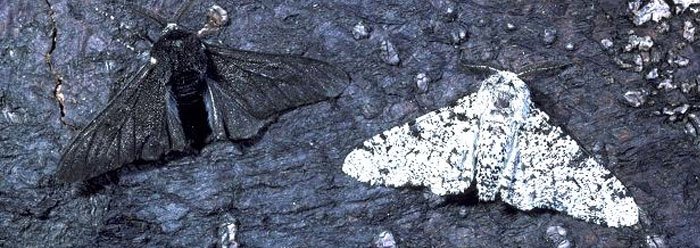
The trees these moths used to live on were white, but have been covered in soot(pollution) from coal factories. Which moth will be more successful in this environment?
Dark moth
Light moth
Both will be equally successful
Neither will be successful
28
Multiple Choice
White tigers are becoming extinct, to overcome this a male and female white tiger are paired together in captivity to help their population continue to grow. This is an example of:
Natural Selection
Gene Flow
Artificial Selection
Genetic Drift
29
Multiple Choice
30
Multiple Choice
Blue catfish are going extinct. A dam in a lake full of blue catfish bursts due to poor engineering and kills some of the blue catfish. This is an example of:
Natural Selection
Gene Flow
Mutation
Genetic Drift
31
Multiple Choice
32
Multiple Choice
Green rhinocerous beetles are some of the biggest beetles to exist on Earth. A green rhinocerous beetle leaves its group and wonders over to another group that only has red rhinocerous beetles and mates with the red beetles. This is an example of:
Gene Flow
Genetic Drift
Mutation
Migration
33
Multiple Choice
34
Multiple Choice
This picture shows how a scientist how a scientist might use this type of data to decide if an animal is closely related or not.
Comparing the anatomy of a living animal to an extinct one
Comparing the DNA of a living animal to another living animal
Comparing the anatomy of a living animal to another living animal
Comparing the development of one living animal to another
35
Multiple Choice
36
Multiple Choice
37
Multiple Choice
Choose a word from the drop-down menu for each blank to complete the sentences below.
The population of a particular moth species was measured over the course of three years. Based on the data in the table, the black moth population _____ compared to the white moth population. This is because the _____ moth is naturally selected by the ecosystem.
steadily increases, black
steadily increases, white
steadily decreases, black
steadily decreases, white
38
Multiple Choice
39
Multiple Choice
Darwin observed many finch species on the Galapagos Islands. To explain these observations, he
proposed that each species evolved from the same common ancestor, which was a finch species
that migrated to the islands from the mainland. What additional evidence did Darwin use to support
his explanation?
The finch populations were very numerous, and different species often bred with one another.
The finch species lived in different habitats on different islands, which isolated them from one another.
The finch species were distributed evenly among all of the islands, but did not interbreed.
The beaks of the finches were identical, allowing them to eat the same foods on any of the islands.
40
Multiple Choice
Based on the data given in the table, which two are most closely related?
Human & Gorilla
Gorilla & Orangutan
Human & Chimpanzee
Chimpanzee & Orangutan
41
Multiple Choice
42
Multiple Choice
43
Multiple Choice
A ______________________ is a scientist who studies fossils.
biologist
chemist
paleontologist
astronomer
44
Multiple Choice
A population of rabbits grows rapidly from one year to the next. Then one year, a disease strikes approximately one fourth of the adult rabbits. The disease remains with the population in the years that follow.
As explained by Darwin’s theory, which of these conditions allows the rabbit population to evolve by natural selection?
The disease affects adult and juvenile rabbits equally.
The disease reduces the ability of the rabbits to reproduce.
Some rabbits are resistant to the disease, and they pass the resistance to their offspring.
No rabbits are resistant to the disease, and all die when the disease strikes them.
45
Multiple Choice
46
Multiple Choice
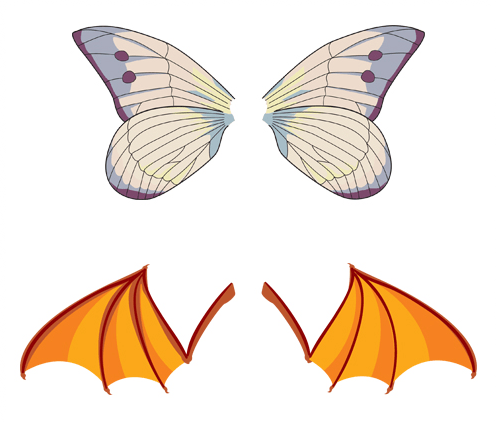
A bat wing and a butterfly wing are both used for flying but they are made differently. What type of structure is this?
Homologous structure
Analogous structure
Vestigial structure
Fossil structure
47
Multiple Choice
48
Multiple Choice
49
Multiple Choice
50
Multiple Choice
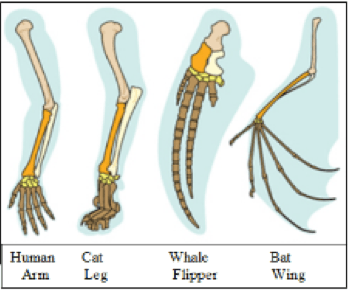
A human arm and a whale fin have similar bone structure but the whale fin is used for swimming and the arm is used for reaching and grabbing. What type of structures are these?
Homologous structures
Analogous structures
Vestigial structures
Fossil structures
51
Multiple Choice
52
Multiple Choice
Based on the given cladogram, which organism is the outgroup?
human
chimpanzee
gorilla
orangutan
gibbon
53
Multiple Choice
54
Multiple Choice
When comparing the DNA of two different organisms, the more differences in the DNA base pairs the more-
Closely related they are.
Distantly related they are.
It doesn't prove anything.
They look alike.
55
Multiple Choice
The bones in the figure above are-
Evidence of a common ancestor
Evidence that animals can walk
Evidence that fossils are old
Evidence of nothing
56
Multiple Choice
The picture shows a/an ___________
homologous structure
vestigial structure
57
Dropdown
58
Multiple Choice
59
Multiple Choice
Which of the following is a situation that could cause evolutionary change that is NOT due to natural selection?
A volcano erupts and kills many individuals in a population.
A mutation produces sea stars that are less visible to predators.
An insecticide is sprayed in a community to combat mosquitoes.
Cattle are treated with antibiotics to prevent the spread of infections.
60
Multiple Choice
61
Multiple Select
Which of the pictures above would be examples of homologous structures? (pick 2)
1
2
3
62
Multiple Choice
63
Multiple Choice
64
Multiple Choice
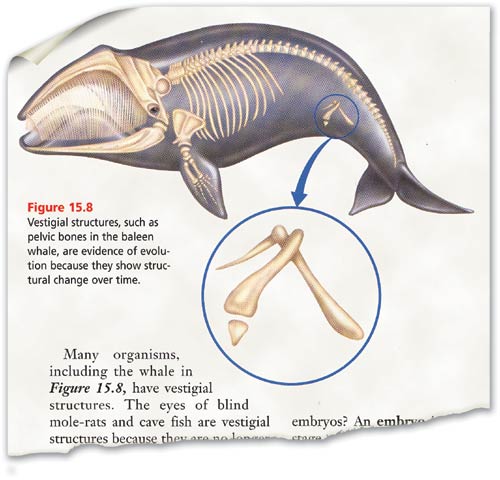
Whales have pelvic bones. What type of structure does this best represent?
Homologous structure
Analogous structure
Vestigial structure
None of the above
65
Multiple Choice
Based on the figure, which organism is most closely related to the polar bear?
black bear
european brown bear
western north american brown bear
asian brown bear
66
Multiple Select
Which of the following are vestigial structures humans have? Select all that apply.
Appendix
Tailbone
Forearm bones
Goosebumps
67
Multiple Choice
The similarities of bone structure in the diagram provide evidence of what?
The organisms probably use there forelimbs for the same thing.
The organisms evolved from a common ancestor.
The organisms have the same DNA.
All vertebrate species have identical forelimbs.
68
Multiple Choice
69
Multiple Choice
The picture shows a/an ___________
homologous structure
vestigial structure
70
Multiple Choice
When scientists see similarities between a hippopotamus embryo and a rabbit embryo, this suggests:
Rabbits evolved from hippopotamus.
Hippopotamus share a common ancestor with rabbits.
Hippopotamus evolved from rabbits.
Hippopotamus and rabbits share the same traits.
71
Match
Analogous Structure
Homologous Structure
Comparative Embryology
Biochemical Evidence
Vestigial Structures
Same function different structure
Same structure different function
Comparing embryological development of different species
Comparing DNA and amino acid sequences of different species
Structures in the body of an organism that no longer work.
Same function different structure
Same structure different function
Comparing embryological development of different species
Comparing DNA and amino acid sequences of different species
Structures in the body of an organism that no longer work.
72
Multiple Choice
body parts that perform a similar function but differ in structure
homologous structures
analogous structures
vestigial structures
comparative anatomy
73
Multiple Choice
The graphs below show the changes in crab color at one beach.
Which of the following is most likely to have caused the change in the distribution?
A new predator arrived that preferred dark-tan crabs.
A new predator arrived that preferred light-tan crabs.
A change in beach color made medium-tan crabs the least visible to predators.
A change in beach color made medium-tan crabs the most visible to predators.
74
Multiple Choice
Penguin flipper and fish fin
Homologous
Vestigial
Analogous
None of the above
75
Multiple Choice
76
Multiple Choice
The analysis of embryos can prove...
fossils
extinction
common ancestry
77
Multiple Choice
Based on the figure, how long ago was the common ancestor of the European Brown Bear and the Asian Brown Bear?
4.5 hundreds of thousands of years ago
3.5 hundreds of thousands of years ago
2.2 hundreds of thousands of years ago
1.4 hundreds of thousands of years ago
78
Multiple Choice
Similar structures with different purposes found in different species are known as _____
vestigial structures
DNA
homologous structures
the fossil record
79
Match
Analogous Structure
Homologous Structure
Comparative Embryology
Biochemical Evidence
Vestigial Structures
Same function different structure
Same structure different function
Comparing embryological development of different species
Comparing DNA and amino acid sequences of different species
Structures in the body of an organism that no longer work.
Same function different structure
Same structure different function
Comparing embryological development of different species
Comparing DNA and amino acid sequences of different species
Structures in the body of an organism that no longer work.
80
Multiple Choice
A population that is isolated in a remote environment is still able to experience genetic variation. How could genetic variation that contributes to evolution occur in such a population?
A mutation in a liver cell produces liver cancer.
Lateral gene transfer occurs that produces an organism that is less resistant to drought.
A mutation in an egg cell causes a change in DNA that produces an organism that is more sensitive to sunlight.
A mistake in DNA replication before meiosis produces an organism that is better able to outrun predators.
81
Multiple Choice
What type of evidence is shown with the diagram above?
Molecular
Anatomical
Embryological
Fossil
82
Multiple Choice
Which evidence would be the most accurate when developing a cladogram?
morphological
molecular
ecological
fossil
83
Multiple Select
Which of the pictures above would be examples of homologous structures? (pick 2)
1
2
3
84
Multiple Choice
The figure shows how natural selection of a single-trait gene affects lizard survival.
Which of the following most likely causes the changes in allele distribution?
The allele for light gray coloration disappears from the population. This may be because light gray lizards are more visible to predators and therefore they might be less likely to survive and reproduce.
The allele for black coloration decreases fitness and becomes less common. This may be because black coloration keeps the lizards cool during hot summer temperatures.
Medium gray coloration in lizards appears to be a neutral mutant allele that allows the lizards to hide better from predators. This leads to increases in phenotype and allele frequency of gray coloration.
Because black and medium gray lizards are less visible to predators, these alleles are neutral to natural selection and therefore will not disappear from the population of lizards.
85
Multiple Choice
Which of the following can be determined by observing the embryos shown in the diagram
86
Multiple Choice
Based on the figure, which organism is most closely related to A. forsteri?
E. ferus
D. polylepis
G. gallus
E. africanus
87
Multiple Choice
What is common ancestry?
When a species no longer exists
When organisms are descended from a single ancestor
88
Multiple Choice
Grass plants in a population range in height from 6 cm to 25 cm. The short plants receive little sunlight, and the tall plants are eaten by grazing animals. Which statement best describes the effect of natural selection on the grasses?
Because average height grass plants are favored, stabilizing natural selection is occurring.
Because average height grass plants are favored, disruptive natural selection is occurring.
Because tall grass plants are favored by the animals that eat grass, directional selection is occurring.
Because short and tall grass plants are favored, normal natural selection is occurring.
89
Multiple Choice
The fossil record help scientists
better understand the kinds of organisms that lived in the past
better understand how the environment has changed over time
better understand how organisms have evolved over time
all of the above
90
Multiple Choice
Based on the figure, which organism would be considered the outgroup?
E. ferus
D. polylepis
G. gallus
E. africanus
A. forsteri
91
Multiple Choice
Scientists use several concepts to explain patterns of evolutionary change. Which evidence would be most useful for identifying a pattern of punctuated equilibrium in an evolutionary lineage?
Similar bone structures among mammal species alive today
An identical genetic code in use among all species alive today
Fossil sequences that show gradual changes over long spans of geologic time
Fossil sequences that show rapid changes over brief spans of geologic time
92
Multiple Choice
Which of the following best illustrates natural selection?
An organism with favorable genetic variations will tend to survive and breed successfully.
A population monopolizes all of the resources in its habitat, forcing other species to migrate.
A community whose members work together utilizing all existing resources and migratory routes.
The largest organisms in a species receive the only breeding opportunities.
93
Multiple Choice
Based on the figure, which three organism are closely related?
cat, horse, human
cat, horse, pig
cow, horse, human
cow, horse, pig
94
Multiple Choice
Which of the following is NOT part of the that mechanisms of natural selection?
Organisms produce more offspring than can survive.
Disease and natural disaster will limit population growth.
Species today descended with modifications from ancestral species.
Organisms with advantages will survive and reproduce.
95
Multiple Choice
Based on the figure, which two organisms are closely related?
cat & human
cat & cow
human & pig
human & horse
96
Multiple Choice
Before the invention of the light bulb, Americans burned oil in lamps for light. Whale oil was popular bio-fuel for these
lamps. Ship crews would hunt whales for their oil. They searched for the largest whales they could find so that they could obtain as much whale oil as possible. How mighty decades of whale hunting possibly affect the natural selection of the species?
The whales lost their legs.
The whales became slower.
The whales became smaller.
The whales changed their calls.
97
Multiple Choice
What is the most likely explanation of the data shown below?
There has been a drought in the area that is affecting all life forms.
The population of natural predators of the moths has gotten smaller.
The moths are living in an environment with light trees.
The moths are living in an environment with dark trees.
98
Multiple Choice
Which of the following statements best describes what will most likely occur to the moth populations in the image above?
The light moths will be captured by predators more easily than the dark moths, and the population of dark moths will rise.
The light moths will be captured by predators more easily than the dark moths, and the population of light moths will rise.
The dark moths will be captured by predators more easily than the light moths, and the dark moths will probably go extinct.
The light moths will change their wing color to match that of the dark moths.
99
Multiple Choice
The pair of population graphs below display the results of two different five-year hunting cycles, one on light trees and one on dark trees. The population of light-colored moths is shown by the light gray dots, and the population of dark moths is shown by the dark gray dots. How do these results demonstrate natural selection?
The moth populations shown here demonstrate random fluctuations over time that are not explained by tree color.
On light trees, individual moths tried to become lighter in color to match the tree background. On dark trees, individual moths tried to become darker in color.
The moths that were the same color as their background were more likely to survive and reproduce. Over time, the populations of these well-adapted moths increased.
Small particles of tree bark became embedded in the moth’s wings, causing the moths to become darker on the dark trees and lighter on the light trees. These acquired traits were then passed down to the next generation of moths, causing the populations to change color over time.
100
Multiple Choice
Suppose a certain species of insect lives in the lush green canopy of the rain forest. Some of the insects are bright green in color, and some are bright yellow. Assume there is a natural predator of the insect in the area. What do you expect to happen to the populations of the green and the yellow insects over time?
The green insect population will increase and the yellow insect population will decrease.
The green insect population will decrease and the yellow insect population will increase.
Both insect populations will remain constant over time.
Both insect populations will increase over time.
LS4-1 Evidence of Evolution
LS4-2 Steps of Natural Selection
LS4-4 Natural selection and Adaptations
LS4-5 Effects of Environmental Changes
Evolution
Show answer
Auto Play
Slide 1 / 100
SLIDE

Similar Resources on Wayground
95 questions
S1 Final Fl Spa 1 Repaso
Presentation
•
9th - 12th Grade
95 questions
The Overview of Law and Justice
Presentation
•
9th - 12th Grade
93 questions
Holt Ch 12 PPT
Presentation
•
9th - 12th Grade
98 questions
10.3 China and Japan Reject Expansion
Presentation
•
9th - 12th Grade
94 questions
Imperialism Japan
Presentation
•
KG - University
94 questions
Lockdown Quiz #4
Presentation
•
8th - 12th Grade
93 questions
RevieWayground - Presente + BOTA
Presentation
•
9th Grade - University
98 questions
Plant reproduction
Presentation
•
10th Grade - University
Popular Resources on Wayground
10 questions
5.P.1.3 Distance/Time Graphs
Quiz
•
5th Grade
10 questions
Fire Drill
Quiz
•
2nd - 5th Grade
20 questions
Equivalent Fractions
Quiz
•
3rd Grade
22 questions
School Wide Vocab Group 1 Master
Quiz
•
6th - 8th Grade
20 questions
Main Idea and Details
Quiz
•
5th Grade
20 questions
Context Clues
Quiz
•
6th Grade
20 questions
Inferences
Quiz
•
4th Grade
12 questions
What makes Nebraska's government unique?
Quiz
•
4th - 5th Grade
Discover more resources for Science
10 questions
Exploring the Layers of the Earth
Interactive video
•
6th - 10th Grade
25 questions
Naming Ionic and Covalent Compounds
Quiz
•
9th Grade
20 questions
Balancing Chemical Equations
Quiz
•
9th Grade
15 questions
Protein synthesis
Quiz
•
9th Grade
20 questions
Human Impact on the Environment Review #2
Quiz
•
9th Grade
20 questions
Newton's Laws of Motion
Quiz
•
9th Grade
20 questions
Mendelian Genetics Review
Quiz
•
9th Grade
16 questions
Balancing Chemical Equations and Types of Reactions
Quiz
•
9th - 10th Grade