Search Header Logo
Last Chem Test Review!

Last Chem Test Review!

Assessment

Presentation

Chemistry

10th Grade

Medium

NGSS
HS-PS1-4, HS-PS3-1, HS-PS1-1

+2

Standards-aligned

Created by

Karina Farias

Used 6+ times

FREE Resource

22 Slides • 23 Questions

1

SE04 Multiple Choice Review!

2

Breakdown for today:

  1. Review (this!) for the first 45 min.

    1. Remember, this will be very similar to the exam, which has 16 questions!

  2. Take the MC portion of the exam for 40 min.

  3. Turn in materials/get ready to go.

3

Semester 1 Topics

4 Questions

4

media

When you write the atomic symbol, you include the mass number at the top left, the atomic number bottom left, and the symbol in the center.

Isotope Notation

5

You can use the APEMAN to create the symbol by finding the mass and atomic number, or deconstruct the symbol using APEMAN.

Isotope Notation

​Atomic # = # Protons = # Electrons

​Mass # = Atomic # + # Neutrons

​Since A is the bottom left, the atomic number is 6, as is the number of protons and electrons.

​Since M = 14 and A = 6, we can find the neutrons using the equation:


media

6

media

Elements that exist in pairs when they are alone are called diatomic elements. There are 7 elements that are diatomic:
H2, N2, O2, F2, Cl2, Br2, I2

Diatomic Elements

7

  1. Name the metal (first element)

  2. Name the nonmetal by changing to end in -ide, unless its an ion on the back of the periodic table.

Ionic Compounds

Naming Compounds

8

Fill in the Blanks

media image

9

Fill in the Blanks

media image

10

Multiple Choice

Question image

How many protons, neutrons, and electrons are in the symbol shown?

1

56 p, 81 n, 56 e

2

137 p, 56, 137 e

3

56 p, 137 n, 56 e

4

56 p, 193 n, 56 e

11

Quarter 3 Topics

3 Questions

12

Conversions

When there's no equation:

13

How many molecules (particles) are in 15 g O2?​

Example

14

Conversions

When there's an equation:

15

Example

How many grams of Bromine are needed to create 150 grams of Sodium Bromide?
2Na + Br2 → 2 NaBr 

16

Multiple Choice

48.86 g of cobalt is equal to how many moles of cobalt?

1

2879 moles

2

8.291 moles

3

.8291 moles

4

.829 moles

17

Multiple Choice

What is the mass of 4.98 x 1024 atoms (particles) of Zn?

1

541 g

2

8.27 g

3

.122 g

4

4.59 x 1046 g

18

Multiple Choice

2Al + 6HCl --> 2AlCl3 + 3H2

Aluminium reacts with hydrochloric acid. How many grams of aluminum are necessary to produce 11 L of hydrogen gas at STP?

1

13

2

8.8

3

0.99

4

1.0

19

media

Helps us determine if a reaction will occur for single replacement reactions.
The higher it is, it wants to be in a compound (more reactive it is).

Activity Series

20

Multiple Choice

Which of the following metals is the most reactive according to the reactivity series of metals.
1
Copper
2
Zinc
3
Magnesium 
4
Lithium

21

Multiple Choice

Question image

Which metal is more reactive than calcium?

1

magnesium

2

potassium

3

silver

4

aluminum

22

Multiple Choice

If single element is above the element in compound, then the reaction ________________occur.

1

will

2

will not

23

media

We can use the relative amount as a percentage by making them into grams! Ex: 30% nitrogen and 70% oxygen would be 30 g N and 70 g O

Empirical Formulas

24

If a sample of a compound is 30% nitrogen by mass and 70% oxygen by mass, what would be the empirical formula?

Empirical Formulas

25

Multiple Choice

A compound consists of 72.2% magnesium(Mg) and 27.8% nitrogen(N) by mass. What is the empirical formula?
1
Mg4N3
2
MgN2
3
Mg3N
4
MgN

26

Quarter 4 Topics

9 Questions

27

Gas Laws

Gases follow a set of rules that allow for us to predict how they will exist or change given a set of conditions.

Variables to know:
P = Pressure; V = Volume; n = moles;
R = Gas Constant; T = Temperature

28

media
media
media
media

Pressure, volume, temperature, and the amount of particles are all related!

​​Ideal Gas Law

Volume and pressure are inversely related, so if one goes up, the other goes down.

​​Boyle's Law

Volume and temperature are directly related, so if one goes up, the other goes up.

​​Charles' Law

​Temperature and pressure are directly related, so if one goes up, the other goes up.

​​Gay-Lussac's Law

29

EQUATIONS ARE ON THE BOARD!

30

  • Releases energy/heat to surroundings

  • Increases surrounding temps

  • -Q and -ΔH

Exothermic

  • Absorbs energy/heat from surroundings

  • Decreases surrounding temps

  • +Q and +ΔH

Endothermic

Thermochemistry

31

Heat flows from my cup to my water, making my cup colder and my water warmer. I should definitely put ice in it.

Ex 2

Heat flows from the oven to the pizza, which made my dinner. Don't judge me. It was from Walmart.

Ex 1

Heat flows from hot to cold (or less hot!)

32

Specific Heat Calculations!

Q = mcpΔT

Q = energy/heat (needs to + or -)
m = mass
cp = specific heat (use your chart!)
ΔT = change in temp (T2 - T1)

33

Multiple Choice

An ___________________ process is a process that releases energy.

1

exothermic

2

endothermic

34

Multiple Choice

Question image

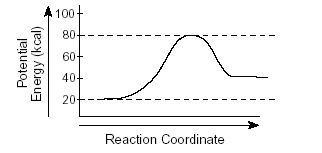
What is the ΔH of this reaction?

1

40 kJ

2

20 kJ

3

80 kJ

4

-60 kJ

35

Multiple Choice

Question image
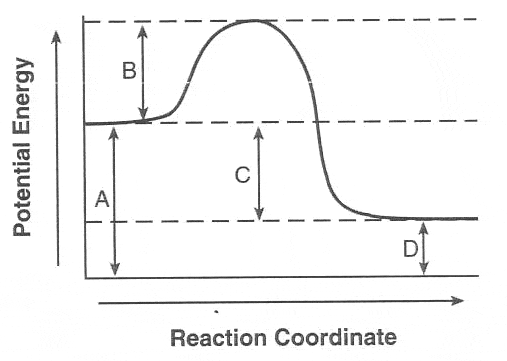
What letter represents the energy of the products?
1
A
2
B
3
C
4
D

36

Multiple Choice

What is the sign of ΔH for all endothermic reactions?
1
Positive
2
Negative

37

Multiple Choice

Question image

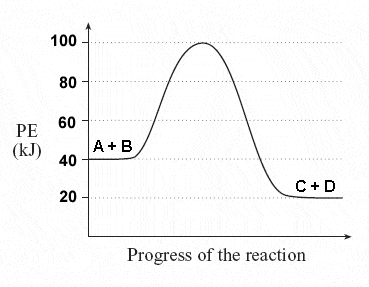
What is the change of the heat of the reaction (ΔH)?

1

-40 kJ

2

-20 kJ

3

100 kJ

4

60 kJ

38

Multiple Choice

Question image
What is the PE of the reactants?
1
100 kJ
2
175 kJ
3
50 kJ
4
75 kJ

39

Multiple Choice

Question image

What is the change of the heat of the reaction (ΔH)?

1

100 kJ

2

-175 kJ

3

-50 kJ

4

75 kJ

40

Multiple Choice

A material was cooled from 100ºC to 40ºC.  What is the temperature change?
1
60ºC
2
40ºC
3
-60ºC
4
-40ºC

41

Multiple Choice

A sample of iron receives 50.J of heat energy that raises the temperature of the iron by 25.0°C. If iron has a specific heat of 0.10 J/g°C, what is the mass of the iron sample?  (show your work)
1
25g
2
30g
3
20g
4
50g

42

Multiple Choice

How does heat flow?
1
Always from cold to warm
2
Always from warm to cold
3
Both warm to cold & cold to warm
4
It depends on the temperature

43

Multiple Choice

The specific heat of water is 4.18 J/g°C.

If 980. J of energy is added to 6.20 g of water at 18.0 °C, what is the final temperature of the water?

1

-55.8 °C

2

-19.8 °C

3

19.8 °C

4

55.8 °C

44

Multiple Choice

Question image

Lighting a match produces heat (energy) as the match stick burns. This is an example of an ____________ reaction.

1

endothermic

2

exothermic

45

Multiple Choice

Question image

Is the process shown to the right exothermic or endothermic?

1

endothermic

2

exothermic

SE04 Multiple Choice Review!

Show answer

Auto Play

Slide 1 / 45

SLIDE