Search Header Logo
Unit 4/5 EOG Review

Unit 4/5 EOG Review

Assessment

Presentation

•

Science

•

6th - 8th Grade

•

Medium

•
NGSS
MS-LS4-2, MS-ESS1-1, MS-ESS1-4

+24

Standards-aligned

Created by

Renee Mosher

Used 3+ times

FREE Resource

17 Slides • 54 Questions

1

media

2

Multiple Select

Do you have both pages for today's assignment?

1

Yes!

2

No, I need to go get them from the bin.

3

media

4

Fill in the Blank

What pages are you expected to complete in your notebook today?

/

5

media

6

Multiple Choice

What is "Geological Evolution"?

1

how the Earth has changed over time

2

how life on Earth has changed over time

3

how school has changed over time

7

media

8

Match

Match the following

Law of Superposition

Uniformitarianism

Geologic Time Scale

Radioactive Dating

oldest at bottom, youngest at the top

slow, gradual processes keep happening

shows major events and changes on Earth

use of isotope to determine absolute age

9

media

10

media

11

Multiple Choice

What is the correct order of the rock layers and features? (youngest to oldest!)

1

A, B, C, D, E, F

2

C, F, A, B, E, D

3

C, F, B, A, D, E

4

D, E, B, A, F, C

12

media

13

Multiple Choice

What is the correct order of the rock layers and features? (youngest to oldest!)

1

G, E, D, C, B, A

2

A, B, C, D, E, G

3

G, D, C, B, A, E

4

A, C, D, B, E, G

14

media

15

media

16

media

17

Multiple Choice

Why can index fossils be used to determine the relative age of other fossils and rocks?

1

they lived during a specific time period.

2

they lived during multiple time periods

3

they are widespread

18

Multiple Choice

Question image

The diagram shows the rock layers and fossils found in four separate rock outcrops. (four different locations)

Which fossil is the best index fossil?

1

it's found in one layer in all four area

2

it's found in multiple layers

3

it's found in only one area

19

Multiple Choice

Question image

The diagram shows the layers of rock with different fossils in it. The fossil type D is an index fossil, and it lived on Earth between 248 million to 206 million years ago.

Which statement correctly predicts the relative age of another fossil?

1

Fossil A might have lived on Earth 150 million years ago

2

Fossil B might have lived on Earth 180 million years ago

3

Fossil C might have lived on Earth 225 million years ago

4

Fossil E might have lived on Earth 500 million years ago

20

media

21

Categorize

Options (8)

Law of Superposition

Index Fossil

Younger

Older

Carbon-14 dating

Uranium-235 dating

Half-life

Radioactive Dating

Organize these options into the right categories

Relative Age
Absolute Age

22

media

23

media

24

Multiple Choice

Wegener had evidence to support his Theory of Continental Drift.  Which of these are pieces of evidence he had:

1

The continents seem to fit together like puzzle pieces (matching coastlines)

2

The similar rocks and rock layers on the coasts of continents that match up

3

all of these

4

Fossils records also support similar species found on matching coastlines

25

Multiple Choice

What can scientists use to study how Earth's climate and atmosphere have changed over time?

1

Ice cores

2

Index fossils

3

Law of Superposition

4

Radioactive dating

26

Multiple Choice

Question image

Which of the following orders the rock layers accurately from oldest to youngest?

1

1, 2, 3, 4, 5

2

5, 4, 3, 2, 1

3

2, 3, 4, 5, 1

4

1, 2, 3, 5, 4

27

Multiple Choice

A fossil that only lived during a specific time period, is widespread, and abundant.

1

Trace Fossil

2

Index Fossil

3

Mold

4

Cast

28

Multiple Choice

What is a principal that states that geologic processes that occurred in the past can be explained by current geologic processes.

1

Catastrophism

2

Unconformity

3

Uniformitarianism

4

Angular Unconformity

29

Multiple Choice

Any method of determining whether an event or object is older or younger than other events or objects.

1

Relative Dating

2

Absolute Dating

3

Isotope

4

Speed Dating

30

Multiple Choice

A gap in the rock layers or area of missing rock, usually caused by erosion.

1

Extrusion

2

Intrusion

3

Unconformity

4

Fault

31

Multiple Choice

A law that states that younger rocks lie above older rocks if the layers have not been disturbed.

1

law of superposition

2

uniformitarianism

3

law of conservation

4

catastrophism

32

Multiple Choice

Which is older? An amphibian from 360 million years ago or a fish from 505 million years ago.

1

the amphibian

2

the fish

33

Multiple Choice

Which is an example of absolute age?

1

"This trilobite is older than that dinosaur."

2

"Velociraptors lived 71-75 million years ago."

3

"The oldest sedimentary layer is on the bottom."

34

Multiple Choice

Which radioactive substance would probably be used in dating the recent remains of a plant found in sedimentary deposits?

1

carbon-14

2

rubidium-87

3

potassium-40

4

uranium-238

35

Multiple Choice

Which best describes uniformitarianism?

1

the formation of rock layers has slowed because humans have altered the environment.

2

The processes that shape the Earth continue as they have since the Earth formed.

3

The time it takes for erosion to occur has changed since Earth first formed.

4

The movement of the continents no longer occurs because of changes in ocean currents.

36

Multiple Choice

Question image

Scientists find dinosaur fossils in the bottom rock layers of a cliff and mammal fossils in the middle rock layer of the cliff. Which could best be concluded from this evidence?

1

Dinosaurs ate plants

2

Dinosaurs were eaten by the mammals

3

Dinosaurs lived on Earth before the mammals

4

Dinosaurs and mammals lived at the same time

37

Multiple Choice

Question image

Which best describes how ice cores are important to the study of geologic history?

1

They show unconformities, which signal changes in deposition.

2

They hold index fossils, which are used to date the different ice cores.

3

They contain evidence showing changes in the atmospheric composition over time.

4

They follow the Law of Superposition, which gives reasons for extinctions of species.

38

Multiple Choice

A fault shifts a sedimentary rock layer. Which geologic event is older?

1

the fault is older

2

the sedimentary rock layer is older

39

Multiple Choice

What is the geologic time scale?

1

a graphic organizer of all major events and changes in Earth's history

2

a record of how Earth's climate has changed

3

keeps track of fossils

40

Multiple Choice

_________________ is a method of determining the absolute ages of rocks.

1

Radioactive dating

2

Radioactive decay

3

Relative age

4

Counting the rings of a rock

41

Multiple Choice

During _________________, the atoms of one element break down to form atoms of another element.

1

radioactive decay

2

relative dating

3

absolute age

4

tooth decay

42

Multiple Choice

Question image
This fossil turtle and this living hawk both have a structure in their neck called the atlas bone. What best explains why both species have an atlas bone?
1
The turtle and hawk are different species, so they must not share an ancestor population. They inherited their atlas bone structure from separate ancestor populations.
2
The turtle and hawk both share the same ancestor population that had an atlas bone. They inherited this structure from the ancestor population.
3
It is impossible to say. Fossils are very old; therefore, we cannot make observations of the turtle’s ancestors, and we cannot explain its body structures.
4
All species have their own specific body structures, so it is a coincidence that this turtle and hawk each happen to have the atlas bone structure.

43

Multiple Choice

Which of the following best describes the variation seen in peppered moths?
1
individual peppered moths can vary their color to camouflage
2
there are multiple species of peppered moths each with different colors
3
there is one species of peppered moths with two color variations
4
pepper moths come in at least 12 different colors

44

Multiple Choice

Question image

The diagram shows the leg bones of a (Left -> Right): Orangutan, dog, pig, cow, tapir, and horse. Most of the animals have the same bones, although some are shaped differently and placed in different positions. What does this suggest about mammals?

1

The mammals are evolving to become more and more like one another.

2

That they share a common ancestor.

3

That the shape of the bones has less to do with the environment pressures on the animal and more to do with what their relatives are.

4

That they all continue to use these structures for the same exact purpose.

45

Multiple Choice

A fossil of an extinct dinosaur is found and the anatomy of the fossil shows similarities to that of a bird. What could this mean?

1

This is purely by chance and isn't significant

2

The extinct dinosaur and modern bird share a common ancestor

3

All dinosaurs evolved into birds and that's why there aren't any dinosaurs alive today

4

Dinosaurs choose to fly, and evolved into birds to escape predation and capture food

46

media

47

Multiple Choice

The change over time in populations of related species.
1
biological evolution
2
transition
3
variation
4
adaptation

48

Multiple Choice

How do transitional fossils provide evidence for common ancestry among different species?

1

Transitional fossils prove that species were created separately and did not evolve from a common ancestor.

2

Transitional fossils are fabricated by scientists to support the theory of common ancestry.

3

Transitional fossils only show random mutations and do not provide evidence of shared evolutionary history.

4

Transitional fossils demonstrate gradual changes between species, indicating a shared evolutionary history.

49

media

50

Multiple Choice

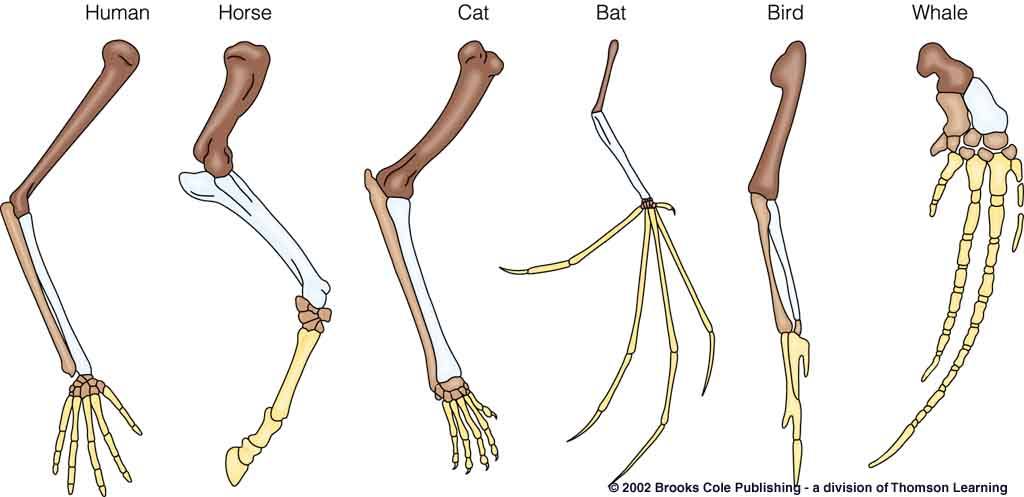
Body parts of organisms that are the same in structure and position but different in function.
1
embryos
2
homologous structures
3
analogous structures
4
vestigial structures

51

Multiple Choice

Body parts that function like each other, but are different in structure.
1
embryos
2
homologous structures
3
analogous structures
4
vestigial structures

52

Multiple Choice

Organisms with these structures are believed to be closely related.
1
analogous structures
2
homologous structures 
3
mutated DNA
4
gills

53

Multiple Choice

Organisms with these structures are NOT believed to be closely related.

1

analogous structures

2

homologous structures

3

gills

54

Multiple Choice

Question image
The structures shown are_________
1
homologous
2
heterologous
3
analogous
4
vestigial

55

media

56

media

57

Multiple Choice

Whales live in the ocean. They do not have legs, but they do have a pelvis with small leg bones attached to it. This is evidence that:
1
Whales are not well adapted to ocean life.
2
Whales do not have homologous structures
3
Whales evolved from animals that once lived on land
4
Whales evolved from some type of fish

58

Multiple Choice

Which describes the theory of biological evolution?

1

a theory that states that matter cannot be created nor destroyed

2

a theory that states life on earth changes gradually and slowly over time due to variations in an organisms's ability to adapt

3

a theory that states earth is formed by slow, ongoing continuous processes

4

a theory that states life on earth is chosen purposefully by God.

59

Multiple Choice

What is taxonomy?

1

the classification and organization of living things.

2

slow, ongoing process that continuously happen

3

life on earth changes gradually and slowly over time due to variations in organisms

60

Multiple Choice

What is a major trigger for biological evolution?

1

mass extinctions

2

change in diets

3

new periods of geologic time

61

Multiple Choice

What is the term for a feature that allows an organism to survive better in its environment?

1

variation

2

adaptation

3

homologous structure

4

vestigial structure

62

Multiple Choice

What would indicate that a series of fossils represents biological evolution?

1

the fossils were identical

2

the fossils were found in the same layers of rock

3

the fossils show similarities

4

the fossils were completely different

63

Multiple Choice

What is another name for natural selection?
1
survival of the smartest
2
survival of the fastest
3
survival of the biggest
4
survival of the fittest

64

Multiple Choice

Biological evolution typically happens...

1

in a few weeks

2

over millions of years

3

never

4

in 100 years

65

Multiple Choice

When looking at two birds of the same species, you notice that one has darker feathers than the other one. You also notice that one has a beak that is just a little longer. These slight differences within members of the same species are called.....

1

Fossils

2

Extinction

3

Variations

66

Multiple Choice

Which term refers to the process by which individuals that are better suited to the environment survive and reproduce therefore passing down their genes to their offspring? 
1
Evolution 
2
Variation 
3
Adaptation
4
Natural Selection 

67

Multiple Choice

Question image
Some organisms that share a common ancestor have features that have different functions, but similar structures.  These are known as
1
vestigial structures
2
analogous structures
3
homologous structures
4
fossil structures

68

Multiple Choice

When a species completely dies out, it is called.....

1

Adaption

2

Extinction

3

Fossilization

4

Mutation

69

Multiple Choice

Why is genetic variation within a species important for the survival of the species?

1

It will likely result in larger individuals in the species.

2

It will likely result in the species becoming predators.

3

It will likely result in more intelligent individuals in the species.

4

It will likely result in the species being able to adapt to its environment.

70

Multiple Choice

These cause variations.

1

gene mutations

2

adaptations

3

a desire to change

4

injuries

71

Multiple Choice

Fossils of mammals found in both Australia and southern Asia were discovered to have body structures believed to have evolved from a common ancestor. What does this evidence suggest?

1

These organisms were capable of swimming from one continent to the other.

2

Australia and Asia were once part of a larger continent.

3

These organisms developed during the same time period.

4

These organisms are the same species

media

Show answer

Auto Play

Slide 1 / 71

SLIDE