Perception and Senses Lecture
Presentation
•
Science
•
9th - 12th Grade
•
Practice Problem
•
Easy
+3
Standards-aligned
Josiah Lawrence
Used 3+ times
FREE Resource
34 Slides • 19 Questions
1
2
3
4
Multiple Choice
What does the term "absolute threshold" refer to?
The minimum stimulation needed to detect a particular stimulus
The maximum stimulation that can be detected
The average level of stimulation required for conscious awareness
The threshold for unconscious perception
5
Multiple Choice
What are messages that are presented below the threshold for conscious awareness called?
Subconscious signals
Supraliminal messages
Supersonic messages
Subliminal messages
6
The process by which our brain cells become less sensitive to constant stimuli that are picked up by our senses.
7
Multiple Choice
What factors influence whether sensory information is sensed or perceived?
Learned behavior and motivation
Attention and Motivation
Stimuli and unconscious processing
Motivation and unconscious processing
8
9
10
11
Multiple Choice
What Lobe of the Brain has vision?
Occipital
Frontal
Lateral
Corpus Callosum
12
13
Multiple Choice
What are the two pathways associated with vision?
What and Where/How Pathway
Normal and Irregular Pathway
Left and Right Pathway
Distance and Location Pathway
14
15
16
Multiple Choice
Light enters into the eye as a
Wave
Image
Reflection
Sensation
17
18
Open Ended
Compare and contrast the Trichromatic and Opponent Process.
19
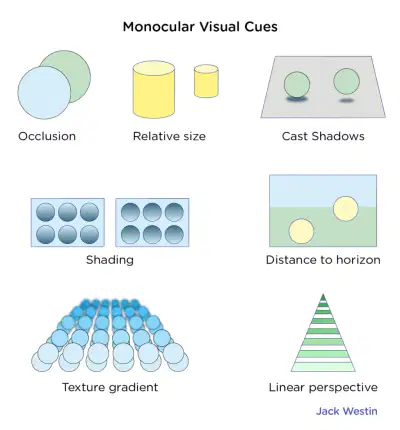
binocular depth cues involve using both eyes, whereas monocular depth cues rely on one eye to process distance and depth perception. Monocular depth cues allow us to see objects two-dimensionally, and binocular cues allow us to see objects in 3D.
20
21
Multiple Choice
Which of these is not a cue for monocular vision
Occlusion
Double Refraction
Shading
Distance to horizon
Shadows
22
23
24
Multiple Choice
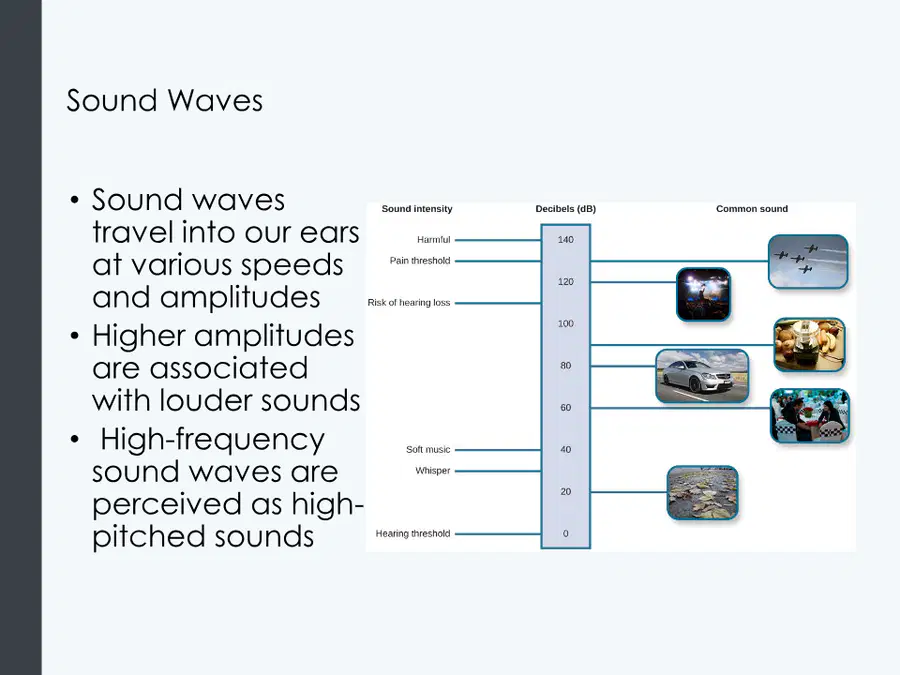
While attending a concert, you notice that the music suddenly becomes much louder. Which of the following best explains why the sound seems louder?
The sound waves are traveling into your ears at a slower speed
The sound waves have higher amplitudes
The sound waves have lower frequencies
Because of the slower velocity
25
26
27
Open Ended
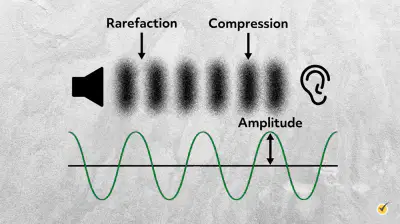
Based on the image and how you perceive sound what do you think that the definition of interaural level difference means and interaural time difference means?
28
29
Multiple Choice
How do we taste?
Food molecules dissolve on taste receptors on our tongue
Food sticks to the outside sides of our mouth and causes a perception change on the tongue
The food molecules dissolve and are read by the tympanic membrane
The nasal receptors and tongue receptors dissolve food
30
Fill in the Blanks
Type answer...
31
32
Multiple Choice
What are the receptors that identify smell?
Olfactory
Gustatory
Auditory
Somatictory
33
34
Match
Match the following
Mechanoreceptors
Thermoreceptors
Chemoreceptors
Stretching, stroking, vibration
Cold or Hot
Respond to chemicals
Stretching, stroking, vibration
Cold or Hot
Respond to chemicals
35
36
Match
Match the following
Nociceptors
Neuropathic
Inflammatory
Chemical receptors (Itching)
Deep pain having to do with nerve damage
Produces a inflammation response
Chemical receptors (Itching)
Deep pain having to do with nerve damage
Produces a inflammation response
37
Multiple Choice
What is a something non-physical that effects pain?
expectation
oxygen level
neurowaves
nociceptors
38
39
Multiple Choice
What is the cortex where pain is mapped on the brain?
Somatosensory
Parasensory
Synapticsensory
Corbalusm Cortex
40
41
42
43
Categorize
Balance
Spatial orientation
body position
feeling dizzy
knowing how far to press a buttion
bodys movement
coordination
Swinging a bat
44
45
46
47
48
49
50
51
Match
Figure-Ground Relationship
Proximity Principle
Similarity Principle
Continuity Principle
Closure Principle
Figure-Ground Relationship
Proximity Principle
Similarity Principle
Continuity Principle
Closure Principle
52
Watch the Edpuzzles that Illustrate these effects.
53
Show answer
Auto Play
Slide 1 / 53
SLIDE

Similar Resources on Wayground
47 questions
Stellar Evolution & Explosions
Presentation
•
9th - 12th Grade
47 questions
Unit 8- Lesson 4: Trade and Globalization
Presentation
•
9th - 12th Grade
48 questions
Chapter 2 - Economics and Environmental Policies
Presentation
•
9th - 12th Grade
44 questions
Central Dogma
Presentation
•
8th - 12th Grade
44 questions
Lesson 7.1 : Plant Structures
Presentation
•
9th - 12th Grade
47 questions
Life Cycle of Stars
Presentation
•
9th - 12th Grade
51 questions
Chemistry 1-4: Electrons in Atoms
Presentation
•
10th - 12th Grade
Popular Resources on Wayground
20 questions
Math Review
Quiz
•
3rd Grade
15 questions
Fast food
Quiz
•
7th Grade
20 questions
Context Clues
Quiz
•
6th Grade
20 questions
Inferences
Quiz
•
4th Grade
19 questions
Classifying Quadrilaterals
Quiz
•
3rd Grade
20 questions
Figurative Language Review
Quiz
•
6th Grade
20 questions
Equivalent Fractions
Quiz
•
3rd Grade
10 questions
Identify Fractions, Mixed Numbers & Improper Fractions
Quiz
•
3rd - 4th Grade
Discover more resources for Science
25 questions
Naming Ionic and Covalent Compounds
Quiz
•
9th Grade
40 questions
NCFE Earth and Environmental Science Released Test
Quiz
•
9th - 12th Grade
10 questions
Exploring Weather Influences and Map Reading
Interactive video
•
6th - 10th Grade
20 questions
Human Impact on the Environment Review #2
Quiz
•
9th Grade
20 questions
Balancing Chemical Equations
Quiz
•
9th Grade
61 questions
End of the Year Trivia Fun
Quiz
•
9th Grade
15 questions
Protein synthesis
Quiz
•
9th Grade
30 questions
Environmental Science Final Exam REVIEW
Quiz
•
9th - 12th Grade