
Articles of Confederation to Constitution

Presentation
•
Social Studies, History, English
•
9th - 12th Grade
•
Practice Problem
•
Hard

Joshua Wright
Used 1+ times
FREE Resource
59 Slides • 71 Questions
1
Early Documents & Thinkers

2
Multiple Choice
In English history, the Magna Carta (1215) and the English Bill of Rights (1689) both reinforced the concept of
universal suffrage
a limited monarchy
religious toleration
a laissez-faire economy
3
Multiple Choice
The American concept of due process can be traced back to common law practices that were FIRST codified in the
Magna Carta
Mayflower Compact
English Bill of Rights
Articles of Confederation
4
Multiple Choice
How did the English Bill of Rights limit the power of the monarch?
Parliament could not rule without the consent of the monarch.
A cabinet was created to represent Parliament's majority party.
The monarch could not levy taxes without a specific grant from Parliament.
Nobles were selected to be a part of the monarch's special advisory group.
5
Fill in the Blanks
The Magna Carta, English Bill of Rights, and Petition of Rights have all had a last impact on American democracy by providing a foundation for
Type answer...
6
Multiple Select
Select the following documents that limited government
Hammurabi's Code
Magna Carta
English Petition of Right
English Bill of Rights
7
Multiple Choice
This is the idea that no one is above the law
rule of law
due process
self government
Magna Carta
8
Multiple Choice
This is a concept that the government should serve the will of the people through a small group of elected officials.
ordered government
limited government
representative government
authoritarian government
9
Multiple Choice
This concept states that government is not all powerful and is restricted in what it can and cannot do.
ordered government
limited government
representative government
authoritarian government
10
Multiple Choice

The Baron de Montesquieu developed this idea of government
bicameral legislature
three branches of government
unicamiral legislature
the invisible hand
11
Multiple Choice

John Locke believed that people had which type of rights?
Life, liberty, and the pursuit of happiness
Freedom of Speech, Religion & Press
The Right to Bare Arms and the Right to a Trial by Jury
Life, liberty, and property
12
Multiple Choice

John Locke inspired the writing of this important document by Thomas Jefferson.
Magna Carta
US Constitution
Mayflower Compact
Declaration of Independence
13
Multiple Choice
What is a social contract?
an agreement between all the leaders of the country
an agreement between the people of the country and the government
an agreement between you and a record label to release your next musical hit
14
Multiple Choice
According to John Locke what must the government do with people's rights?
Get rid of them
Protect Them
Get Over them
15
Multiple Choice
Thomas Hobbs is considered an outlier because he believes a Social Contract must have this type of person in charge?
A Fair Leader
A Weak King
An Absolute Monarch
The President
16
Multiple Choice

17
Multiple Choice

18
Multiple Choice

19
Multiple Choice
What notable document in the United States contains wording similar to the Petition of Right?
The Declaration of Independence
The Magna Carta
The Colonial Charter
The Constitution
20
Multiple Choice
21
By Mary Corrigan
22
First constitution; confederal government
States held most of the power with a weak central government
Weaknesses:
no federal taxes, no national military, no national trade alliances, no president, no common currency, one branch of government; amendments must be approved by all 13 colonies
Shay's Rebellion showed how the national government was unable to control and enforce laws among the states
23
Multiple Choice
Which of the following weaknesses of the Articles of Confederation were corrected by creating the Executive Branch under the current Constitution?
different currencies per state
no national military
no ability to negotiate national treaties
no ability to collect taxes
24
Delegates from 12 colonies meet to make new Constitution
Federal power: strong national government shares power with states
Separation of Powers: power split across three branches
Checks and Balances: each branch has the ability to limit the others
Amendments: proposed by 2/3 Congress, ratified by 3/4 states
Some text here about the topic of discussion
25
Multiple Choice
Which of the following was not an outcome of the Constitutional Convention?
The federal government was broken into three branches
The US separated from England and became an independent country
The branches were able to limit the power of the others
An official amendment process was established
26
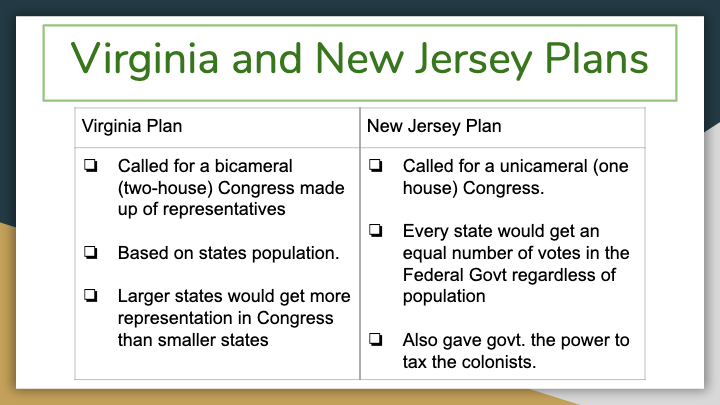
New Jersey Plan: 1 chamber, 1 vote per state
Virginia Plan: 2 chambers, representation based on population
Congress: bicameral; Senate - 2 votes per state, House - population = representation
Great Compromise
Federalists: wanted strong central government, president; against Bill of Rights; Federalist Papers
Anti-Feds: Against federal power, against president; demanded Bill of Rights
Feds/Anti-Feds
Constitution worked to find compromise between all groups and better represent the needs of the people
27
Multiple Choice
Which of the following was a shared concern among the disagreements between the Federalists and Anti-Federalists and the supporters of the New Jersey v. Virginia Plans?
Both centered around the idea of who would lead the federal government
Both centered around the way in which the legislative branch should be shaped
Both sets of discussions centered around the distribution of power between the federal government and the states
Both centered around the idea of giving the federal government legislative power
28
Parts of the Constitution
Preamble: introduction; self-government and 6 promises of government
Article I: Establishes Legislative Branch (Congress)
Article II: Establishes Executive Branch (President)
Article III: Establishes Judicial Branch (Supreme Court)
Article IV: Reserved Powers; how to admit new states
Article V: How to amend the Constitution
Article VI: Supremacy Clause
Article VII: How to ratify the Constitution
Subject | Subject
The Constitution is the longest, continuest use constitution in the World
29
Multiple Choice
Which of the following parts of the Constitution contains the idea that the Constitution is the supreme law of the land?
Preamble
Article I
Article II
Article VI
30
Preamble
We the people - self government; popular sovereignty
In order to form a more perfect union - make our country better than under the Articles
Establish justice - create a fair court system of laws
Ensure domestic tranquility - keep peace at home
Provide for the common defense - national military and protection
Promote the General Welfare - ensure the security and wellbeing of citizens
Secure the blessings of liberty - freedom for ourselves and our children
Do ordain and establish - give this document power
Subject | Subject
31
Multiple Choice
Which part of the Preamble supports the idea of self-government?
We the people...
establish justice...
ensure domestic tranquility...
promote the general welfare...
32
Strengths and Weaknesses

33
Ratified by the 13 colonies in 1781
34
Americans feared that if they gave too much power to the federal government they would be left with similar issues and concerns they had while under King George III rule.
Americans thought that too much government power would infringe on their rights, and liberties they fought to get.
35
Multiple Choice
The Articles of Confederation formed a _______ Government?
Strong
Weak
Powerful
36
Multiple Choice
Americans feared that if they gave the government too much _____ they would be left with similar issues they had while under King George III rule
Power
Money
Freedom
37
Multiple Choice
Under the Articles of Confederation who had the most power?
People
National Government
King
States
38
Congress could not collect taxes to pay back dept
No common currency
Weak national government
No national court system
Unable to enforce laws
9 out of 13 states had to vote in order to approve a law. Each state was only allowed one vote
All states (13) had to vote in order to amend the Articles of Confederation.
39
Multiple Choice
Congress could collect tax?
True
False
40
Multiple Choice
Congress could enforce laws and force the states to obey those laws.
True
False
41
Multiple Choice
There was no common currency/money for all 13 states.
True
False
42
Multiple Choice
How many votes did congress need to approve a new law?
13
5
9
7
43
Multiple Choice
How many votes did each state get to contribute?
1
2
3
44
Multiple Choice
How many votes did congress need in order to make amendments to the Articles of Confederation?
9
7
50
13
45
Establish and maintain military
Make Treaties
Settle disputes among states
46
Multiple Choice
Congress was able to establish a national army to defeat the British in the American Revolution.
True
False
47
Multiple Choice
Congress granted all power to the national government and did not give states and free citizens rights.
True
False
48
Multiple Choice
Congress was able to negotiate the end of the American Revolution by signing the Treaty of Paris.
True
False
49
by Taylor Looney
50
First Constitution in America
Weak on purpose
Single branch of government

51
Fill in the Blanks
The Articles of Confederation were
Type answer...
52
constitution: document that sets out the laws and principles of the government
53
Multiple Choice
What does a constitution do?
defines unalienable rights
sets out laws and principles of a government
separates branches of government
lists grievances
54
States rights
Ability to:
Declare war
Make peace treaties

55
Multiple Choice
Under the Articles of Confederation, who had more power?
states
government
56
Authority to:
operate post offices
maintain army
conduct foreign affairs

57
Multiple Choice
The Articles of Confederation gave the government the authority to operate...?
banks
hospitals
post offices
schools
58
9 states approval
no court system

59
Multiple Choice
Under the Articles of Confederation, the government did not have a(n) ...
national court system
army
constitution
alliance with foreign countries
60
No power to:
tax
regulate trade
currency
amend/enforce laws
standing army
https://youtu.be/Gw7gZS_B5mY

61
Multiple Choice
The Articles of Confederation allowed the states to refuse ...
creating and army
common currency
voting
taxation
62
ratification: official approval

63
Multiple Choice
Ratification means ...
a vote
a veto
official approval
document of laws
64

65

66

In 1787, 55 delegates from 12 of the 13 states (every state except Rhode Island) attended the Constitutional Convention in Philadelphia, Pennsylvania
They met to amend (make changes to) the Articles of Confederation. However, in order to amend the Articles of Confederation all 13 states would have to agree. Only 12 states showed up so this was impossible. They eventually decided to scrap the Articles of Confederation and make a new constitution

67
Multiple Choice
Which of the following was the original purpose of the Constitutional Convention?
To create a new constitution
To revise the Articles of Confederation
To form a national army
To strengthen the power of the states
68
Multiple Choice
Why did they have to change their goals to making a new constitution instead of revising the Articles of Confederation?
They didn't have enough states at the convention to get the 100% approval needed to amend the Articles of Confederation
No one at the Convention liked the Articles of Confederation
They didn't have enough time to revise the Articles of Confederation
69
The men who wrote the Constitution are referred to by several different names. These include:
Delegates - A representative sent to a conference.
Framers - A person who shapes a concept or plan.
Founding Fathers - The men who created the U.S. government

70
Multiple Choice
Which of the following is NOT a name that describes the men who attended the Constitutional Convention?
Delegates
Framers of the Constitution
Founding Fathers
Parliament
71
72
Multiple Choice
Which of the following best describes the Constitutional Convention?
A secretive meeting that created a new government for the United States
A public meeting that all U.S. citizens were invited to attend to create a new government
A meeting between Great Britain and the U.S. to discuss the terms of the end of the Revolution
73
All delegates at the Constitutional Convention were white men, most were very wealthy and well-educated and more than half were lawyers and had previous government experience.
More than half of the delegates were slave owners.

74
Multiple Choice
Which of the following best describes the framers of the Constitution?
Average Americans
Wealthy, well educated and powerful
Loyalists
Poor and uneducated
75
The delegates included some well-known patriots such as George Washington, Benjamin Franklin, and Alexander Hamilton. Thomas Jefferson and John Adams did not attend because they were in other countries handling important business for the U.S.
However, some famous patriots intentionally did not come such as Patrick Henry. There were many Americans who did not want the Articles of Confederation to be changed.

76
Multiple Choice
All Americans supported the idea of replacing the Articles of Confederation with a new form of government
True
False
77
George Washington was chosen to be the president of the convention because he was respected by many and viewed as a unifying person.

78
James Madison took many notes at the convention, and would eventually go on to write most of the Constitution. This is why he is called “The Father of the Constitution” today.

79
Multiple Choice
George Washington was the president of the Constitutional Convention
True
False
80
Multiple Choice

John Adams was known as the "Father of the Constitution" because of the large role he played in writing the Constitution
True
False
81
The delegates at the Constitutional Convention had many different ideas on how the new government should be set up. The debates lasted for 3 months!
The only way for them to be able to create a Constitution that could be passed by a majority of states was to work together and make compromises

82


83
What is an example of a compromise that you have made with someone or that you have seen happen?
Remember in order for it to be a true compromise, both sides must get some of what they want (both sides meet in the middle)
84


Articles of Confederation
Social Studies
85


Who wrote the Articles of Confederation?
●
Altogether, six drafts of the Articles were
prepared before Congress settled on a final
version in 1777.
●
Benjamin Franklin wrote the first and
presented it to Congress in July 1775.
86
Multiple Choice
How many drafts were prepared before they passed the final version in 1777
nine
six
five
four
87
Fill in the Blanks
Type answer...
88


What was the Articles of Confederation?
●
The Articles of Confederation was an
agreement among the 13 original states of the
United States of America that served as its first
constitution.
●
(Our first constitution, inspired by Hiawatha!)
●
Constitution - “a group of important ideas/rules
which an organization agrees to be governed
(ruled) under”
89
Multiple Choice
a group of important ideas/rules which an organization agrees to be governed (ruled) under” is called a ___________
Constitution
compact
agreement
statement
90


When was the document ratified by the colonies?
●
In order for the Articles to be official, they had to
be approved by all thirteen states.
●
The Congress sent the articles to the states to
be ratified near the end of 1777.
●
Ratified - signed or made official
91
Multiple Choice
How many states had to ratify or pass the Articles ?
12
13
11
10
92


Where was the Articles of Confederation drafted?
●
The Articles of Confederation was an
agreement among the 13 original states of the
United States of America that served as its first
constitution.
●
It was approved, after much debate between
July 1776 and November 1777.
●
Drafted and ratified by the 2nd Continental
Congress in Pennsylvania
93
Multiple Choice
Which state did delegates meet to write and discuss the Articles of
Confederation ?
New York
Pennsylvania
Georgia
New Jersey
94


Why did the colonies write the Articles of Confederation?
●
The colonies knew they needed some form of
official government that united the thirteen
colonies.
●
They wanted to have written down rules that
all the states agreed to.
95
Multiple Choice
Why did they write the Articles of Confederation ?
They wanted start a war
They wanted to unify the 13 states
They wanted to have a king ruling
They wanted one person to decide all laws
96

97
Open Ended
What was one weakness of the Articles of Confederation according to the political cartoon ?
98

99
Multiple Choice
Congress could not levy or collect taxes
true
false
100
Multiple Choice
The Articles of Confederation did not include
a national court
a president
a way to collect taxes
all the above
101
Multiple Choice
The Articles included a president and executive branch
True
False
102
Building a Government from Scratch

103

104
Multiple Choice
Under the Articles of Confederation, who held the most power?
Congress
The States
The President
Parliament
105

106
107
Fill in the Blanks
The
Type answer...
108
Multiple Choice
Why did smaller states like the New Jersey plan?
larger states had more votes
equal number of votes
President would have to come from New Jersey
One house of Congress
109

110
Multiple Choice
Who proposed the Great Compromise?
George Washington
Roger Sherman
Thomas Jefferson
Abraham Lincoln
111
Delegate in the Continental Congress from 1774 - 1784
Helped write Declaration of Independence
Senator from Connecticut
Proposed the "Great Compromise"
His plan for a House of Reps and Senate is still in place today

112

113
Multiple Choice
Why did southern slave states want slaves to count towards population?
more representation and power in gov't
more money from the President
more people to enlist in the army
114

115
Multiple Choice
Only the Senate and House of Representatives can propose and pass laws.
TRUE
FALSE
116

117
118
1781-1789
Confederacy: State Governments control Central Government
The Articles of Confederation was the governing document of the US before the Constitution
The war was not yet officially over
119
The Articles of Confederation Section
Prepare to respond without the textbook to
1) the powers of the central government
2) problems with the Articles without the Textbook
120
Multiple Choice
Which was not a power of the Confederate Central Government?
Settling Disputes between states
Declaring War
Borrowing Money
Override any state decision
121
Confederacy
The Central Government is subordinate to the State Governments
Central Government is made up of a congress which can
deal with certain foreign affairs
borrow money
regulate value of currency
Declare or end war
raise an army
Mediate and settle disputes between states
122
Open Ended
What were the 3 major problems of the Articles?
123
Problems with the Articles
1) Incredibly difficult to pass anything - 9 out of 13 vote
2) The Central Government didn't have much ability to do anything
3) Congress couldn't raise taxes
124
Multiple Choice
Were the Articles of Confederation ratified before or after the Declaration of Independence?
Before
After
Same time
time time
125
Presidents of the US
John Hanson
Elias Boudinot
Thomas Mifflin
Richard Henry Lee
John Hancock
Nathaniel Gorham
Arthur St. Clair
Cyrus Griffin
126
Problems with the Articles
1) Incredibly difficult to pass anything - 9 out of 13 vote
2) The Central Government didn't have much ability to do anything
3) Congress couldn't raise taxes
127
1781
In 1781 General Cornwallis (British) lost a major defeat at Yorktown
Scattered Battles continued for the next year, but the war was essentially lost for the British
128
1783 - War officially over
England recognized the 13 Independent States
Still governed under the Articles of Confederation by the Continental Congress
129
1783 - War officially over
England recognized the 13 Independent States
Still governed under the Articles of Confederation by the Continental Congress
130
Multiple Choice
What is the correct order of the Documents?
1) The Constitution, 2) Dec. of Independence, 3)Articles of Confederation
1)Dec. of Independence 2)Articles of Confederation
3) Constitution
1)Dec. of Independence 2)Constitution
3) Articles of Confederation
Early Documents & Thinkers
Show answer
Auto Play
Slide 1 / 130
SLIDE
Similar Resources on Wayground

126 questions
Reading SOL Review
Presentation
•
11th Grade
122 questions
Data mining techniques
Presentation
•
10th Grade
130 questions
2nd Semester Spanish I Review (includes Preterite)
Presentation
•
9th - 12th Grade
125 questions
G9 Revision - Climate Change Lesson and Quiz
Presentation
•
9th Grade
120 questions
Ecology Community interactions and Ecology review questions
Presentation
•
8th - 12th Grade
118 questions
OP 6.1-6.4 American Imperialism
Presentation
•
11th Grade
125 questions
FIGURATIVE LANGUAGE 2
Presentation
•
11th Grade - University
Popular Resources on Wayground
10 questions
Safety Day 2026 – Student Review

Quiz
•
9th Grade
21 questions
Continents and Oceans
Quiz
•
6th Grade
20 questions
Parts of Speech
Quiz
•
5th Grade
16 questions
Subject & Predicate
Quiz
•
5th Grade
25 questions
Multiplication Facts
Quiz
•
5th Grade
12 questions
Map Skills
Quiz
•
3rd Grade
22 questions
Continents and Oceans
Quiz
•
5th Grade
15 questions
Rounding Decimals
Quiz
•
5th Grade
Discover more resources for Social Studies
10 questions
Exploring the Age of Exploration: Key Events and Figures

Interactive video
•
6th - 10th Grade
9 questions
Exploring Ancient Mesopotamia and Its Civilizations
Interactive video
•
10th Grade
20 questions
Chapter 8 Test "Types of Business Organizations"
Quiz
•
12th Grade
39 questions
Unit 7 Key Terms
Quiz
•
11th Grade - University
10 questions
Debating the Legacy of Christopher Columbus
Interactive video
•
6th - 10th Grade
38 questions
Unit 6 Key Terms
Quiz
•
11th Grade - University
27 questions
World Geography - Q1 9week Test
Quiz
•
9th Grade
22 questions
U3T2 Vocab FAC: Domestic Policy
Quiz
•
10th Grade