

1.2 Parental Roles

Presentation
•
Other
•
9th - 12th Grade
•
Practice Problem
•
Easy

Margeaux Cronce
Used 7+ times
FREE Resource
16 Slides • 13 Questions
1

Unit 1 - Lesson 1.2
Lesson Objectives:
1) Identify the specific responsibilities of different parental roles
2) Identify the consequences of not fulfilling your parental role
3) Explain the qualities that help an individual to succeed in different parental roles
• nurture, parental roles,
socialization, socioemotional
support, structure
Do Now:
1) Connect to Wayground
2) Add to our class padlet! Link in chat

Welcome to Real World Parenting!


Next slide: Chat waterfall :)
2
Chat Waterfall:
Don't write your answer yet.
Just think about it...
Which one is better?

Batman OR Superman
3
4
Multiple Select
Review: What is one of the MAIN responsibilities of being a parent? Click all that apply
To fulfill their basic needs
To love and emotionally support them
To provide structure and teach how to do life
To be their best friend and give them anything they want
5
Open Ended
How much does a parent effect a child and the rest of their life?
6

Think about it...
•Recall that one of the main responsibilities of
parenting is to provide the basic needs for
young children.
•However, as children grow up, they should be
taught how to take care of themselves.
•At a younger age, children may help put
clothes away or clean up toys.
•As older children become more
independent, they can begin taking charge of
their basic needs, like making food and
choosing clothing.
7
Poll

What are some household tasks that you do?
Taking out the garbage
Doing the dishes
Vaccuming
Mowing the grass/
yard work
8

New Content:
Parental Roles and Responsibilities
Parental roles are the ways that parents
fulfill their child's basic needs. It also refers
to how they support their child's cognitive
and social development. Parental roles can
generally be divided into two main
categories: nurture and structure.
•The nurture role refers to how parents
care for their child's needs and how
they support them emotionally and
provide them with love.
•The structure role involves shaping
their child's behavior and providing
them with boundaries and
consequences for their actions.
9
Match
Match the word with his definition.
Parental Roles
Nurture Role
Structure Role
how parents fulfill child's basic needs
how parents support & love children
how parents shape child's behavior
how parents fulfill child's basic needs
how parents support & love children
how parents shape child's behavior
10
Let's talk about the structure role...
11
Word Cloud

How do you think a child feels when they have the same bedtime routine each night: Dinner, bath, brush teeth, read books, sing, and then go to bed?
12


The Structure Role
•Structure and consistency helps
children learn how to set and achieve
goals, follow through with
responsibilities, and develop
accountability.
•Providing children with structure helps
them become more mature and
independent. Structure provides
children with a sense of safety. Safety
means making sure children feel secure
in their environments.
13


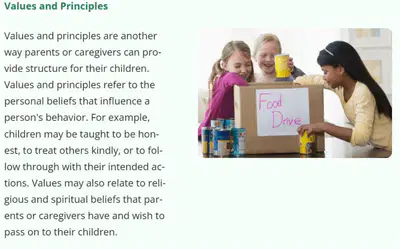
Responsibilities of
Parents in the
Structure Role
14
Multiple Choice
The point of structure is for children to feel
Chaotic
Unsupported
Calm
Tired
15

Impact of the Structure Role
One of the most positive aspects of providing structure for
children is that it helps them understand the results of their
actions. It also helps children understand how their behaviors
impact the lives of the people around them.
•Decision Making and Consequences: When parents or caregivers set limits and explain boundaries to their children, they can learn to be considerate of others. This understanding allows children to make informed decisions
on their own. It can also help children get a better grasp
of boundaries and limitations.
•Self-Sufficiency and Independence: As a caregiver, you can encourage the child to slowly take care of their own needs. This includes things like making their meals and purchasing their clothing.
oWhat are ways that your parent has given you some independence? Write in the chat?
16
Draw
How could a child feel when there is TOO much structure and not enough nurturing from their parent(s)? Draw their emotion!
17
Open Ended
What can happen if there is too much nurturing and not enough structure for a child?
18


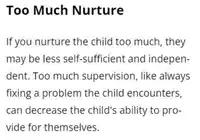
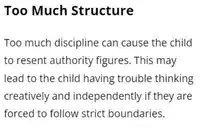
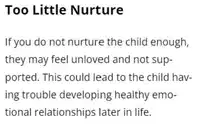
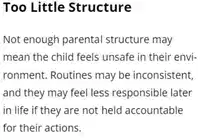
Balancing
Nurture and
Structure
• Parents need to find the right
balance between nurture and
structure.
• Providing too much of one
can have an uneven impact
on a child's development.
• This could also leave a child
unprepared for a life of
independence once they
reach adulthood.
19
Let's review what we've covered so far...
20
Multiple Choice
What's the keyword for how much structure versus nurturing you should offer to a child?
INDULDGE
BALANCE
IGNORE
21
Match
Match the word with his definition.
Parental Roles
Nurture Role
Structure Role
how parents fulfill child's basic needs
how parents support & love children
how parents shape child's behavior
how parents fulfill child's basic needs
how parents support & love children
how parents shape child's behavior
22
Remember, a parent is the child's main teacher in life. One of the primary goals of a parent is to help the child understand their emotions and know how to manage them.
Why is this important?
23
New Idea: Qualities of Parenting
24
Poll

Which do you think is the most important quality of parenting?
Patience
Empathy
Communication
Flexibility
Self-reflection
25
I'm sorry. It was a trick question. They are ALL important aspects of being a good parent.
26

Qualities of Parenting
Children of parents or caregivers who successfully fulfill their parental roles can emotionally
connect with others and provide for their basic needs. These parents or caregivers likely had
qualities that enabled them to overcome the many challenges of being parents. Several qualities
can make a person a successful parent or a caregiver including:
1.Patience: Showing children patience when they make a mistake helps the children better understand what they should have done differently. On the other hand, angry outbursts can create lasting fear and anxiety in children. This can make it harder for children to cope with stress and challenges as they grow up.
2.Empathy: the ability to identify and understand the emotions of others, is an essential quality for parents or caregivers. It helps parents or caregivers to perceive their children's emotions and understand how best to help them with those feelings.
3.Communication: Practicing appropriate communication helps parents or caregivers discuss and resolve issues with their children. This will also help with the socialization process of children as they will learn appropriate communication models. Later in life, children will be able to work effectively with their peers and develop lasting relationships due to their ability
to communicate well.
4.Flexibility: Remaining flexible and able to respond to new situations will help make a successful parent or caregiver. Children will experience many emotions as they grow and develop. A parent or a caregiver who can provide the appropriate emotional response will also help their child develop emotional skills.
5.Self-reflection: Taking a step back and analyzing your actions is important for all parents or caregivers. Self-reflection allows time to consider your actions and feelings toward your child and how they could impact the child's development. This also helps children learn that making mistakes is okay and that it is important to consider the consequences of their actions.
27
Multiple Choice
Cara stopped to think about how she reacted to her son. "I think I could listen more next time, and have a kinder face."
This is an example of what characteristic?
Patience
Self-Reflection
Empathy
Communication
28



Summary
In this lesson, you learned:
othe specific responsibilities that
individuals fulfill in different parental
roles;
othe consequences of an individual not
fulfilling their roles and responsibilities
as a parent; and
othe qualities that help an individual to
succeed in different parental roles.
Monday, 9/9/24, you will examine the costs
and benefits of parenthood.

During our next class,
29
Multiple Choice

An adult is not self-sufficient and is unable to live independently. Which of the following was received by this adult from their parents when growing up?
Too much structure
Too little structure
Too much nurture
Too little nurture
Unit 1 - Lesson 1.2
Lesson Objectives:
1) Identify the specific responsibilities of different parental roles
2) Identify the consequences of not fulfilling your parental role
3) Explain the qualities that help an individual to succeed in different parental roles
• nurture, parental roles,
socialization, socioemotional
support, structure
Do Now:
1) Connect to Wayground
2) Add to our class padlet! Link in chat
Welcome to Real World Parenting!
Next slide: Chat waterfall :)
Show answer
Auto Play
Slide 1 / 29
SLIDE
Similar Resources on Wayground

23 questions
le passe compose avec Etre
Presentation
•
9th - 12th Grade
23 questions
Le passé composé avec Etre
Presentation
•
9th - 12th Grade
21 questions
Human Life Stages & Health Concerns
Presentation
•
9th - 12th Grade
22 questions
3-1: Parallel Lines and Transversals
Presentation
•
9th - 12th Grade
22 questions
Ecological Succession EOC Review
Presentation
•
9th - 12th Grade
22 questions
Ideal Gas Law
Presentation
•
9th - 12th Grade
22 questions
Protein Synthesis
Presentation
•
9th - 12th Grade
22 questions
avancemos 3 4.2 Preterite Irreg Verbs
Presentation
•
9th - 12th Grade
Popular Resources on Wayground
25 questions
The Ultimate College Knowledge Quiz

Quiz
•
8th Grade
20 questions
Math Review
Quiz
•
3rd Grade
15 questions
Fast food
Quiz
•
7th Grade
20 questions
Math Review
Quiz
•
6th Grade
20 questions
Context Clues
Quiz
•
6th Grade
20 questions
Inferences
Quiz
•
4th Grade
19 questions
Classifying Quadrilaterals
Quiz
•
3rd Grade
20 questions
Figurative Language Review
Quiz
•
6th Grade
Discover more resources for Other
10 questions
Fact Check Ice Breaker: Two truths and a lie
Quiz
•
5th - 12th Grade
40 questions
Math Large Group Session 1
Quiz
•
9th - 12th Grade
20 questions
Algebra 1 Review
Quiz
•
9th Grade
20 questions
Math 1 EOC Review
Quiz
•
9th Grade
10 questions
Logos
Quiz
•
6th - 9th Grade
14 questions
Attributes of Linear Functions
Quiz
•
9th - 12th Grade
100 questions
NC Biology EOC Review
Quiz
•
9th - 10th Grade
9 questions
NC Math 1 EOC Review Non-Calculator
Quiz
•
9th Grade