
Compromises

Presentation
•
Social Studies, History
•
10th - 11th Grade
•
Practice Problem
•
Medium

Joshua Wright
Used 2+ times
FREE Resource
43 Slides • 29 Questions
1
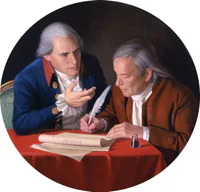
What compromises were made agreed upon in order to create our Constitution?

2
*Philadelphia – May 29th
*7 Original intent was to rewrite the Articles of Confederation
*12 out of 13 states participated (Rhode Island not there)
*Decided to make new constitution
* A new, stronger central government would be created
* George Washington was in charge of the convention

3
Multiple Choice
The main purpose of the Constitutional Convention was to write a brand new constitution.
True
False
4
Multiple Choice
Which state refused to send a delegate?
North Carolina
Rhode Island
New York
Massachusetts
5
How much power would be given to the federal government?
Structure of the government?
Slavery?
Representation in government
How should the president be chosen?
6
*Called for 3 branches of government: executive, legislative, and judicial
*Legislative branch (law makers) split into two houses (Bicameral): House of Representatives and Senate.
* Representation in both houses would be based on population.
*Who would not like this plan? ____
*Author~ James Madison

7
*Called for three branches of government: executive, legislative and judicial
*Called for a one house legislature to be called Congress ( unicameral)
*Each state would have equal votes in Congress regardless of their size.
*Who would not like this plan?____
Author-William Paterson

8

9
*aka. The Connecticut Compromise
*Called for three branches of government: executive, legislative and judicial
*A two house legislature(bicameral)
House of Representatives – representation based on population
Senate – every state has two senators
*Author~ Roger Sherman

10
Multiple Choice
Which plan wanted to have representation based on population?
Virginia Plan
New Jersey Plan
11
Multiple Choice
Coming into the Great Compromise, which state wanted one hous(unicameral) and each state would only have one vote?
New Jersey
Virginia
12
Multiple Choice
The Great Compromise called for a house of representatives and a Senate which is called
unicameral
one camel
bicamel
bicameral
13
Multiple Choice
The Connecticut Compromise wanted a bicameral system where
representative was based solely on population
each state would get 2 votes
each state would get 2 votes in the Senate and the House would be based on population
14

15
Issue: Southern states wanted slaves counted as population (large amount of slaves) The North rejected idea. If enslaved people are counted, Southern states would have more votes and power in the House of Representatives
Compromise: every 5 slaves would be counted as 3 freed men towards representation and taxes
Called: 3/5 Compromise
16
*As a result of the 3/5 Compromise, Southern states with large slave populations had disproportionate representation.
* For example, in 1793 slave states had 47 of the 105 members of the House of Representatives, but would have had only 33 had the seats been assigned based on free populations.
*The 3/5 Compromise was overturned by the 13th and 14th amendments after the CiviL War
17
Issue: The federal government wanted the power to regulate interstate and foreign trade. Southern states feared a high export tax and an end to slavery.
Compromise: Federal gov't got the power to regulate trade in exchange for no export tax and the federal government couldn't touch the slave trade for 20 years.

18
Issue: Most framers of the constitution thought the average person was not smart enough to choose a president. Only a small number of the population voted anyway. They were worried that the slow diffusion of info would lead to uneducated votes and citizens would only vote for candidates from their own state or region.
Solution: Electoral College – Representatives of each state (called electors) chose the President. All names were put on one ballot. The person with the most electoral votes was president and the person that came in second was vice president. Worked until 1804
19
20
A group named the Anti-Federalists refused to sign or ratify the Constitution unless a Bill of Rights was added. or
The North Carolina delegates were one of the groups that refused to sign the Constitution unless their rights were protected.
The Anti-Federalists believed the Constitution gave the federal government way too much power and they were fearful to be put back in the same position as they had been with Britain and its monarch.
The Federalists believed that the new federal government needed to be strong in order for the nation to be successful. It would stay in check or balancing by sharing its power with the states.
21
Multiple Choice
Which compromise included the agreement that Congress could not do anything about the importation of slaves until 1808 and agreed that Congress is given control over commerce(trade)?
3/5 compromise
electoral college
Commerce and Slave Trade
22
Multiple Choice
What was the main issue for the Great Compromise?
Do enslaved people count towards representation?
Should we stop bringing enslaved people into the colonies?
Can the government control imports and exports?
How do we determine representation for each state?
23
Multiple Choice
What was the main issue for the Three Fifths Compromise?
How do we determine representation for each state in each house?
Do enslaved people count towards population and representation?
Should we stop bringing enslaved people into the US?
Can the government place tariffs on imports and exports?
24
Multiple Choice
Which group benefited most by the 3/5 Compromise?
Eastern states
Western states
Northern states
Southern states
25
Multiple Choice
The Founding Fathers believed this compromise would protect the election process from corruption and faction influence.
3/5 Compromise
Electoral College Compromise
Connecticut Compromise
26

27

28

29

30

31

32
Multiple Choice

Which of these states would benefit most from basing state representation on total population?
Pennsylvania
Rhode Island
Delaware
Georgia
33
Multiple Choice
Which state would benefit most from having equal state representation?
Maryland
Rhode Island
North Carolina
New York
34
Multiple Choice
Which state would benefit least from counting enslaved people toward state representation?
Maryland
South Carolina
Massachusetts
Virginia
35
Multiple Choice
Which state would benefit most from counting enslaved people toward state representation?
New Hampshire
Rhode Island
Massachusetts
Virginia
36

37

38

39

40
Open Ended
What is a compromise? Choose one of the Constitutional compromises that we looked at today. Explain the issue and what compromise was made.
41

42

In 1787, 55 delegates from 12 of the 13 states (every state except Rhode Island) attended the Constitutional Convention in Philadelphia, Pennsylvania
They met to amend (make changes to) the Articles of Confederation. However, in order to amend the Articles of Confederation all 13 states would have to agree. Only 12 states showed up so this was impossible. They eventually decided to scrap the Articles of Confederation and make a new constitution

43
Multiple Choice
Which of the following was the original purpose of the Constitutional Convention?
To create a new constitution
To revise the Articles of Confederation
To form a national army
To strengthen the power of the states
44
Multiple Choice
Why did they have to change their goals to making a new constitution instead of revising the Articles of Confederation?
They didn't have enough states at the convention to get the 100% approval needed to amend the Articles of Confederation
No one at the Convention liked the Articles of Confederation
They didn't have enough time to revise the Articles of Confederation
45
The men who wrote the Constitution are referred to by several different names. These include:
Delegates - A representative sent to a conference.
Framers - A person who shapes a concept or plan.
Founding Fathers - The men who created the U.S. government

46
Multiple Choice
Which of the following is NOT a name that describes the men who attended the Constitutional Convention?
Delegates
Framers of the Constitution
Founding Fathers
Parliament
47
48
Multiple Choice
Which of the following best describes the Constitutional Convention?
A secretive meeting that created a new government for the United States
A public meeting that all U.S. citizens were invited to attend to create a new government
A meeting between Great Britain and the U.S. to discuss the terms of the end of the Revolution
49
All delegates at the Constitutional Convention were white men, most were very wealthy and well-educated and more than half were lawyers and had previous government experience.
More than half of the delegates were slave owners.

50
Multiple Choice
Which of the following best describes the framers of the Constitution?
Average Americans
Wealthy, well educated and powerful
Loyalists
Poor and uneducated
51
The delegates included some well-known patriots such as George Washington, Benjamin Franklin, and Alexander Hamilton. Thomas Jefferson and John Adams did not attend because they were in other countries handling important business for the U.S.
However, some famous patriots intentionally did not come such as Patrick Henry. There were many Americans who did not want the Articles of Confederation to be changed.

52
Multiple Choice
All Americans supported the idea of replacing the Articles of Confederation with a new form of government
True
False
53
George Washington was chosen to be the president of the convention because he was respected by many and viewed as a unifying person.

54
James Madison took many notes at the convention, and would eventually go on to write most of the Constitution. This is why he is called “The Father of the Constitution” today.

55
Multiple Choice
George Washington was the president of the Constitutional Convention
True
False
56
Multiple Choice

John Adams was known as the "Father of the Constitution" because of the large role he played in writing the Constitution
True
False
57
The delegates at the Constitutional Convention had many different ideas on how the new government should be set up. The debates lasted for 3 months!
The only way for them to be able to create a Constitution that could be passed by a majority of states was to work together and make compromises

58


59
What is an example of a compromise that you have made with someone or that you have seen happen?
Remember in order for it to be a true compromise, both sides must get some of what they want (both sides meet in the middle)
60
Open Ended
What compromises have already been made by the delegates writing the Constitution?
61

62
"While there remained one acre of swamp-land uncleared of South Carolina, I would raise my voice against restricting the importation of [slaves.] … without them South Carolina would soon be a desert waste." Charles Cotesworth Pinckney, South Carolina Ratifying Convention
63
Multiple Choice
What is Pinckney's argument in favor of slavery?
Southerners need people to do their work.
It's important to bring religion to African people.
People in slavery don't mind doing work for free.
64
“[if we allow the Southern plan for Congress] …the inhabitant of a state who goes to the coast of Africa and …tears away his fellow creatures from their dearest connections and [curses] them to the most cruel slavery shall have more votes in a Government for protection of the rights of mankind.” Gouverneur Morris, New York
65
Multiple Choice
What does Morris say is wrong about the southern plan for representation?
It's unfair to kidnap people to boost your population and representation in a "democratic" government.
It's unfair to count everyone in the population.
Everyone should get to vote.
66
South wanted to count the entire population (more people = more representatives in Congress)
North wanted to count the free population (if some people aren't allowed to be citizens, they shouldn't be counted to give the South more power)
67
https://www.khanacademy.org/humanities/ap-us-history/period-3/apush-the-constitutional-convention-and-debates-over-ratification/v/constitutional-compromises-the-three-fifths-compromise

68
Multiple Choice
How many enslaved people "equaled" 3 free people in the population under the 3/5ths Compromise?
5
3
1
69
In 1790, each state got ONE representative for every 30,000 people
3/5th of the enslaved population was included in this count
70
Pennsylvania - population 433,661 (3,707 enslaved people)
Under the Northern Plan 429,954 (free) / 30,000 = 14.33 representatives
Under Southern Plan 433,661 / 30,000 = 14.45 representatives
Under the Compromise 429,954 (free) + 2,224 (fraction of enslaved population) / 30,000 = 14.4 representatives
Little change in numbers of representatives for northern states
71
South Carolina- population 247,073 (104,094 enslaved people)
Under the Northern Plan - 142,979 (free) / 30,000 = 4.77 representatives.
Under Southern Plan - 247,073 / 30,000 = 8.24 representatives
Under the Compromise 142,979 (free) + 62,456 (fraction of slave) / 30,000 = 6.84 representatives
Changes in number of representatives for the southern states.
72
Poll
Do you think the 3/5th Compromise was fair?
No, because it still gave the South more power than the North
No, because it is still counting people were weren't treated like citizens
Yes, because it was a little of what both sides wanted
Yes, because it was the only way to get the Constitution approved
What compromises were made agreed upon in order to create our Constitution?
Show answer
Auto Play
Slide 1 / 72
SLIDE
Similar Resources on Wayground

66 questions
Using the subjunctive in context
Presentation
•
9th Grade - University
67 questions
Kingdom of Mali
Presentation
•
5th - 8th Grade
67 questions
The 1960s (Final Study Guide)
Presentation
•
9th Grade
67 questions
GSSP 330 Lesson 2.2 (Chapter 2)
Presentation
•
University
66 questions
Lesson #1- Causes of the Great Depression
Presentation
•
9th - 12th Grade
70 questions
SSUSH8: Sectionalism & Westward Expansion
Presentation
•
11th Grade
62 questions
French Revolution and Napoleon
Presentation
•
10th Grade
62 questions
World Religions
Presentation
•
10th Grade
Popular Resources on Wayground
10 questions
Safety Day 2026 – Student Review

Quiz
•
9th Grade
21 questions
Continents and Oceans
Quiz
•
6th Grade
20 questions
Parts of Speech
Quiz
•
5th Grade
16 questions
Subject & Predicate
Quiz
•
5th Grade
25 questions
Multiplication Facts
Quiz
•
5th Grade
12 questions
Map Skills
Quiz
•
3rd Grade
22 questions
Continents and Oceans
Quiz
•
5th Grade
15 questions
Rounding Decimals
Quiz
•
5th Grade
Discover more resources for Social Studies
10 questions
Exploring the Age of Exploration: Key Events and Figures

Interactive video
•
6th - 10th Grade
9 questions
Exploring Ancient Mesopotamia and Its Civilizations
Interactive video
•
10th Grade
39 questions
Unit 7 Key Terms
Quiz
•
11th Grade - University
10 questions
Debating the Legacy of Christopher Columbus
Interactive video
•
6th - 10th Grade
38 questions
Unit 6 Key Terms
Quiz
•
11th Grade - University
22 questions
U3T2 Vocab FAC: Domestic Policy
Quiz
•
10th Grade
38 questions
The Progressive Era
Quiz
•
11th Grade
25 questions
Progressive Era
Quiz
•
11th Grade