

Layers of the Sun- Lesson 3

Presentation
•
Science
•
8th Grade
•
Practice Problem
•
Medium
+11
Standards-aligned

Danielle Battisti
Used 6+ times
FREE Resource
8 Slides • 13 Questions
1
2
The Sun is the only star in our solar system. Astronomers have been
able to study the Sun in more detail than other stars because it is much closer to Earth. As a result, they have learned a great deal about its size and composition and the way it produces energy.
The Sun produces energy from hydrogen.

3
Multiple Choice
The sun is a ____, while Earth is a ______.
star; planet
star; star
planet; star
planet; planet
4

The Sun is far larger than any of the planets. It contains 99.9 percent
of the mass of the entire solar system. For comparison, imagine that Earth had the mass of a sparrow; then the Sun would have the mass of an elephant.
The Sun produces energy from hydrogen.
5
Multiple Choice
The Sun is far smaller than any of the planets in thr Solar System
True
False
6
The Sun consists mostly of hydrogen gas. Energy is produced when hydrogen in the Sun’s interior turns into helium. This energy is the
source of light and warmth that make life possible on Earth.
The Sun produces energy from hydrogen.

7
Multiple Choice
The Sun is made up of what 2 elements?
Helium and Boron
Hydrogen and Oxygen
Hydrogen and Helium
Hydrogen and Argon
8

Although the Sun is made entirely of gas, it does have a structure.
Energy produced in the center of the Sun flows out through the Sun’s
layers in different forms, including visible light.
Energy flows through the Sun’s layers.
9


The center of the Sun, called the core, is made of very dense gas. Temperatures reach about 15 million degrees Celsius. Under these extreme conditions, some hydrogen particles collide and combine to form helium in a process called FUSION. The process releases energy that travels through the core by radiation.
Core
Energy from the core moves by radiation through a thick layer called the radiative zone. Although this layer is very hot and dense, conditions in the radiative zone are not extreme
enough for fusion to occur.
Radiative Zone
In the convection zone, energy moves mainly by convection. is the transfer of energy from place to place by the motion of heated gas or liquid. Rising currents of hot gas in the convection zone carry energy toward the Sun’s surface.
Convection Zone
10
Multiple Choice
Rising currents of hot gas in the convection zone carry energy _______ the Sun’s surface.
toward
away from
11
Fill in the Blanks
The Sun’s interior generally becomes
12
Multiple Choice
The is hottest in the convective zone.
True
False
13
Multiple Choice
The core of the Sun reaches temperatures up to...
5 million degrees celcius
10 million degrees celcius
10 billion degrees celcius
15 million degrees celcius
14
Fill in the Blanks
15
Multiple Choice
The radiative zone is ______ the core.
the same temperature as
hotter than
cooler then
16
The Sun’s outer layers are called its atmosphere. These layers are much less dense than the interior. The atmosphere generally becomes hotter and less dense as you move outward.
The Sun's Atmosphere
17
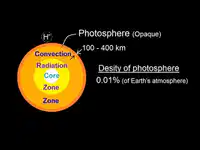


Visible light moves by radiation out into space from the photosphere. It takes about eight minutes for the light to reach Earth. Since the photosphere is the layer you see in photographs of the Sun, it is often called the Sun’s surface. Convection currents beneath the photosphere cause it to have a bumpy texture.
Photosphere
The chromosphere is the thin middle layer of the Sun’s atmosphere. It gives off a pinkish light.
Chromosphere
The Sun’s outermost layer is called the the corona, which varies in shape, extends outward several million kilometers. Both the chromosphere and the corona are much hotter than the photosphere. However, they have such low densities that you can see their light only during a total eclipse of the Sun, when the Moon blocks the much brighter light from the photosphere.
Corona
18
Multiple Choice
Which layer gives off a pinkish light?
Photosphere
Chromosphere
Corona
19
Fill in the Blanks
It taks
20
Multiple Choice
What leads to the bumpy surface of the photosphere?
Uneven rock layers
Convection currents underneath the photosphere
Tetonic plate movement
Convection currents in the core
21
Labeling
Label the 6 layers of the sun.
Radiative Zone
Convection Zone
Corona
Chromosphere
Core
Photosphere
Show answer
Auto Play
Slide 1 / 21
SLIDE
Similar Resources on Wayground

18 questions
Scientific Method Notes
Presentation
•
8th Grade
16 questions
The Scientific Method
Presentation
•
8th Grade
17 questions
Formulas and Reactions
Presentation
•
8th Grade
16 questions
Intro to the Solar System
Presentation
•
8th Grade
17 questions
calc speed/motion graphs
Presentation
•
8th Grade
15 questions
Weather Fronts
Presentation
•
8th Grade
17 questions
Acceleration
Presentation
•
8th Grade
18 questions
Lunar Cycle
Presentation
•
8th Grade
Popular Resources on Wayground
10 questions
How much do you know about our Portrait of an Eagle?

Quiz
•
10th Grade
10 questions
Fast Food Slogans
Quiz
•
6th - 8th Grade
21 questions
Continents and Oceans
Quiz
•
6th Grade
20 questions
Parts of Speech
Quiz
•
5th Grade
16 questions
Subject & Predicate
Quiz
•
5th Grade
25 questions
Multiplication Facts
Quiz
•
5th Grade
12 questions
Map Skills
Quiz
•
3rd Grade
22 questions
Continents and Oceans
Quiz
•
5th Grade
Discover more resources for Science
20 questions
Scientific Method and Variables
Quiz
•
8th Grade
20 questions
Scientific method and variables
Quiz
•
8th Grade
27 questions
Counting Atoms - Subscripts
Quiz
•
8th Grade
20 questions
Claim, Evidence and Reasoning (CER)
Quiz
•
6th - 8th Grade
18 questions
Counting Atoms
Quiz
•
7th - 8th Grade
20 questions
Elements, Compounds and Mixtures
Quiz
•
8th Grade
10 questions
Exploring Chemical and Physical Changes

Interactive video
•
6th - 10th Grade
10 questions
Decoding the Periodic Table of Elements
Interactive video
•
6th - 10th Grade