untitled
Presentation
•
Science, English
•
9th - 12th Grade
•
Easy
Standards-aligned
Linda Kim
Used 1+ times
FREE Resource
3 Slides • 62 Questions
1
Multiple Choice
Which type of population dispersion is characterized by resources being spread unevenly, so individuals group wherever the resources are located?
Clumped
Uniform
Random
Environmental
2
Multiple Select
Click density dependent factor(s).
competition for resources
predator-prey relationships
parasitism and disease
weather
3
Multiple Choice
A graph that shows the number or proportion of individuals surviving to each age for a given species or group.
survivorship curve
exponential
linear
logistic
4
Multiple Choice
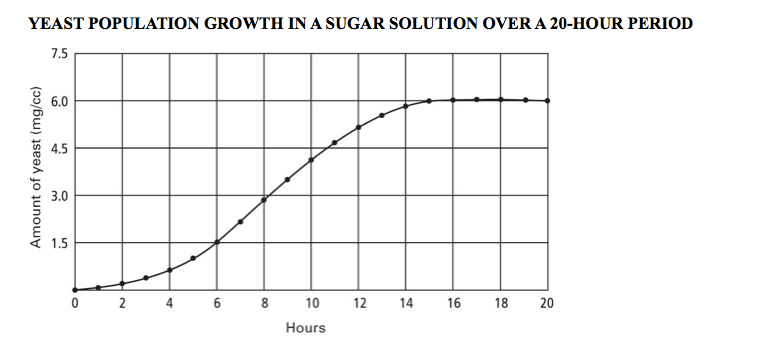
At what hour did the bacterial population carrying capacity?
1-7 hours
8-14 hours
14-17 hours
18 hours - 24 hours
5
Multiple Choice
6
Multiple Choice
The wolf goes extinct, and the deer population has no predator to worry about. They graze the land. Because there is no more food. Some of the deer begin to bite at each other, while others die of starvation. What is the limiting factor to the deep population?
Competition
Overcrowding
Predator-Prey Relationships
Herbivory Effect
7
Multiple Choice
What is an example of a density-independent (Abiotic) limiting factor?
food
parasites
disease
pollution
8
Multiple Choice
9
Multiple Choice
Which of the following is an example of mutualism in ecological interactions?
A lion hunting a zebra
Bees pollinating flowers
A bird eating a worm
A parasite living on a host
10
Multiple Choice
Identify the primary producers in a typical food chain.
Herbivores
Carnivores
Plants
Decomposers
11
Multiple Choice
How do disturbances such as fires impact ecological succession?
They prevent any form of succession from occurring.
They reset succession to an earlier stage, allowing new growth.
They accelerate the process of reaching a climax community.
They have no impact on ecological succession.
12
Multiple Choice
Analyze the impact of removing a top predator from a food web.
It will have no effect on the ecosystem.
It will increase the population of primary producers.
It will cause an increase in herbivore populations, potentially leading to overgrazing.
It will lead to the extinction of all species in the food web.
13
Multiple Choice
Which of the following is a key component of the carbon cycle?
Photosynthesis
Nitrogen fixation
Evaporation
Erosion
14
Multiple Choice
Predict the consequences of nutrient depletion in an ecosystem.
Increased biodiversity
Enhanced growth of primary producers
Decline in plant growth and reduced energy flow through the food web
No impact on the ecosystem
15
Multiple Choice
What is the role of apex predators in an ecosystem?
They are primary producers.
They help control the population of herbivores and maintain balance.
They decompose organic matter.
They compete with decomposers for nutrients.
16
Multiple Choice
Which interaction type is it when different male lions strive to find territories?
Intraspecific Competition
Interspecific Competition
Commensalism
Mutualism
17
Multiple Choice
A crab is protected from fish when an anemone rides on its shell. The anemone gets more food.
Commensalism
Competition
Predation
Mutualism
18
Multiple Choice
This interaction occurs when lions, cheetahs, and leopards all need the same food source.
Intraspecific Competition
Interspecific Competition
Predation
Mutualism
19
Multiple Choice
Orchid vines are skinny and grow on the trunk of trees to get more light and space with no negative effect.
Mutualism
Commensalism
Parasitism
Competition
20
Multiple Choice
When the population of predators gets too high...
Prey pop. will increase--> predator pop. will increase
Prey pop. will decrease--> predator pop. will increase
Prey pop. will decrease--> predator pop. will decrease
It depends on the biome
21
Multiple Choice
Parasites and predators help maintain ecosystem stability because...
They increase the population of all organisms so ecosystems become diverse
They decrease the population of certain organisms to ensure no species overpopulates
They increase the survival of all species
Any of the above are possible
22
Multiple Select
What are some reasons ecosystems are being destroyed?
Select all that apply.
Humans need land for food
There is a growing number of animals being born
There aren't enough animals dying
The human population in increasing
23
Multiple Choice
24
Multiple Choice
25
Multiple Choice
What is true about ecosystems with very high biodiversity?
They are unstable and threatened by environmental changes
They more stable and are more likely to recover from environmental changes.
They have so much competition that it harms most organisms
The environmental conditions tend to be very harsh in these ecosystems
26
Multiple Choice
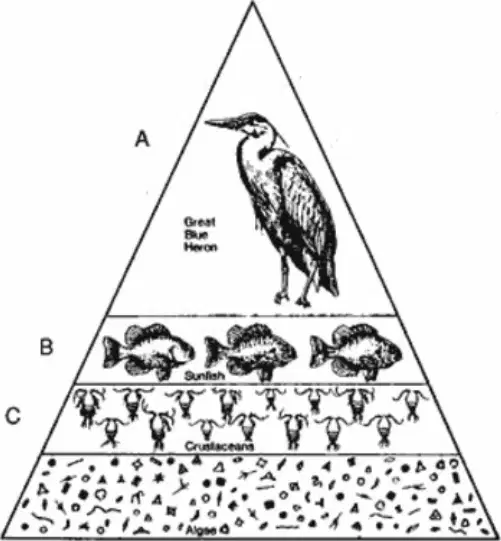
Which statement best describes one of the levels of this pyramid?
Level A contains the largest producers in the pyramid.
The organisms in level B obtain food directly from level A.
Level C contains the largest group of consumers in the pyramid.
Level D contains the greatest number of heterotrophs in the pyramid.
27
Multiple Choice
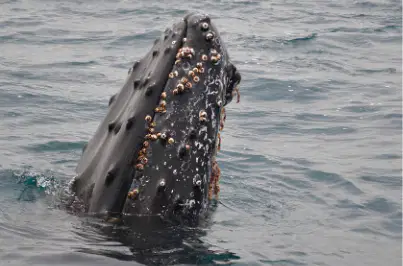
To the right you will see an image of barnacles attached to a whale. The whale neither benefits nor is harmed by the barnacles. The barnacles benefit from being attached to the whale. What type of symbiotic relationship is being exemplified?
Commensalism
Parasitism
Mutualism
Predation
28
Multiple Choice
A climax community is generally established most directly as a result of a
Catastrophic climate change
Series of successive ecological stages
Long period of evolutionary change
Change in the dominant animals
29
Multiple Choice
A heterotroph that benefits at the expense of its living host is known as a
Parasite
Decomposer
Scavenger
Producer
30
Multiple Choice
Which level of the pyramid contains autotrophic organisms?
A
B
C
D
31
Multiple Choice
Which is a possible food chain derived from this energy pyramid?
Sunfish → algae → great blue heron → crustaceans
Great blue heron → sunfish → crustaceans → algae
Great blue heron → crustaceans → sunfish → algae
Algae → crustaceans → sunfish → great blue heron
32
Multiple Choice
Which of the following best describes a keystone species?
A species that is the most abundant in an ecosystem
A species that has a disproportionately large impact on its ecosystem
A species that is at the top of the food chain
A species that is the primary producer in an ecosystem
33
Multiple Choice
Which of the following is an example of mutualism?
A lion hunting a zebra
A bee pollinating a flower
A tick feeding on a dog
A bird eating insects off a buffalo
34
Multiple Choice
Which process converts atmospheric nitrogen into a form usable by plants?
Photosynthesis
Respiration
Nitrogen fixation
Decomposition
35
Multiple Choice
Which type of population dispersion is characterized by resources being evenly distributed in an ecosystem?
Clumped
Uniform
Random
Environmental
36
Multiple Choice
Which survivorship curve is characterized by fewer offspring being born, but most live longer?
Type I
Type II
Type III
Type IV
37
Multiple Choice
Which survivorship curve is characterized by survivorship being roughly equal at all life stages?
Type I
Type II
Type III
Type IV
38
Multiple Choice
Which survivorship curve is characterized by many offspring being born, but fewer of them survive?
Type I
Type II
Type III
Type IV
39
Multiple Choice
Which type of population growth is characterized by individuals reproducing at a constant rate and resources appear unlimited?
Exponential
Logistic
Both Exponential and Logistic
Neither Exponential nor Logistic
40
Multiple Choice
Which type of population growth shows growth rate slowing or stopping due to resources becoming less available, resulting in a stabilized growth at the carrying-capacity?
Exponential
Logistic
Both Exponential and Logistic
Neither Exponential nor Logistic
41
Multiple Choice
_________ is the largest number or individuals that a given environment can support
Population Capacity
Population Growth
Maximum Capacity
Carrying Capacity
42
Multiple Choice
Which type of population dispersion is shown in this picture?
Clumped
Random
Uniform
None of the Above
43
Multiple Choice
Which type of population dispersion is shown in this picture?
Clumped
Random
Uniform
None of the Above
44
Multiple Choice
Which type of population dispersion is shown in this picture?
Clumped
Random
Uniform
None of the Above
45
Multiple Choice
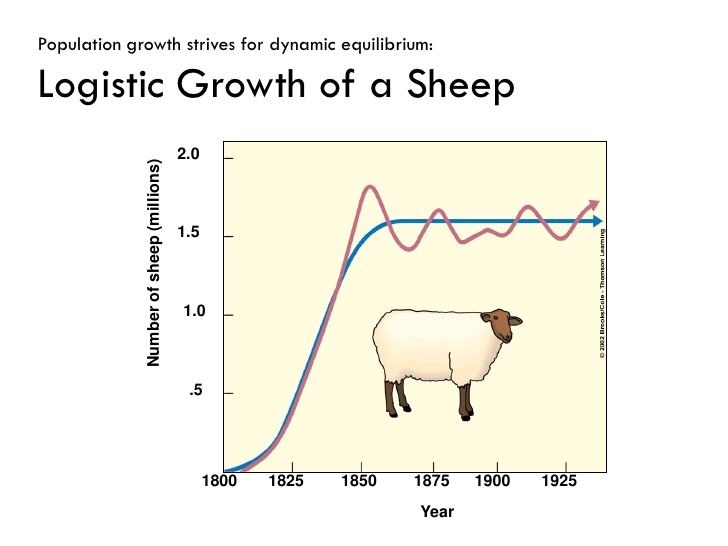
Which description best fits Line A?
It shows logistic growth.
It shows exponential growth.
It shows the carrying capacity.
It shows linear growth of a population.
46
Multiple Choice
Which description best fits Line B?
It shows logistic growth.
It shows exponential growth.
It shows the carrying capacity.
It shows linear growth of a population.
47
Multiple Choice
48
Multiple Choice
49
Multiple Choice
50
Multiple Choice
51
Multiple Choice
The graph below represents the growth of a population of flies in a car? Which of the following statements best describes the graph?
The fly population did not change.
The fly population decreased, then increased.
The fly population grew following the logistic growth model.
The fly population grew following the exponential growth model.
52
Multiple Choice
Which point on the graph best represents the carrying capacity?
Letter A
Letter C
Letter E
Letter D
53
Multiple Choice
In which month(s) did the Cottontail Rabbits reach their carrying capacity?
January and February
March and May
April and January
April and May
54
Multiple Choice
A convergent boundary is formed when
plates move apart
plates push together
plates slip past each other
55
56
Multiple Choice
Many woodpeckers eating at a bird feeder is an example of -
predation
mutualism
competition
commensalism
parasitism
57
Multiple Choice
An owl snatching a mouse from a field to eat is an example of -
predation
mutualism
competition
commensalism
parasitism
58
Multiple Choice
An orchid using a high tree branch as a place of attachment to receive more sunlight but not affecting the tree is an example of -
predation
mutualism
competition
commensalism
parasitism
59
60
Multiple Choice
What happens to the population of a species after it reaches its carrying capacity?
Increases linearly (in a straight line) over time.
Increases exponentially (line is curved) over time.
Decreases to zero in a very short amount of time.
Remains relatively the same.
61
Multiple Choice
A large population of geese gathered together in a marsh is which type of dispersion?
Clumped dispersion
Uniform dispersion
Random dispersion
62
63
Multiple Select
Why has the world population dramatically increased?
[select ALL that apply]
Medicine
Sanitation
Technology
Disease
64
Multiple Choice
What growth rate does this population pyramid represent?
RAPID GROWTH
SLOW GROWTH
STABLE
DECLINING
65
Multiple Choice
Which country is the less developed of the two?
Kenya
Japan
Both are of equal development
None of the above
Which type of population dispersion is characterized by resources being spread unevenly, so individuals group wherever the resources are located?
Clumped
Uniform
Random
Environmental
Show answer
Auto Play
Slide 1 / 65
MULTIPLE CHOICE

Similar Resources on Wayground
56 questions
GRAMMAR FOR RECEPTION
Presentation
•
KG
60 questions
Protein Synthesis
Presentation
•
9th - 12th Grade
58 questions
Adaptations and Evolutions
Presentation
•
9th - 12th Grade
60 questions
Properties of Sound Waves
Presentation
•
9th - 12th Grade
58 questions
argument and logical fallacies
Presentation
•
9th - 12th Grade
60 questions
Ions & LDD Notes
Presentation
•
9th Grade - University
64 questions
Proportional Parts in Triangles
Presentation
•
9th - 12th Grade
63 questions
Wednesday, June 11th
Presentation
•
KG
Popular Resources on Wayground
15 questions
Grade 3 Simulation Assessment 1
Quiz
•
3rd Grade
22 questions
HCS Grade 4 Simulation Assessment_1 2526sy
Quiz
•
4th Grade
16 questions
Grade 3 Simulation Assessment 2
Quiz
•
3rd Grade
19 questions
HCS Grade 5 Simulation Assessment_1 2526sy
Quiz
•
5th Grade
17 questions
HCS Grade 4 Simulation Assessment_2 2526sy
Quiz
•
4th Grade
20 questions
Equivalent Fractions
Quiz
•
3rd Grade
24 questions
HCS Grade 5 Simulation Assessment_2 2526sy
Quiz
•
5th Grade
20 questions
Math Review
Quiz
•
3rd Grade
Discover more resources for Science
20 questions
Earth Day Trivia
Quiz
•
9th - 12th Grade
100 questions
Biology EOC Review
Quiz
•
9th - 12th Grade
20 questions
Earth Day
Quiz
•
3rd - 12th Grade
38 questions
Biology EOC Review Game
Quiz
•
10th Grade
20 questions
Human Impact on the Environment Review #2
Quiz
•
9th Grade
10 questions
Exploring Natural Selection Concepts
Interactive video
•
6th - 10th Grade
20 questions
Balancing Chemical Equations
Quiz
•
9th Grade
10 questions
Exploring Air Masses and Weather Fronts
Interactive video
•
6th - 10th Grade