

Health Optimizing Physical Education

Presentation
•
Other
•
11th Grade
•
Practice Problem
•
Hard

Edgar Monte
Used 3+ times
FREE Resource
58 Slides • 27 Questions
1
Replace this with a sub-header that can be in multiple lines.
Duplicate this text as many times as you would like.Quarters 1 and 2 – Module 2:
Set Fitness Goal
2
What I Need to Know
After browsing this module, you're expected to: 1. Discuss the FITT principles and principle of physical activity in helping to develop a private exercise preparation;
2. Create the fitness plan based on the FITT principle and principle of physical activity to reach a fitness goal;
3. Evaluate the potential benefits of FITT principles;
4. Perform moderate to vigorous physical activities based on the programmed fitness plan.
3
What I Know
Choose the letter of the best answer. Write the chosen letter on a separate sheet of paper.
4
Multiple Choice
What is the first element you should set up when planning a workout plan? It refers to how often you exercise.
Frequency
Intensity
Time
Type
5
Multiple Choice
What is the most basic principle in physical activity that indicates doing more than normal for improvement to happen?
Overload Principle
Progression Principle
Reversibility Principle
Specificity Principle
6
Multiple Choice
What principle in physical activity is defined as a gradual increase in exerting effort or load that is done not too slowly, nor too rapidly?
Overload Principle
Progression Principle
Reversibility Principle
Specificity Principle
7
Multiple Choice
Jogging, dancing, lunges, brisk walking, squats, and planking are examples of what FITT principle?
Frequency
Intensity
Time
Type
8
Multiple Choice
The effect of training will be lost if the training is discontinued. Which principle of physical activity does it refer to?
Overload Principle
Progression Principle
Reversibility Principle
Specificity Principle
9
Multiple Choice
Cardo does jogging, running, and dancing to improve his cardiovascular endurance. What principle of physical fitness does it manifest?
Overload Principle
Progression Principle
Reversibility Principle
Specificity Principle
10
Multiple Choice
Which of the FITT principles discuss the effort level of the exercise?
Frequency
Intensity
Time
Type
11
Multiple Choice
Juan is 32 years old. What is his maximum target heart rate?
186
187
188
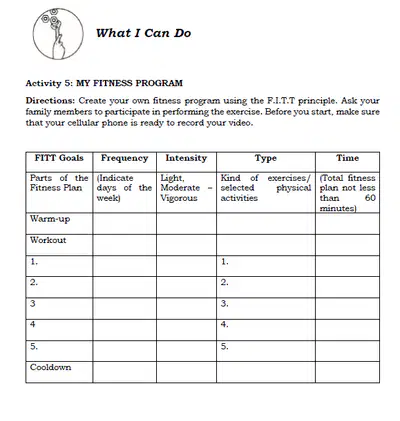
189
12
Multiple Choice
Jannah is 17 years old. She has a resting heart rate of 41, what is Jannah’s heart rate reserve?
162
164
166
167
13
Multiple Choice
Which part of the exercise program stimulates beneficial adaptation when performed regularly?
Cool-down
Exercise load
Stretching
Warm-up
14
Multiple Choice
Which is essential before the actual workload so that the body can prepare for more strenuous activity?
Cool-down
Exercise load
Stretching
Warm-up
15
Multiple Choice
Which part of the exercise program is essential after a workout as it permits the pre-exercise heart rate and blood pressure for a gradual recovery?
Cool-down
Exercise load
Stretching
Warm-up
16
Multiple Choice
How much MET will you spend while sitting at rest?
1 MET
2 METs
3 METs
4 METs
17
Multiple Choice
Which of the following is considered vigorous exercise?
Basketball game
Sweeping floors
Tennis doubles
Walking -5 km/h
18
What’s In
Activity 1. FITNESS QUEST
Direction: Identify if the following activities listed in column A are for Cardiovascular Activity, Flexibility, Muscular Strength Activity, and Endurance Activity. Write your answer on a separate sheet of paper.
Example: Weightlifting - Muscular Strength Activity
19
Match
Direction: Match if the following activities listed in column A are for Cardiovascular Activity, Flexibility, Muscular Strength Activity, and Endurance Activity. Write your answer on a separate sheet of paper.
Jogging
Walking
Yoga
Weight Lifting
Cycling
Cardiovascular/Endurance Activity
Cardiovascular/Endurance Activity
Flexibility Activity
Muscular Strength Activity
Cardiovascular Activity
Cardiovascular/Endurance Activity
Cardiovascular/Endurance Activity
Flexibility Activity
Muscular Strength Activity
Cardiovascular Activity
20
Match
Direction: Match if the following activities listed in column A are for Cardiovascular Activity, Flexibility, Muscular Strength Activity, and Endurance Activity. Write your answer on a separate sheet of paper.
Dynamic Stretching
Brisk Walking
Stretching
Squats
Planks
Flexibility
Cardiovascular/Endurance Activity
Flexibility
Muscular Strength Activity
Muscular Strength Activity
Flexibility
Cardiovascular/Endurance Activity
Flexibility
Muscular Strength Activity
Muscular Strength Activity
21
Open Ended

Activity 2: WORD HUNT Directions: Find ten (10) words related to health on the grid. Words appear straight across, up and down, down and up, and diagonally. Write your answer on a separate sheet.
22
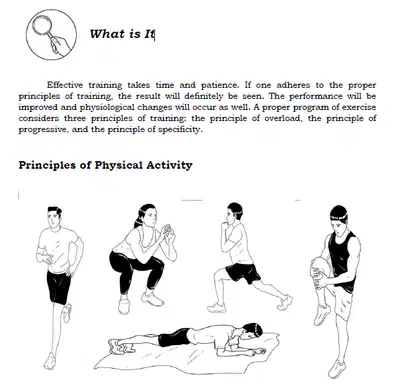
23
Overload Principle
This principle pertains to doing “more than normal” for improvement to happen. It means to boost our fitness, strength, or endurance. The workload is extended accordingly. Applying these training principles will cause long-term adaptations, enabling the body to figure more efficiently to deal with higher levels of performance.
24
Overloading will be achieved by following the acronym FITT:
Frequency: Increasing the number of times you train per week Intensity: Increasing the problem of the exercise, for instance, running at 12 km/h rather than 10 or increasing the load you're squatting with. Time: Increasing the length of your training time for every session, for instance, cycling for 45 minutes rather than 30.
Type: Increase the intensity of the training. For instance, progress from walking to running
25
Principle of Progression
To ensure that the results will still improve over time, the adapted workload should be continually increased. A gradual and systematic increase within the workload over a period of time will lead to improvement in fitness without risk of injury. If overload occurs and increases rapidly, it may lead to injury or muscle damage. If it increases slowly, improvement is unlikely. For instance, the athlete who exercises vigorously only on weekends violates the principle of progression and may not see obvious fitness gains.
26
Principle of Progression
The Principle of Progression also stresses the requirement for correct rest and recovery. Continual stress on the body and constant overload will lead to exhaustion and injury. You ought not to train hard all the time, as you'll risk overtraining and a decrease in fitness.
27
Principle of Specificity
We have all heard the phrase, "Practice makes perfect." Well, this is often the principle of specificity in action. This principle simply states that exercising a specific piece or component of the body primarily develops that part. The principle of specificity implies that to become better at a selected exercise or skill, you need to perform that exercise or skill. For example, a cyclist should be trained in cycling and a runner should be trained in running. Use the acceptable sort of exercise that directly improves your target muscles.
28
Principle of Reversibility
Development of muscles will happen if regular movement and execution are completed. If activity ceases, it will be reversed. This shows that benefits and changes achieved from overload will last as long as training is continuous. On the flip side, this also implies that the detraining effect will be reversed once training is resumed. Extended rest periods reduce fitness and therefore the physiological effects diminish over time which throws the body back to its pre-training condition.
29
30

31
Frequency
The first thing to identify in the workout plan is frequency—how often you exercise. Your frequency often depends on a spread of things including the sort of workout you're doing, how hard you're working, your fitness level, and your exercise goals. Three to five times a week is a safe frequency for each component of health-related physical fitness.
32
Frequency
American College of Sports Medicine sets exercise guidelines to provide a place to start figuring out how often to work out:
33
Frequency
For cardio: Include your goal, guidelines recommend moderate exercise five or more days every week or intense cardio three days every week to improve your health. If your goal is to lose weight, you'll need to work often up to six or more days a week.
34
Frequency
For strength training: The suggested frequency is two to three non-consecutive days a week, it should be one to two days between sessions. If you are doing a split routine, like the upper body at some point and lower body subsequent, your workouts are going to be more frequent than total body workouts.
35
Intensity
Intensity refers to how hard you work during the physical activity period. Intensity is often measured in several ways, counting on the health-related component. For instance, monitoring pulse rate is a technique to measure intensity during aerobic endurance activities but gives no indication of intensity during flexibility activities.
36
Intensity
For cardio: For cardio, you will usually monitor intensity by heart rate or pulse rate. The recommendation for steady-state workouts is at a moderate intensity and for interval training, it should be done at a high intensity for a shorter period of time.
37
Intensity
For strength training: Monitoring the intensity of strength training involves a special set of parameters. The intensity depends on the workload you are doing, the amount of weight you lift, and the number of repetitions and sets. You can change the intensity based on your goals. For a beginner use a lighter weight and do fewer sets with high repetitions (two or three sets of 12 to 20 repetitions). If your goal is to develop muscle, do a higher number of sets with a moderate amount of repetitions (four sets of 10 to 12 reps each). If you want to create strength, use heavyweights to try to do more sets with fewer repetitions, for example, five sets of three repetitions each.
38

39

40
Time
Time is the length of the physical activity. Considering the other aspects of the F.I.T.T principle, the time differs depending on the health-related fitness component targeted.
41
Time
For cardio: The suggested cardio exercise is 30 to 60 minutes but the duration of your workout depends on the type of exercise. For a beginner, you might start with a workout of 15 to 20 minutes. If you're doing steady-state cardio, like going for a run, you may exercise for 30 minutes to an hour. If you're doing interval training and working at a high intensity, your workout should be shorter, around 20 minutes to a half-hour.
42
Time
For strength training: How long you lift weights depends on the type of workout you're doing and on your schedule. For a total body workout, you may take up to an hour, but a split routine may take less time because you're working for fewer muscle groups.
43
Type
Type refers to the definite physical activity selected to improve a component of health-related fitness. For example, a person who wants to improve the arm strength should exercise the triceps and biceps, while an individual who wants to improve aerobic endurance needs to execute some other aerobically challenging activities such as jogging, running, swimming.
44
Type
For Cardio: Cardio is changeable since any activity that makes your heart rate up counts. Dancing, running, walking, jogging, and cycling are some of the wide variety of activities you may choose. Having more than one cardio activity helps reduce boredom.
45
Type
For strength training: Strength training workouts can also offer a variety of exercises. It includes any exercise using resistance like dumbbells, barbells, machines, and many others to work your muscles. You may also use your body as a resistance tool. You may change the type of your strength workout depending on your goal.
46
How to Use the F.I.T.T Principle in Yourn Workout
The F.I.T.T. principle provides guides on how to control your program and get favorable results. To avoid boredom, injuries, and weight loss plateaus, this principle will help you figure out how to alter workout types, time, intensity, and activities.
47
How to Use the F.I.T.T Principle in Yourn Workout
For example, walking three times a week for 30 minutes at a moderate pace might be a great help for a beginner. Your body adjusts to these workouts and several things may happen after a few weeks such as:
● Burn fewer calories
● Weight loss
● Boredom sets in
48
You may also utilize one or more of the F.I.T.T. principles, such as:
● Changing the frequency by adding a day of jogging or walking
● Changing the intensity by adding some running intervals or walking faster
● Changing the time spent jogging each workout day
● Changing the type of workout by dancing, cycling, or running.
49
Changing one of the elements will create a big difference in the workout plan and in how your body reacts to exercise. It's significant to alter things up on a regular basis to keep your body and mind healthy.
50
Muscle develops once the body is trained to do more than what it used to. The Principles of Training implies that overloading helps develop targeted muscle areas. Benefits of this can be achieved through continuous overloading, or else, if stopped, it will go back to its original form.
51
FITT principle acknowledges the importance of optimum fitness development. It stands for Frequency, Intensity, Time, and Type. The physical activity program is used as a guideline for a fitness routine to achieve results. Execution of exercise is also related to its intensity. The more the activity is repeated, the more chances of developing fitness.
52
Intensity is defined as how easy or hard the designed task is accomplished or the magnitude of work done. The body’s response by the number of times the heart pumps measured in beats per minute determines the intensity. Workable heart rate capacity will help in getting the ideal Target Heart Rate (THR) range.
53
Proper choosing of activities helps to achieve goals set by specifying the target muscles to develop. To keep activities exciting and interesting, setting up variations in exercises or routines may help.
54
Part of an Exercise Program
An exercise workout has three components: warm-up, exercise load, and cool-down. The exercise load or workout load is the program activity that would stimulate beneficial adaptation when performed regularly. A warm-up is essential prior to the actual workload as it prepares the body for more strenuous activity. It increases the blood flow to the working muscles without an abrupt increase in lactic acid accumulation. According to research, the warmer the body and muscle, the higher the muscular output. A good warm-up also prepares the heart, muscles, and joints for the next activity by decreasing joint stiffness and increasing nerve impulses. Cool-down is essential after a workout as it permits the pre-exercise heart rate and blood pressure for a gradual recovery. Cooling down may be most vital for competitive endurance athletes, like marathoners, because it helps regulate blood flow.
55
Part of an Exercise Program
Warm-up - At least 5 to 10 minutes of low to moderate intensity aerobic exercise or resistance exercise with lighter weights.
Conditioning -15 to 60 minutes of aerobic, resistance, neuromuscular, and/or sport activities
Cool-down - At least 5 to 10 minutes of low to moderate intensity aerobic exercise or resistance exercise with lighter weights
Stretching - At least 10 minutes of stretching exercises performed after the warm-up or cool-down phase
Note: For a beginner at least 15 to 30-minute exercise load
56
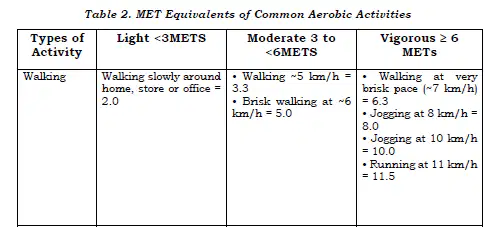
Methods for Assessing Aerobic Intensity
Metabolic equivalents (METs) express aerobic intensity as mL per kg per min of oxygen being consumed.
❖ The energy expenditure while sitting at rest is equal to 1MET. It is taken by convention to be an oxygen uptake of 3.5 mL per kg of body weight per min.
❖ Light-intensity aerobic activity is an activity done at 1.1 to 2.9 METs, moderate-intensity activity is an activity done at 3 to 5.9 METs while vigorous activity is an activity done at ≥ 6 METs.
The intensity of aerobic activities is sometimes measured as the speed of the activity (for example, walking at 5 km/h, jogging at 10 km/h).
57
58

59

60
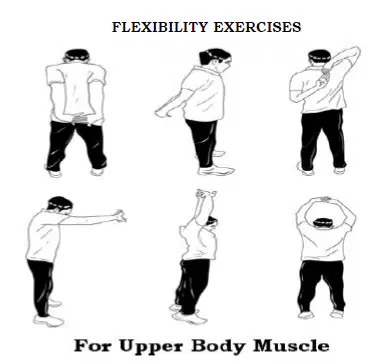
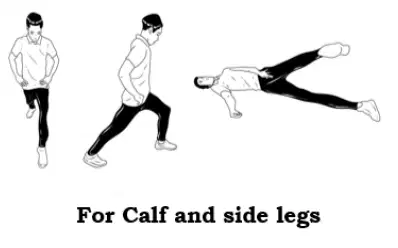
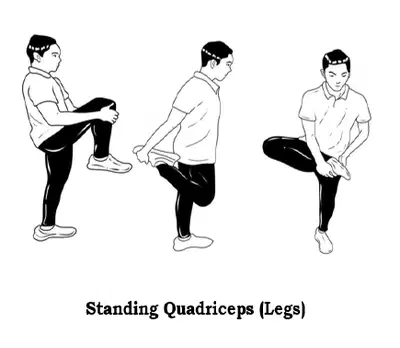
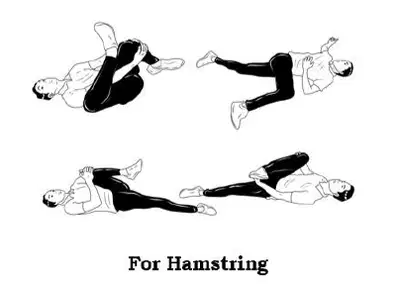
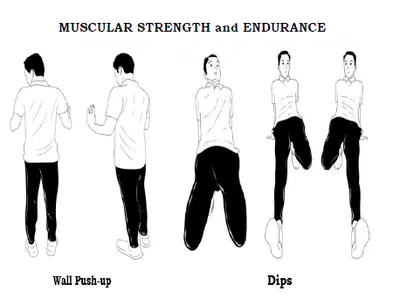
Here are some examples of physical activities and exercises that you may integrate into your own fitness plan. Remember that the intensity of exercise, as well as the type of activity to be done, will vary for each person, as it is based on the fitness level results during self-testing.
61
62
63
64
65
66
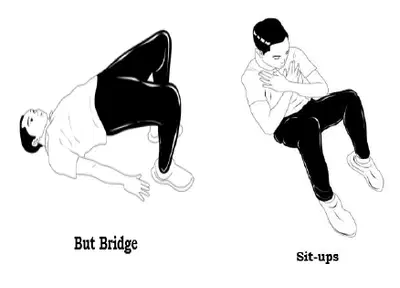
67
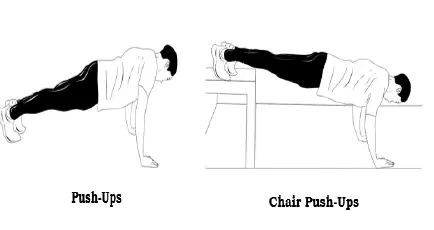
68
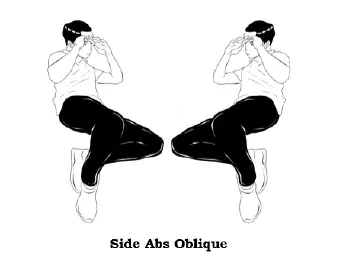
69
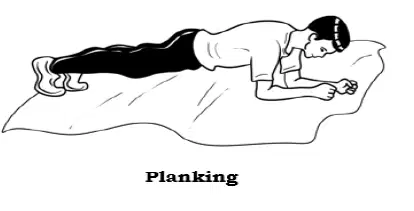
70
Activity 3: LET’S DO THIS
Direction: Perform each activity one at a time and fill out the table below with the required information.
71
Open Ended
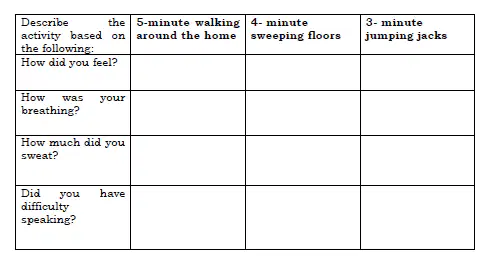
Reflection:
1. Which among the three (walking around, sweeping floor, 3-minute jumping jacks) is considered:
a) Light activity: ________
Justify your answer: _____
72
Open Ended
Reflection:
1. Which among the three (walking around, sweeping floor, 3-minute jumping jacks) is considered:
b. Moderate activity: ___________
Justify your answer: __________
73
Open Ended
Reflection:
1. Which among the three (walking around, sweeping the floor, 3-minute jumping jacks) is considered:
c. Vigorous Activity: ___________
Justify your answer: __________
74
What I Have Learned
Activity 4: SUM IT UP!!
Direction: In this activity, you will summarize all your learnings.
75
Open Ended
A. F.I.T.T is ________________________________________________
76
Open Ended
Principles of overload is______________________
77
Open Ended
Principles of progression is_____________________
78
Open Ended
Principles of specificity is __________________________________________________
79
Open Ended
Principles of reversibility is _________________________________________________
80
Open Ended
What factors should be considered when designing a personal fitness program? Why? ________________________________________________________________________
81
Open Ended
Why is it essential to incorporate a warm-up and cool down in a routine exercise? _____________________________________________________________________
82
83
Additional Activities
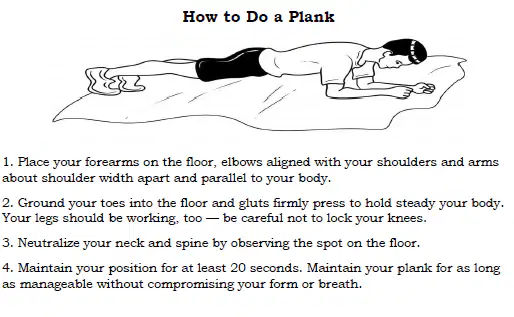
According to Nicole Blades a certified trainer in Connecticut, “Plank is one of those jack-of-all-trades exercises you can carry in your back pocket to strengthen not only your core, but also your chest, arms, back, legs, and booty”, she added a “plank with proper form can help improve your posture. The best part is, this dynamic move doesn’t require any equipment. It’s a total body weight exercise”.
84
85

Replace this with a sub-header that can be in multiple lines.
Duplicate this text as many times as you would like.Quarters 1 and 2 – Module 2:
Set Fitness Goal
Show answer
Auto Play
Slide 1 / 85
SLIDE
Similar Resources on Wayground

79 questions
Mga Isyung Pangkapaligiran
Presentation
•
10th Grade
82 questions
Spanish 3: 5.1-5.3
Presentation
•
10th Grade
79 questions
Released Reading SOL Review Questions
Presentation
•
11th Grade
80 questions
MI Unit 1 Review
Presentation
•
11th - 12th Grade
79 questions
Nervous System
Presentation
•
10th - 12th Grade
79 questions
chapter 3.1 factoring quadratics
Presentation
•
10th Grade
80 questions
Operations with Complex Numbers
Presentation
•
10th Grade
Popular Resources on Wayground
10 questions
Safety Day 2026 – Student Review

Quiz
•
9th Grade
21 questions
Continents and Oceans
Quiz
•
6th Grade
20 questions
Parts of Speech
Quiz
•
5th Grade
16 questions
Subject & Predicate
Quiz
•
5th Grade
25 questions
Multiplication Facts
Quiz
•
5th Grade
12 questions
Map Skills
Quiz
•
3rd Grade
22 questions
Continents and Oceans
Quiz
•
5th Grade
15 questions
Rounding Decimals
Quiz
•
5th Grade
Discover more resources for Other
26 questions
SLIME!!!!!
Quiz
•
KG - 12th Grade
20 questions
Cell Transport
Quiz
•
9th - 12th Grade
20 questions
Budgeting
Quiz
•
9th - 12th Grade
20 questions
Investing
Quiz
•
9th - 12th Grade
8 questions
DNA vs. RNA
Presentation
•
9th - 12th Grade
12 questions
Identify Rigid Transformations
Quiz
•
8th - 12th Grade
10 questions
Complementary, Supplementary, Vertical, and Linear Pairs
Quiz
•
9th - 12th Grade
20 questions
Managing Credit
Quiz
•
9th - 12th Grade