

Atoms and Bonding

Presentation
•
Science
•
9th Grade
•
Practice Problem
•
Easy

Bekah Schumacher
Used 10+ times
FREE Resource
116 Slides • 16 Questions
1


Atoms and Bonding
2


What is a chemical bond?
The joining of 2 or more atoms.
3
4


Why do they bond? To get a full outer
energy level
5


because it takes less energy
6


What part of the atom makes bonds?
7

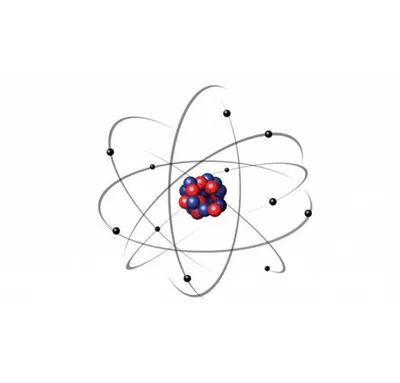
What part of the atom makes bonds? valence
electrons
8
9


Valence electrons:
Electrons in the outer energy level that make
bonds
10


How do we know how many valence e- each atom has?
11


How do we know how many valence e- each atom has?
The group number of the element
12


Lewis structure:A diagram that shows valence
electrons
13


Lewis structure:
Made up of 1. atomic symbol and
14


Lewis structure:
2. dots to show valence e- (there is a pattern to
follow)
15

Ex:Write down the following chemical symbols.
Li
B
N Cl Mg Si Se Ne
16

We will draw the Lewis structures for the following
atoms on your notes paper.
Li
B
N
Cl
Mg
Si
Se Ne
Always CIRCLE the pairs of e-
17


NONBONDING PAIRS:
Full pairs of e- that do NOT bond.
18


UNPAIRED electrons are bonding e-
19


Octet Rule
20


Octet Rule:
Atoms WANT a full outer energy level!!!!
21


Octet Rule:
Atoms WANT a full outer energy level!!! (Usually 8e-)
22


WHY???? It takes LESS ENERGY!!
23


Many atoms tend to gain or lose e-
24


to follow the octet rule.
–
25


Number of electrons each energy level can hold:
1st energy level: 2
2nd energy level: 8
3rd energy level: 8
26


CHANGES IN ATOMS:
1. Ions: An atom that gains or loses electrons causing it to
have a negative or positive charge.
27


Ion: An atom that gains or loses electrons to fill
28


the outer energy level and has a + or - charge.
29


Gaining electrons makes - ions
30


called an aNion
31


Losing electrons makes + ions
32


called a cation
33


How many electrons will an atom gain or lose
when it becomes an ion?
Enough to get a full outer energy level
34


How many electrons will an atom gain or lose
when it becomes an ion?
Enough to get a full outer energy level (Octet
Rule)
35


Atoms with NO pairs of valence e- will lose them
and become +
36


lose them and become +.
37


Atoms with pairs of valence e- will gain e- to have
full pairs and become -
38


gain e- to have full pairs
39


and become -.
40


41

Ion Notation:
Superscript: small number written to show the
charge on an ion.
superscript
Al+3
42

Written up and to the right of the atomic symbol
and shows
Practice:
Li1+
Ca??
Al??
K??
F1-
S??
As??
Br??
43

the charge (+ or -) and the number of the ion’s
charge.
Practice:
Li+1
Ca??
Al??
K??
F-1
S??
As??
Br??
44

+ Charge = # of e- it loses (no pairs)
- Charge = # of e- it gains (pairs)
Practice: Draw the Lewis structure AND write the ion notation for
the following elements. They are all in period 4.
As
Ca
Br
Ga
K
Se
45
Fill in the Blanks
The joining of two or more atoms is a chemical
46
Fill in the Blanks
Atoms bond to get a ____ _____ ______ _____
47
Fill in the Blanks
Atoms bond because it takes ____ ______
48
Multiple Choice
What part of the periodic table tells you the number of valence electrons?
period number
atomic number
group number
atomic mass
49
Draw
Draw the Lewis Structure for Aluminum
50
Draw
Draw the Lewis Structure for Potassium
51
Draw
Draw the Lewis Structure for Argon
52
Fill in the Blanks
The
53
Multiple Choice
Gaining electrons makes an atom have what charge?
negative
positive
neutral
54
Multiple Choice
Atoms with NO pairs of electrons will ________ electrons
gain
lose
55
Draw
Draw the Lewis Structure for Magnesium and write it's ion notation.
56
Draw
Draw the Lewis Structure for Chlorine and write it's ion notation.
57


MAKING BONDS:
Ions and atoms bond to make compounds and
molecules
58


Writing Chemical formulas:
Subscripts: small numbers written to show the
number of
59


Writing Chemical formulas:
ions or atoms of each element in the compound.
60


Written down and to the right of the element
symbol.
61
Draw
Write the chemical formula for 2 carbon atoms and 6 hydrogen atoms
62
Draw
Write the chemical formula for 1 carbon atom, 3 chlorine atoms, 1 fluorine atom
63
Draw
Write the chemical formula for 1 sodium atom, 2 hydrogen atoms, 2 oxygen atoms
64
Draw
Write the chemical formula for 2 potassium atoms, 1 sulfur atom, 2 oxygen atom
65


Ionic Bonds:
+ and - ions join together because of opposite
charges.
66


Ionic bonds are between a metal and a nonmetal
67


Ionic bond = Metal + Nonmetal
68


These bonds form ionic compounds that have a
total charge of 0.
69


These bonds form ionic compounds that have a
total charge of 0.
Na+1+Cl-1
NaCl
Mg+2 +Cl-1 MgCl2
70


How Atoms Bond
Ted-Ed
How atoms bond - George Zaidan and Charles Morton
Ionic bonds til 1:11
71


Covalent Bonds:
Atoms share electrons in order to fill the outer
energy level.
72


The electrons orbit around 2 atoms, holding them
together.
Very STRONG!!!
73


covalent bond = nonmetal + nonmetal
74


Covalent Bonds:
Covalent bonds form between nonmetal and
nonmetal atoms.
75


These bonds are strong and make molecules.
Very STRONG!!!
76


The number of covalent bonds an atom makes
equals the number of e- it needs
77


to fulfil the octet rule
or get a full outer energy level.
78


Covalent bonds are shown as circles between the
Lewis structures of the elements in a molecule.
79


Each circle counts as 2 electrons.
H
O
H
80


Every atom in the molecule MUST have enough
e - to have a full outer energy level.
81


Ex.
82


Bigger atoms don’t share electrons evenly.
83


Creates a molecule with - and + sides.
84


They are called polar molecules.
85


Ex. water - most common
86


How can we use the Periodic Table to determine what
type of bond an atom/element will make???
87


Sci Show on Bonding
4:16-9:26
88


Periodic Trends - What can the table tell us?
Radius
89


Periodic Trends - What can the table tell us?
Atomic Radius - size of atom measured from center of the
nucleus to outer edge of the e- cloud
90

Quick Monday Periodic Trends Review
1. The amount of energy needed to remove an e- is
2. The distance from the nucleus to the outer e.l. Is
3. An atom’s ability to attract e- is its
4. Which of these (1,2 or 3) increases as you go
DOWN the periodic table?
5. Which of these increases as you go ACROSS the
periodic table?
91

Review
1. Atoms bond to have a __ __ __ __ because it takes __ __.
2. Valence e- are in the __ __ __ and make __.
3. The number of valence e- on an atom is shown in the __ __.
4. A Lewis structure is a __ that shows __ __.
5. Draw the Lewis structures for F(9) / B(5) (circle pairs)
6. The __ __ says that atoms want a full outer energy level.
7. Write the number of electrons each energy level can hold.
1st__
2nd __
3rd __
8. An atom that loses or gains e- becomes an __.
9. If it gains electrons it gets a __ charge.
10. Write the Lewis structure & ion notation for an ion of nitrogen.
92

1. Write symbols for 2 elements that make +1 ions.
2. Write symbols for 2 elements that make +3 ions.
3. Write symbols for 2 elements that make -2 ions.
4. Write symbols for 2 elements that make -3 ions.
5. When you add the charge of the + ion and the
- ion in an ionic compound, what is the total
charge?
6. What will the formula be for Calcium chloride?
93

Ionic Compound Review:
1. C14H18N2O5 Tell the number of atoms of C_ H_ N_ O_
2. Write the formula of a molecule that has 6 carbon, 14 hydrogen,
two nitrogen, 2 oxygen
3. Atoms gain or lose e- to have a _ _ _ _ because it takes _ _.
4. An atom that gains e- has a _ charge and is called a __.
5. An atom that loses e- has a _ charge and is called a __.
6.Write the symbols for Potassium(19) & Selenium(34)
Write below them if they are a M(metal) or NM(nonmetal)
Draw the Lewis Structure for each.
Write the ion notation for each.
Write the correct chemical formula for the compound they will form.
94


Periodic Trends - Where is the smallest atom?
Atomic Radius
95


Periodic Trends - Where is the smallest atom?
smallest
Atomic Radius
96


Periodic Trends - What happens as you go down?
Atomic Radius
97


Periodic Trends - The size increases.
Atomic Radius
98


Periodic Trends - What about horizontally? Right to Left
Atomic Radius
99


Periodic Trends - What about horizontally? Right to Left
Atomic Radius
100


Periodic Trends - Which atom is biggest?
Atomic Radius
101


Periodic Trends - Biggest atom!
biggest
Atomic Radius
102

103


Periodic Trends - What can the table tell us?
Ionization energy: the amount of energy needed to
remove an e- from an atom
104


What happens to Ionization Energy as you go from Left to Right?
Use
BLUE
105


What happens to Ionization Energy as you go Down the table?
106


It DECREASES What direction do you go to have it INCREASE?
107


It also INCREASES when you go up diagonally.
I
n
c
r
e
a
s
e
s
108


Chlorine has the highest Ionization Energy
I
n
c
r
e
a
s
e
s
109


What does that mean? Chlorine holds onto its e- the best.
I
n
c
r
e
a
s
e
s
110


Periodic Trends - What can the table tell us?
Electronegativity: an atom’s ability to attract e- in a
covalent bond
111


What happens to electronegativity as you go across from
Left to Right?
Use
GREEN
112


113


What happens to electronegativity as you go UP?
114


What happens to electronegativity as you go UP?
I
n
c
r
e
a
s
e
s
115


Fluorine - Highest Electronegativity
I
n
c
r
e
a
s
e
s
116


It has the highest ability to attract e- from other atoms
I
n
c
r
e
a
s
e
s
117


118

Friday Review Quiz - 10 points
1. Do the following for Boron: A. Draw the Lewis structure.
B. Write the ion notation. C. Tell if it is a cation or anion.
2. Do the following for Sulfur: A. Draw the Lewis structure.
B. Write the ion notation. C. Tell if it is a cation or anion.
3. The number that shows the charge of an ion in ion notation is
called a ______script.
4. The number that shows the number of ions in a formula,
Al2O3is called a ____script.
5. Why do atoms gain or lose electrons?
6. How many e- do atoms want in the 2nd and 3rd energy levels?
119

Quickie Notes Review
1.Why do atoms make bonds?
2. What part of the atom makes the bonds?
3. How many e- can be held in energy levels 1_, 2_ & 3_
4. When an atoms loses or gains e- it becomes an __.
5. Atoms with ____ gains e- and atoms with __ lose e-
6. The total charge on an ionic compound is ___
7. Covalent bonds form when atoms ____ ___.
120

Review
1.
The joining of 2 or more atoms is a ____ ___.
2.
Valence electrons are found in the _____ ______ ______.
3.
Valence electrons are drawn in a diagram called a ____ ____.
4.
The number of valence electrons can be found on the periodic table
by using the ____ _____.
5.
Bonding electrons are the ________ electrons.
6.
The Octet Rule says that atoms want a ____ ____ ____ ____.
7.
How will Calcium (Ca/20) obey this rule? gain or lose
8.
It will become a cation/anion. (Choose one.)
9.
How will Bromine (Br/35) obey this rule? gain or lose?
10.
It will become a cation/anion. (Choose one.)
121

Monday Quick Notes/Brain Review 1/25/2021
1.Atoms make bonds to get a _ _ _ _ because it takes _ _
2. How many e- can be held in the 1st_, 2nd_ &3rd_ energy
levels?
3. In covalent bonds, atoms ___ their electrons.
4. Covalent bonds form between __ and __ atoms.
5. How do you know the number of covalent bonds an atom will
make?
122

Thursday/Friday Quick Notes Review 10/31/2019
1.Why do atoms make bonds?
2. What part of the atom makes the bonds?
3. How many e- can be held in energy levels 1_, 2_ & 3_
4. When an atoms loses or gains e- it becomes an __.
5. Atoms with ____ gains e- and atoms with __ lose e-
6. The total charge on an ionic compound is ___
7. Covalent bonds form when atoms ____ ___.
123

What do we know about bonds? 11/1/2019
1. Why do atoms bond?
2. Name 2 types of bonds.
3. Which type of bond is just an attraction of - & +?
4. Which type of bond shares electrons?
5. Which type of bond is stronger?
124

Chemical Bonds Practice 1/28/21
1. Label I if ionic or C if covalent.
2. Draw Lewis Structure
3. If I - write ion notation for each
If C - draw the lines to show the bonds
A. CS2
B. CaCl2
C. H2PF
D. K3N
125

Quick Monday Review 10/10/22
1. Draw a model of a Sulfur atom. Include the correct
number of P+, N, energy levels and e- and place
everything in the correct area of the atom.
2. What would be the charge on a S ion?
3. Name an element the S ion would bond with.
4. Name an element the S atom would make a covalent
bond with.
5. Show a covalent bond between S and that element.
Draw Lewis structures and circle shared e-
126


The Periodic Table - one more time!!
Hank Green
127


Changes in atoms:
Atoms with the same number of protons
128


but different numbers of neutrons.
129


Same atomic number
130


But different atomic mass
12
13
14
131


2. Isotope: An atom that gains neutrons causing it to
be unstable so it tends to break apart.
Unstable atoms
132


This is called radioactivity.
Radioactive atoms
Atoms and Bonding
Show answer
Auto Play
Slide 1 / 132
SLIDE
Similar Resources on Wayground

119 questions
Ch5 : Networks
Presentation
•
10th Grade
131 questions
The 1960s
Presentation
•
11th Grade
119 questions
WW3 Review Lessons 7-9
Presentation
•
8th Grade
133 questions
Anatomy & Physiology 1a: Midterm
Presentation
•
11th Grade
130 questions
Tawa College - Junior - Revision of Angles
Presentation
•
8th - 10th Grade
129 questions
Exploration of the Americas
Presentation
•
7th - 8th Grade
130 questions
Sets & Problems Involving Sets
Presentation
•
7th Grade
122 questions
Sub plan 2
Presentation
•
8th Grade
Popular Resources on Wayground
10 questions
Safety Day 2026 – Student Review

Quiz
•
9th Grade
21 questions
Continents and Oceans
Quiz
•
6th Grade
20 questions
Parts of Speech
Quiz
•
5th Grade
16 questions
Subject & Predicate
Quiz
•
5th Grade
25 questions
Multiplication Facts
Quiz
•
5th Grade
12 questions
Map Skills
Quiz
•
3rd Grade
22 questions
Continents and Oceans
Quiz
•
5th Grade
15 questions
Rounding Decimals
Quiz
•
5th Grade
Discover more resources for Science
10 questions
Exploring Chemical and Physical Changes

Interactive video
•
6th - 10th Grade
20 questions
Atomic Structure
Quiz
•
9th Grade
10 questions
Exploring the Electromagnetic Spectrum for Middle School Science
Interactive video
•
6th - 10th Grade
10 questions
Exploring Force and Motion Concepts
Interactive video
•
6th - 10th Grade
10 questions
Exploring Air Masses and Weather Fronts
Interactive video
•
6th - 10th Grade
10 questions
Exploring the States of Matter
Interactive video
•
6th - 10th Grade
10 questions
Exploring Forces: Net Force, Normal Force, Gravity, and Friction
Interactive video
•
6th - 10th Grade
10 questions
Differentiating Thermal Energy and Temperature
Interactive video
•
6th - 10th Grade